Zing Forum

Reading

AgentFlowController: A Modular Framework for AI Agent Orchestration and Reasoning Strategy Governance

This article deeply analyzes the AgentFlowController project, exploring the orchestration architecture design of complex AI agents, data pipeline governance mechanisms, and reasoning strategy execution methods, providing technical references for building scalable and manageable enterprise-level agent systems.

AI Agent智能体编排工作流数据管道推理策略机器学习模块化架构企业级应用
Published 2026-05-22 02:53Recent activity 2026-05-22 03:21Estimated read 6 min
AgentFlowController: A Modular Framework for AI Agent Orchestration and Reasoning Strategy Governance
1

Section 01

[Introduction] AgentFlowController: Core Analysis of Enterprise-Level Agent Orchestration and Governance Framework

This article deeply analyzes the AgentFlowController project, which aims to solve the problems of orchestration, data pipeline governance, and reasoning strategy control in multi-agent collaboration, providing a modular solution and technical references for building scalable and manageable enterprise-level agent systems. Its core functions cover three major areas: agent orchestration, data pipeline governance, and reasoning strategy execution.


2

Section 02

Background: Challenges and Needs in the Era of Multi-Agent Collaboration

With the improvement of large language model capabilities, AI agents have moved from concept to application, but the capabilities of a single agent are limited, so multi-agent collaboration has become the key to value. However, collaboration brings new challenges: How to orchestrate workflows? How to govern data flow? How to ensure reasoning complies with strategies? AgentFlowController is a modular framework designed to solve these problems.

3

Section 03

Modular Architecture Design Philosophy

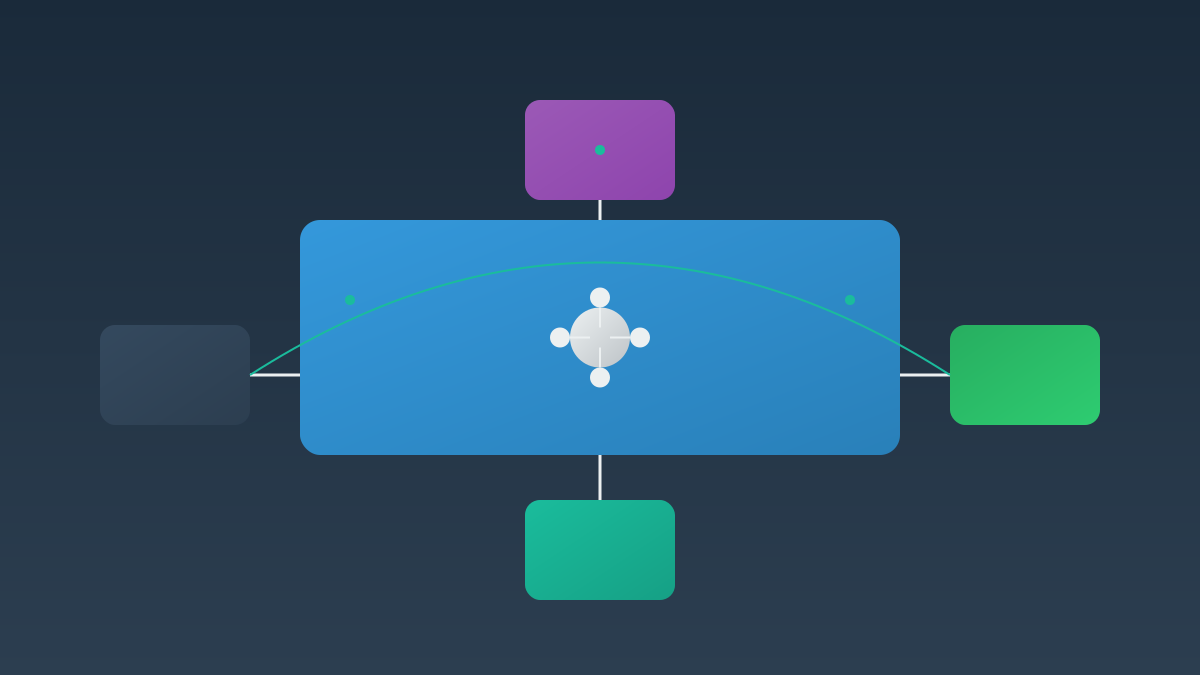
The core design philosophy of the framework is modularity, decomposing into independent and reusable components, following the principle of separation of concerns. Modules include agent management (lifecycle), workflow orchestration (collaboration process), data pipeline (data flow), and strategy execution (rule compliance). Standardized interfaces and event-driven architecture are used between components, ensuring loose coupling and flexible expansion.

4

Section 04

Detailed Explanation of Agent Orchestration Mechanism

It supports multiple orchestration modes (sequential, parallel, conditional branching, loop retry), uses declarative syntax (defines processes via configuration files/visual interfaces), separating "what to do" from "how to do it". State management achieves fault recovery and breakpoint resumption through persistent storage, and state snapshots support version management and rollback.

5

Section 05

Full-Lifecycle Governance Strategy for Data Pipelines

It covers the full lifecycle of data collection, transformation, routing, and storage. Data lineage tracking supports problem troubleshooting and compliance auditing; data quality assurance detects and handles anomalies through verification rules; data security and privacy include sensitive data desensitization, fine-grained permission control, transmission encryption, and audit logs.

6

Section 06

Reasoning Strategy Control and Embedded ML Integration

The strategy execution module allows defining multi-dimensional strategies (output format, content security, business rules), using embedded ML models (text classification, entity recognition, etc.) to execute strategies, which is more flexible than rule-based methods. The effective scope of strategies can be configured (global/local), supporting version management and gray release. The framework uniformly manages the model lifecycle and provides extension interfaces to integrate custom models.

7

Section 07

Key Design Considerations for Enterprise-Level Features

For enterprise-level applications, it supports cluster deployment and load balancing (high availability); complete indicator collection and log recording (observability); horizontal expansion capability (scalability). Security design includes identity authentication and authorization, communication encryption, and audit logs. It provides integration methods such as REST API, message queue adapters, and database connectors to reduce the integration cost with existing systems.

8

Section 08

Application Scenarios and Practical Recommendations

Suitable scenarios include multi-agent collaboration in customer service, intelligent document processing in enterprise knowledge management, and complex decision support systems. Practical recommendations: Adopt progressive deployment (from single agent to multi-agent, small-scale pilot then expansion); attach importance to monitoring feedback and optimize collaboration strategies based on data.

