Zing Forum

Reading

AgentFlow: A Visual AI Agent Automation Orchestration Platform

A no-code/low-code platform that connects applications, AI Agents, and workflows via a drag-and-drop interface to enable automated orchestration and large-scale deployment of intelligent tasks.

AI Agent工作流编排低代码平台自动化可视化编程Agent工作流
Published 2026-05-07 23:15Recent activity 2026-05-07 23:26Estimated read 8 min
AgentFlow: A Visual AI Agent Automation Orchestration Platform
1

Section 01

AgentFlow: Core Guide to the Visual AI Agent Automation Orchestration Platform

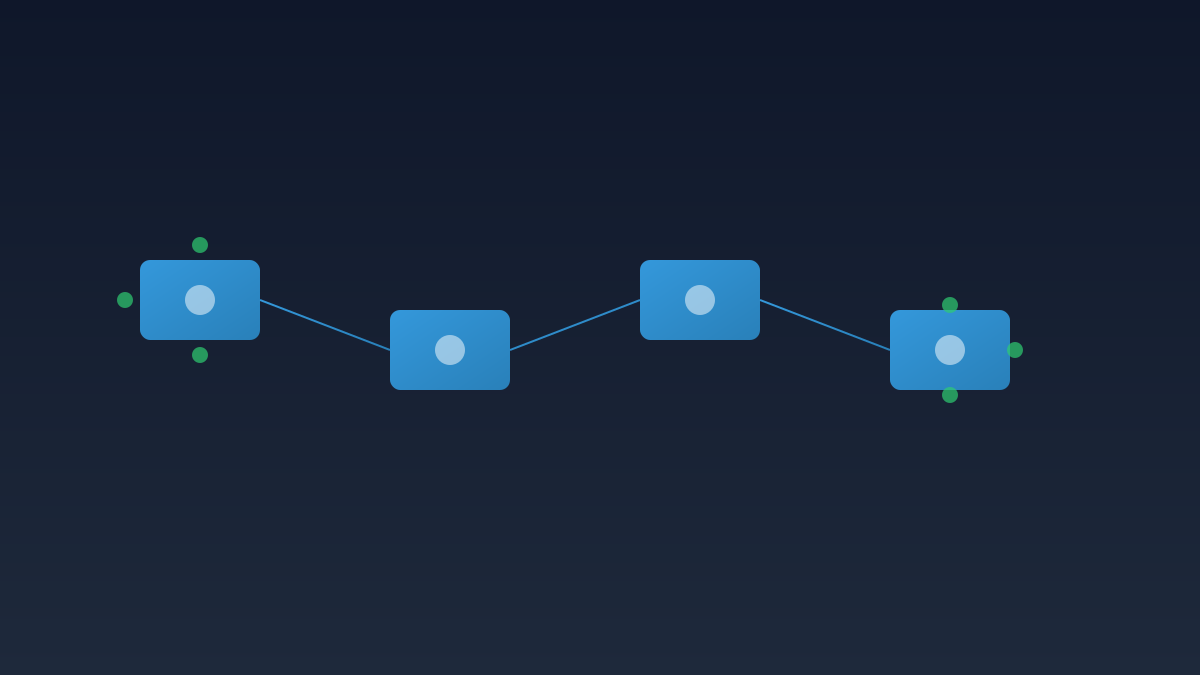
AgentFlow is a no-code/low-code visual platform designed to help users build, connect, and orchestrate AI Agents and application workflows via a drag-and-drop interface, addressing the high barrier of needing extensive code for orchestration in the AI Agent era. The platform supports everything from single-Agent tasks to complex multi-Agent collaboration, providing a low-threshold entry point for intelligent automation. Its core value lies in lowering technical barriers, enabling more users to participate in AI application development.


2

Section 02

Orchestration Challenges in the AI Agent Era

The explosion of large language models has spurred the rise of AI Agents, but building and orchestrating Agent workflows typically requires writing extensive code (defining tool interfaces, state management, multi-Agent collaboration, external API integration, etc.). This barrier significantly hinders non-technical users and developers looking to quickly validate ideas from adopting AI automation.

3

Section 03

AgentFlow Core Methods and Platform Features

Core Concept: Visual Node Orchestration

  • Node Types: Agent nodes (encapsulate LLM calls), Tool nodes (connect to external APIs), Condition/Loop nodes (flow control), Memory nodes (manage conversation history), Input/Output nodes.
  • Connection and Data Flow: Map upstream outputs to downstream inputs, supporting data transformation and visual path display.

Platform Features:

  1. Drag-and-drop workflow building: Canvas assembly, connection to establish dependencies, real-time preview.
  2. Agent configuration: Model selection (OpenAI/Anthropic, etc.), system prompts, tool binding, output format, memory configuration.
  3. Tool ecosystem: Pre-built connectors for search (Google/Bing), communication (email/Slack), data (database/CSV), code (sandbox/GitHub), and AI services (image/voice).
  4. Execution and monitoring: Manual/scheduled/event triggers, real-time monitoring of status/duration/error handling.
4

Section 04

Typical Application Scenarios of AgentFlow

Scenario 1: Intelligent Customer Service Workflow Receive customer message → Intent classification Agent → Conditional branch → Information retrieval Agent → Response generation Agent → Send response.

Scenario 2: Content Creation Pipeline Topic input → Research Agent (search for materials) → Outline generation Agent → Parallel writing → Editing Agent → Publish to CMS/Export document.

Scenario 3: Data Analysis Report Data source connection → Data processing → Analysis Agent (interpret trends) → Visualization → Report generation → Email distribution.

These scenarios validate the platform's feasibility and value in real-world business contexts.

5

Section 05

Technical Architecture and Competitor Comparison

Technical Architecture

  • Scalability: Modular architecture, plugin-extended nodes, custom node SDK (Python/TypeScript), standard JSON workflow definition.
  • Execution engine: Synchronous/asynchronous modes, event-driven state management, horizontally scalable execution clusters.
  • Security: Sandboxed tool calls, sensitive data encryption, fine-grained permission control.

Competitor Comparison

Feature AgentFlow n8n Zapier LangChain/LangGraph
Positioning AI Agent Orchestration General Workflow App Integration Programming Framework
Code Requirement Low/None Medium None High
AI Native Support Core Feature Plugin Support Limited Core Feature
Visualization Level High High High Low
Open Source Yes Yes No Yes
Deployment Method Self-hosted/Cloud Self-hosted/Cloud Cloud-only Library/Self-hosted

AgentFlow's Unique Value: Optimized for AI Agent scenarios, balancing low-code ease with flexibility and scalability.

6

Section 06

Limitations and Future Development Directions

Current Limitations

  • Complex logic expression: Visualization is less intuitive than code for highly complex conditional/loop logic.
  • Debugging experience: Uncertainty in Agent reasoning poses challenges for debugging complex workflows.
  • Performance optimization: The visualization abstraction layer may introduce performance overhead; needs optimization for latency-sensitive scenarios.
  • Ecosystem maturity: The tool ecosystem and number of integrations are still under development.

Future Directions

  • Enhance support for multi-Agent collaboration modes (ReAct, Plan-and-Execute).
  • Provide a market for pre-built workflow templates.
  • Support team collaboration (sharing, version control, approval).
  • Edge deployment: Compile into lightweight services for deployment on edge devices.
7

Section 07

AgentFlow Summary

AgentFlow is a significant attempt in the evolution of AI automation tools toward low-code. By encapsulating AI Agent capabilities in visual components, it lowers the technical barrier to intelligent automation and enables more users to participate in AI application development. Amid the rapid growth of AI Agents, the platform is poised to become a bridge connecting AI capabilities to business scenarios, driving AI from the lab to widespread production environments.

