Zing Forum

Reading

Agent Werewolf: Design and Implementation of AI Werewolf Agents with Seven Personalities

The Agent Werewolf project builds 7 AI Werewolf agents with unique personality traits, running on the 0G Compute sealed inference service, demonstrating how to shape AI's social reasoning capabilities through system prompts and decision biases.

AI智能体狼人杀人格设计社会推理0G Compute密封推理TypeScript多智能体系统
Published 2026-05-03 15:38Recent activity 2026-05-03 15:50Estimated read 7 min
Agent Werewolf: Design and Implementation of AI Werewolf Agents with Seven Personalities
1

Section 01

Agent Werewolf Project Overview

The Agent Werewolf project builds 7 AI Werewolf agents with unique personality traits, running on the 0G Compute sealed inference service, demonstrating how to shape AI's social reasoning capabilities through system prompts and decision biases. The project is open-source under the MIT License, and the code is available on GitHub.


2

Section 02

Project Background and Architecture

Agent Werewolf is part of the Agent-Werewolf ecosystem, including 7 reference agent implementations (5 basic personalities + 2 variants). These agents are developed based on the TypeScript SDK and use the 0G Compute sealed inference service for LLM calls. The project is currently in the v1 phase; the agent implementations are integrated into the GameMaster repository. After the SDK is officially released, it will be externalized into an independent Docker orchestration service to enable more flexible deployment and expansion.

3

Section 03

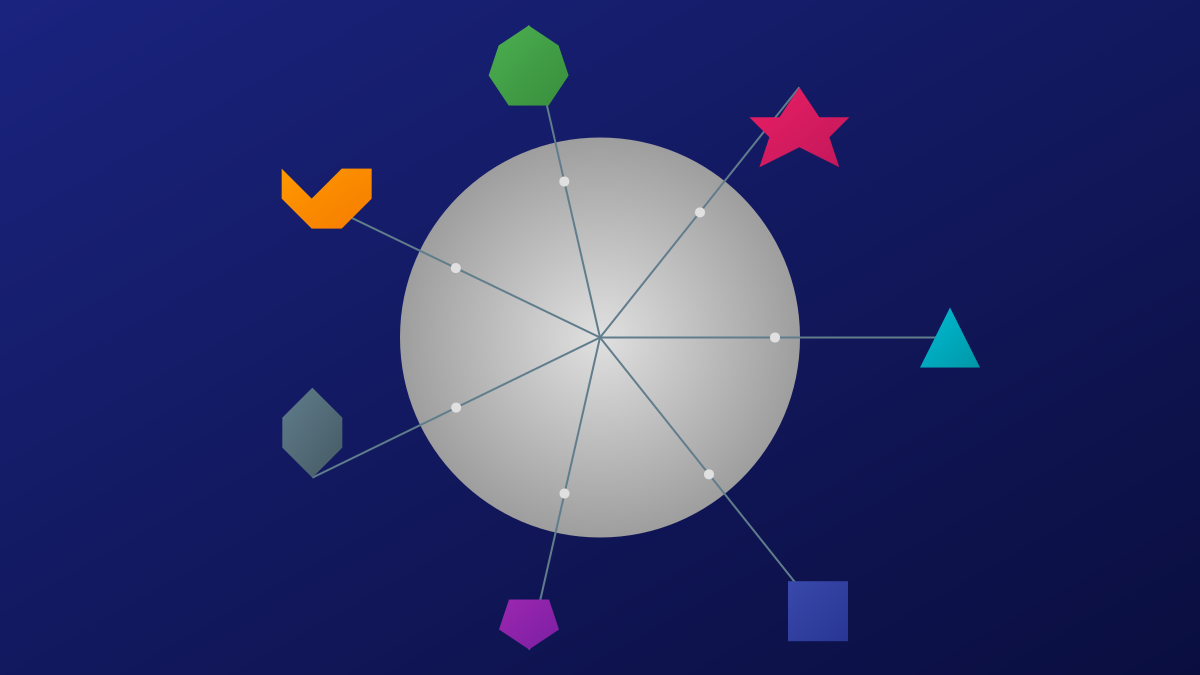
Details of the Seven Personality Designs

The core highlight of the project is the design of distinct personality traits for each agent, shaped through system prompts and decision biases:

  1. Suspicious Paranoid: Short, accusatory dialogue; tends to vote for the quietest player;
  2. Charming Manipulator: Smooth and good at building alliances; votes with the consensus;
  3. Quiet Analyst: Sparse but logical speech; votes based on patterns;
  4. Loud Accuser: Dramatic and declarative; votes for the first accused player;
  5. Peaceful Mediator: Gentle and avoids conflict; votes with the latest consensus;
  6. Paranoid Shadow (Variant 1): Long-winded paranoid conspiracy theories; votes based on multi-round patterns;
  7. Manipulator Shadow (Variant 2): Charismatic contrarian who protects the weak; votes against the consensus.
4

Section 04

Technical Implementation Architecture

The project adopts a modular design, with main components including:

  • Personas module (src/personas.ts): Contains system prompts and decision bias definitions for all 7 personalities;
  • WerewolfAgent class (src/agent.ts): Handles game state updates, calls LLM to generate dialogue decisions, applies biases to adjust votes, and maintains dialogue context;
  • LLM client encapsulation (src/llm.ts): Encapsulates the 0G Compute sealed inference client and supports mock mode for development and testing.
5

Section 05

Value of 0G Compute Sealed Inference

The project chose 0G Compute as the inference backend due to its sealed inference features: prompt protection (system prompts and dialogue history are not leaked), inference integrity (output generated in a trusted execution environment), and verifiability (auditable process). This is crucial for games like Werewolf that require hidden information, ensuring agents do not "see" the real identities of other players.

6

Section 06

Development History and Future Plans

Agent Werewolf is a prototype project completed in a 15-hour hackathon. The priority of v1 is a demonstrable demo, with some features postponed to v2. The v2 plan includes: externalizing agents into independent Docker services, supporting dynamic addition of new personalities, introducing learning mechanisms to improve strategies, and supporting multilingual and multicultural variant personalities.

7

Section 07

Application Scenarios and Insights

Although it is a game project, it demonstrates important principles of AI personality engineering: 1. System prompts can shape AI's speaking style, values, and behavior patterns; 2. Decision biases make AI more like human players; 3. Diverse agents simulate real social diversity. These experiences can be applied to AI scenarios requiring "personality" such as customer service robots, virtual companions, and educational assistants.

8

Section 08

Project Summary

Agent Werewolf demonstrates how large language models can participate in complex social reasoning games through 7 carefully designed AI personalities. The project's technical implementation is concise and elegant, providing valuable references in AI personality design. It is worth attention for developers researching AI social reasoning, multi-agent systems, or game AI. The project is open-source under the MIT License, and the code is available on GitHub.