Zing Forum

Reading

Agent-Mux: A Terminal-Native Multi-Agent Collaboration Framework

Agent-Mux is an innovative multi-agent coordination system that enables terminal-native agent collaboration using tmux shared workspaces, supporting cross-pane message passing and large-scale task handover.

AI Agenttmux终端多Agent协作开发者工具开源LLM编程助手
Published 2026-05-04 23:45Recent activity 2026-05-04 23:52Estimated read 7 min
Agent-Mux: A Terminal-Native Multi-Agent Collaboration Framework
1

Section 01

Agent-Mux: Terminal-Native Multi-Agent Collaboration Framework Overview

Agent-Mux is an open-source multi-agent coordination system created by developer maxto, focusing on terminal-native collaboration using tmux as the core infrastructure. Its key features include shared tmux workspaces (isolated panes, shared file systems/env), cross-pane message passing (JSON protocol for task delegation, state sync, result return), and large-scale task handover via Thread Transport. It targets developer workflows like code review, multi-step code generation, and long-running background tasks, with advantages like zero-config deployment and high observability, while having limitations such as platform dependency on Unix-like systems. Unlike general frameworks like AutoGen or CrewAI, it prioritizes minimal intrusion into developers' existing terminal environments.


2

Section 02

Background: Why Terminal-Native AI Agent Collaboration Matters

For developers, terminals remain an efficient, flexible workspace despite GUI/Web dominance. Traditional AI agents often rely on API/Web interfaces, which are cumbersome and disjointed for deep integration into dev workflows. Agent-Mux addresses this pain point by proposing the terminal-native design philosophy—leveraging tools developers already use (like tmux) to enable seamless multi-agent collaboration without extra complex setups.

3

Section 03

Core Architecture: How Agent-Mux Uses tmux for Collaboration

Agent-Mux's core architecture is built on tmux:

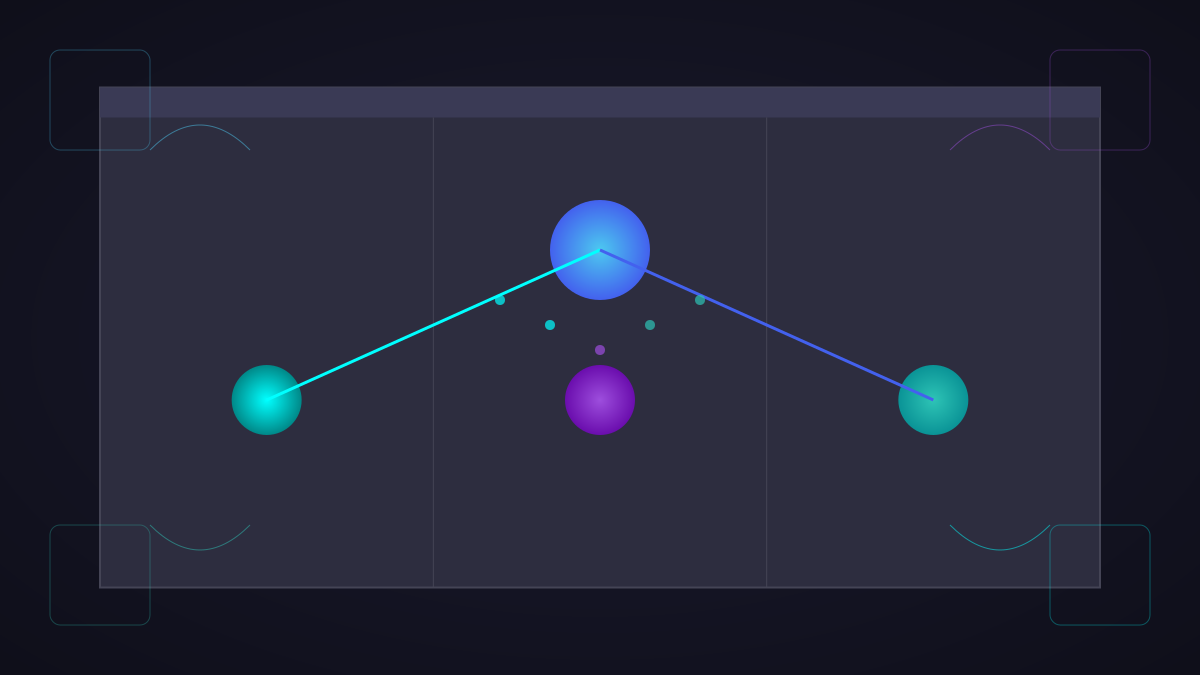
  1. Shared Workspace: Tmux sessions act as 'shared offices'—each agent runs in an independent pane, with access to shared file systems/env and ability to observe others' operations.
  2. Cross-Pane Messaging: A lightweight JSON protocol supports task delegation, state synchronization, and result return, with transparent communication (auditable via tmux logs).
  3. Thread Transport: For large context transfer, agents serialize data to shared storage, send a 'pointer message', and the receiver loads it—avoiding inefficient large data transfers and auto-cleaning storage post-completion.
4

Section 04

Practical Use Cases of Agent-Mux

Agent-Mux excels in developer workflows:

  • Code Review: Agents for static analysis, unit testing, and documentation check run in parallel panes, coordinating via Agent-Mux.
  • Multi-Step Code Generation: Architecture agents plan modifications, implementation agents handle modules, and integration agents manage dependencies/order.
  • Long-Running Tasks: Background agents handle time-consuming tasks (like code indexing), with results auto-returned to foreground agents once done.
5

Section 05

Advantages & Limitations of Agent-Mux

Advantages:

  • Zero-config deployment (uses existing tmux environment).
  • Resource-efficient (agents run as independent processes, utilizing multi-core CPUs).
  • High observability (all operations visible in terminal, easy to debug/audit).
  • Seamless integration with terminal tools (vim, emacs, git).

Limitations:

  • Platform-dependent (works best on Unix-like systems; Windows support is limited).
  • Requires tmux familiarity (learning curve for new users).
  • No strict sandbox isolation (shared workspace means agents have access to the same environment).
6

Section 06

Agent-Mux vs AutoGen & CrewAI: Key Comparisons

Feature Agent-Mux AutoGen CrewAI
Deployment Complexity Low (terminal-native) Medium (Python env) Medium (Python env)
Multi-Agent Coordination tmux message mechanism Direct method calls Role definition + task allocation
Observability High (terminal visible) Medium (log output) Medium (log output)
Use Cases Developer workflows General dialogue Business process automation

Agent-Mux is not a general multi-agent framework—it focuses on minimal intrusion into developers' terminal environments, filling a niche for dev-focused collaboration.

7

Section 07

Future Directions for Agent-Mux

Agent-Mux is in early stages, with potential evolutions:

  • Visualization: Optional web dashboard while keeping terminal-native core.
  • Agent Market: Pre-configured agent templates for common dev tasks.
  • IDE Integration: Deep integration with VS Code/JetBrains IDEs.
  • Security Enhancements: Optional sandboxing for untrusted agents.
8

Section 08

Conclusion: Agent-Mux's Pragmatic Approach

Agent-Mux embodies a pragmatic philosophy—instead of building complex new frameworks, it adds collaboration capabilities to the terminal environment developers already use daily. For efficiency-focused developers, this terminal-native multi-agent collaboration is a solution worth trying.