Zing Forum

Reading

Agent-Harness: A Portable Agent Infrastructure Framework for Claude Code

A portable agent infrastructure designed for Claude Code, providing hooks, skills, agent configurations, and Sprint planning workflows to enable any project to quickly gain AI-assisted development capabilities.

Claude CodeAI 辅助开发智能体基础设施提示词工程开发工作流Sprint 规划代码审查开源框架
Published 2026-05-26 04:44Recent activity 2026-05-26 04:51Estimated read 6 min
Agent-Harness: A Portable Agent Infrastructure Framework for Claude Code
1

Section 01

Agent-Harness: Introduction to the Portable Claude Code Agent Infrastructure Framework

Core Idea: Agent-Harness is a portable agent infrastructure framework specifically designed for Claude Code, aiming to solve the pain points of reusing AI-assisted workflows, prompt templates, and agent configurations in new projects. It achieves standardization through modular components (hook system, skill library, agent configuration, Sprint planning workflow), enabling any project to quickly gain AI-assisted development capabilities. The project is maintained by Mark Hazlett, open-sourced on GitHub (link: https://github.com/markhazlett/agent-harness), and released in May 2025.


2

Section 02

Project Background and Pain Points

Background: Traditional Claude Code usage relies on the .claude directory and local configurations within the project, leading to the need for reconfiguration in each new project, and making it difficult to migrate optimized prompts and skills across projects. Project Origin: Developed and maintained by Mark Hazlett (@markhazlett), released on GitHub with the original title "agent-harness: Portable Claude Code agent infrastructure" in May 2025.

3

Section 03

Core Component Architecture

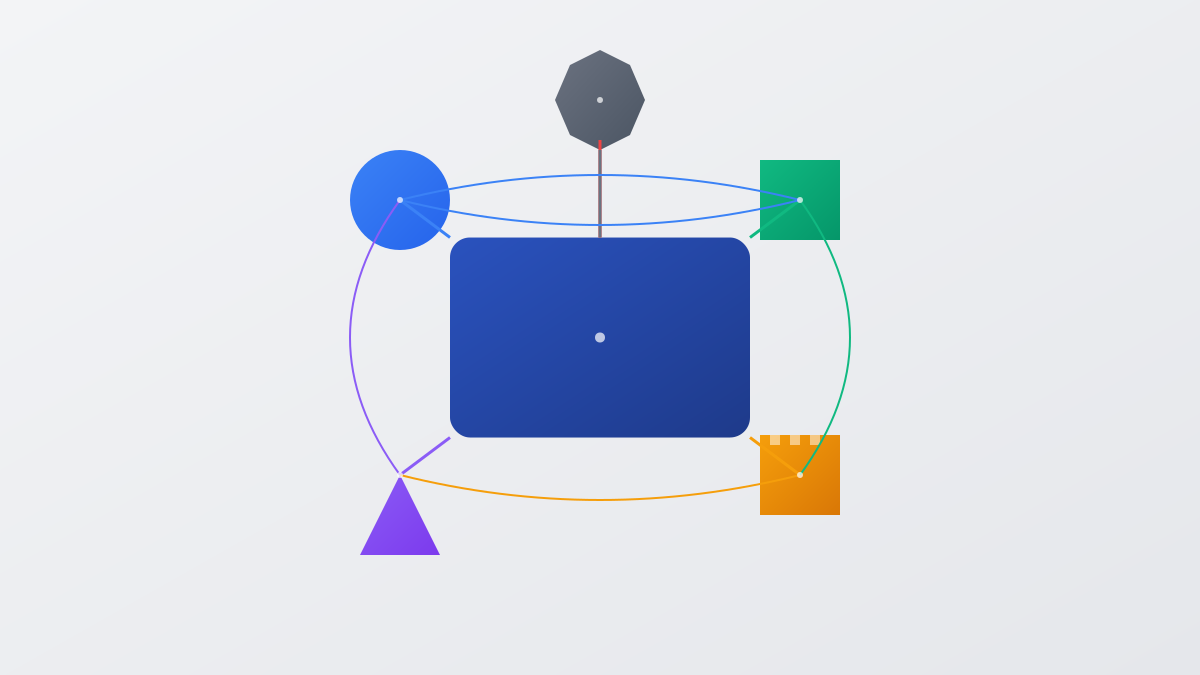
Agent-Harness adopts a modular design, consisting of four core components:

  1. Hook System: An event response mechanism that supports hooks like pre-commit, code review, and build, transforming AI assistance from "on-demand invocation" to "automatic response".
  2. Skill Library: Reusable capability units with built-in skills such as code refactoring, document generation, test generation, and architecture review, supporting customization via YAML definitions.
  3. Agent Configuration: Predefined agent roles like architect, reviewer, and debugging expert, including configurations for role definitions, system prompts, and tool permissions.
  4. Sprint Planning Workflow: Integrates agile development, supporting functions like backlog grooming, workload estimation, task decomposition, progress tracking, and retrospective assistance.
4

Section 04

Portability Design Details

To enable cross-project reuse, Agent-Harness uses the following designs:

  • Standardized Directory Structure: A unified layout (hooks/, skills/, agents/, etc.) to reduce learning and migration costs.
  • Configuration Inheritance and Override: Supports three layers of configuration (base → organization → project), where lower layers inherit from upper layers and can override as needed.
  • Versioned Management: Configurations can be managed as Git submodules or independent repositories, with built-in version checks to ensure compatibility with Claude Code.
5

Section 05

Deployment Process and Applicable Scenarios

Deployment Steps: 1. Run setup.sh to initialize the directory; 2. Edit AGENTS.md to define requirements; 3. Integrate hooks into the Git workflow; 4. Load the configuration in Claude Code. Applicable Scenarios:

  • Multi-project development teams: Ensure consistency in AI assistance experience;
  • Open-source project maintainers: Lower the barrier for contributors and ensure code review and documentation quality;
  • Consulting delivery teams: Quickly establish validated workflows;
  • Individual developers: Reuse optimized AI assistance patterns to improve efficiency.
6

Section 06

Summary and Community Expansion

Summary: Agent-Harness represents the systematization of AI-assisted development tools, helping teams upgrade from "casual use" of Claude Code to "systematic application", addressing key needs for configuration and knowledge asset management. Ecosystem Relationship: It does not replace Claude Code but enhances its capabilities, compatible with existing features (e.g., /agents command, .claude directory, etc.). Community: Open-source model that encourages contributions of new skills, agent configurations, hook scripts, etc. The modular architecture supports independent expansion.

