Zing Forum

Reading

Agent-Forge: An Analysis of the Multi-Agent AI Workflow Orchestration Framework Based on LangGraph

An in-depth introduction to how Agent-Forge leverages a tech stack including LangGraph, LangChain, and ChromaDB to provide Windows users with out-of-the-box multi-agent collaboration capabilities, lowering the barrier to building complex AI workflows.

多智能体LangGraphAI工作流Agent编排LangChainChromaDBRAGStreamlitFastAPIWindows部署
Published 2026-04-19 08:13Recent activity 2026-04-19 08:20Estimated read 8 min
Agent-Forge: An Analysis of the Multi-Agent AI Workflow Orchestration Framework Based on LangGraph
1

Section 01

Introduction / Main Floor: Agent-Forge: An Analysis of the Multi-Agent AI Workflow Orchestration Framework Based on LangGraph

An in-depth introduction to how Agent-Forge leverages a tech stack including LangGraph, LangChain, and ChromaDB to provide Windows users with out-of-the-box multi-agent collaboration capabilities, lowering the barrier to building complex AI workflows.

2

Section 02

The Rising Background of Multi-Agent Architecture

Traditional single-agent interaction models have obvious limitations: an AI assistant needs to take on multiple responsibilities such as understanding, reasoning, execution, and verification simultaneously, which easily leads to capability bottlenecks in complex tasks. Multi-agent architecture, through role division and collaboration mechanisms, allows different agents to focus on specific domains, forming a more powerful overall capability.

Typical multi-agent collaboration scenarios include:

  • Research and analysis tasks: One agent is responsible for information retrieval, another for comprehensive analysis, and the third for quality review
  • Code development process: A planning agent breaks down requirements, a coding agent implements functions, and a testing agent verifies quality
  • Content creation workflow: A creative agent proposes solutions, a writing agent generates content, and an editing agent optimizes and polishes it

This division of labor and collaboration model not only improves the quality of task processing but also makes the entire process more transparent and controllable.

3

Section 03

Overview of Agent-Forge's Technical Architecture

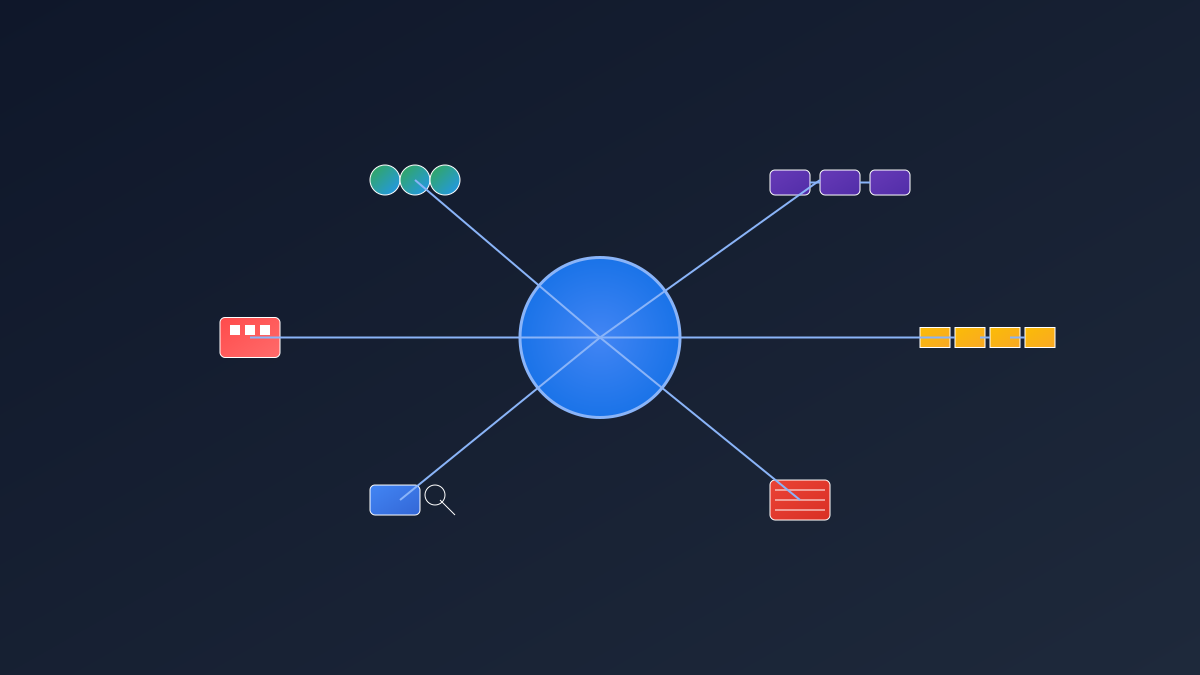
Agent-Forge is built using a series of mature open-source technologies for its tech stack:

4

Section 04

Analysis of Core Components

LangGraph: Workflow Orchestration Engine

LangGraph is a workflow orchestration framework in the LangChain ecosystem, specifically designed for building stateful agent interaction graphs. It allows developers to define complex agent flow logic, including conditional branching, loop iteration, parallel execution, and other patterns. Agent-Forge uses LangGraph as its core, abstracting multi-agent collaboration into a clear graph structure.

LangChain: Model and Tool Integration Layer

As a widely adopted LLM application development framework in the industry, LangChain provides a unified model interface and rich tool integrations. Agent-Forge achieves compatibility with different LLM service providers through LangChain and simplifies the implementation complexity of tool calls.

ChromaDB: Local Vector Storage

Multi-agent collaboration often requires sharing context and knowledge. As a lightweight local vector database, ChromaDB provides Agent-Forge with efficient knowledge retrieval and memory capabilities. Agents can store intermediate results, retrieved documents, historical interactions, etc., into the vector storage for subsequent use by other agents.

FastAPI: Backend Service Framework

Agent-Forge uses FastAPI to build its RESTful API layer, providing high-performance asynchronous request processing capabilities. This allows agent workflows to be called by external systems and facilitates integration with other enterprise applications.

Streamlit: Interactive Web Interface

To lower the barrier to use, Agent-Forge provides an intuitive web operation interface through Streamlit. Users can configure agent parameters, start workflows, and view execution results without writing code.

5

Section 05

Typical Application Scenarios and Usage Patterns

Agent-Forge's design makes it suitable for various practical business scenarios:

6

Section 06

Intelligent Document Processing Workflow

For scenarios requiring processing of large volumes of documents, the following agent collaboration chain can be built:

  1. Retrieval Agent: From knowledge bases or external sources, locate relevant documents
  2. Extraction Agent: Parse document content and extract key information
  3. Summary Agent: Condense long documents into core points
  4. Review Agent: Verify the accuracy and completeness of the summary

This pipeline-style processing ensures output quality, while each link can be optimized independently.

7

Section 07

Step-by-Step Task Planning and Execution

In the face of complex multi-step tasks, Agent-Forge supports a closed-loop model of planning-execution-verification:

  • The planning agent breaks down large tasks into manageable subtasks
  • The execution agent completes each subtask one by one
  • The verification agent checks whether the execution results meet expectations
  • If there are deviations, the process can automatically backtrack or request human intervention
8

Section 08

Iterative Content Creation

Content creation often requires multiple rounds of polishing. Through Agent-Forge, a cyclic workflow of creation-review-revision can be built:

  • The creative agent proposes a draft based on the theme
  • The review agent evaluates content quality from multiple dimensions
  • The revision agent optimizes the content based on review comments
  • Cycle until the preset quality standards are met


