Zing 论坛

正文

BrainRC:受大脑解剖结构启发的储备池计算模型用于心律失常分类

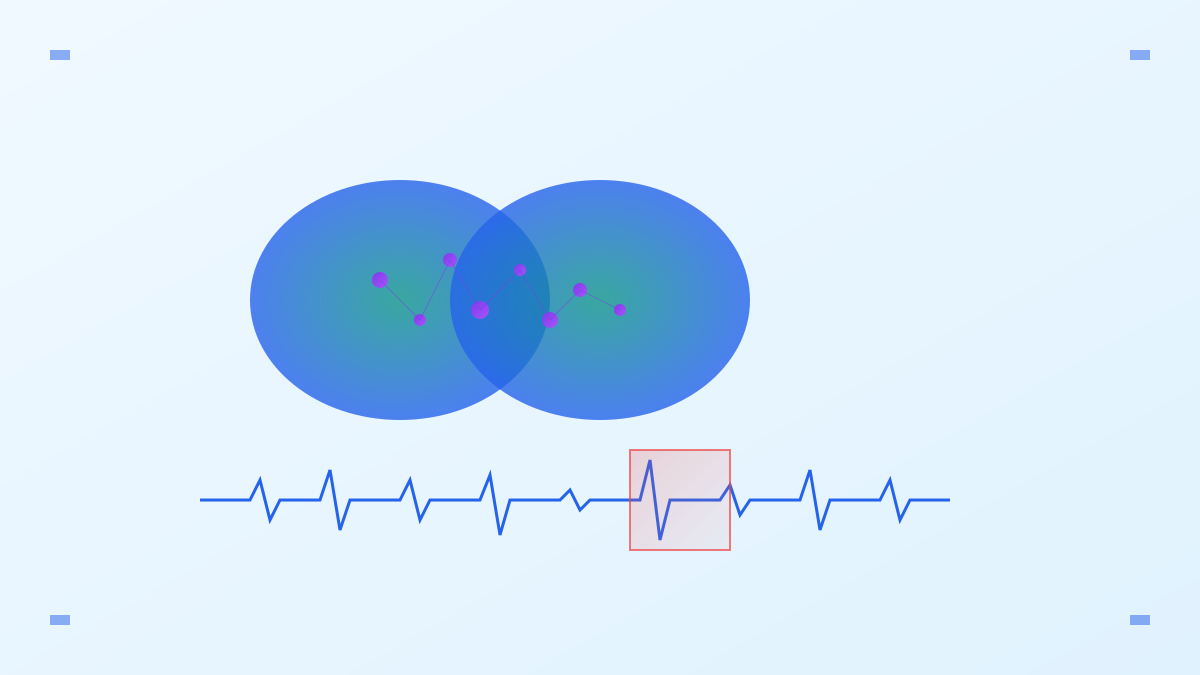
BrainRC是一个九区域储备池计算网络,其连接模式、时间常数和兴奋/抑制平衡都反映了已确立的神经解剖学原理。在MIT-BIH心电图数据集的五种心律失常分类任务中,该模型达到了66.3%的准确率,显著优于传统扁平Echo State Network和Liquid State Machine。

reservoir computingbrain-inspiredECG classificationarrhythmia detectionneural networksmachine learningmedical AI
发布时间 2026/05/13 03:54最近活动 2026/05/13 03:59预计阅读 6 分钟
BrainRC:受大脑解剖结构启发的储备池计算模型用于心律失常分类
1

章节 01

BrainRC: A Brain-Inspired Reservoir Computing Model for Arrhythmia Classification (Main Guide)

BrainRC is a 9-region reservoir computing (RC) model inspired by brain anatomical principles (structured connections, heterogeneous time constants, excitation/inhibition balance). It outperforms traditional flat Echo State Network (ESN) and Liquid State Machine (LSM) in 5-class arrhythmia classification on the MIT-BIH dataset (66.3% average accuracy in cross-validation). This project bridges neuroscience and machine learning, offering a computationally efficient and interpretable solution for medical signal processing.


2

章节 02

Background & Motivation Behind BrainRC

Reservoir Computing (RC) is a recursive neural network with fixed input/reservoir connections and trainable output weights, efficient for time-series data. However, traditional RC models use random/uniform connections, unlike the brain's structured, region-specific connections. BrainRC aims to introduce neuroanatomical constraints into RC to explore if structured connections improve performance.

3

章节 03

Core Design & Technical Details of BrainRC

BrainRC's key design features:

  1. Regionalized structure: 9 functional regions simulating brain cortex, with constrained inter-region connections (via NetworkX).
  2. Heterogeneous time constants: Different regions have distinct leaky integration time constants.
  3. Excitation/inhibition balance: Explicit excitatory/inhibitory connections maintain balance. Neuron dynamics follow leaky integrator model: x(t+1) = (1-α)*x(t) + α*tanh(W_in*u(t)+W_res*x(t)) (α=region-specific leak rate). Supported datasets: MIT-BIH arrhythmia (8199 records,5 classes), UCI HAR (10299 records,6 activities), EEGBCI (180 trials,2 classes).
4

章节 04

Experimental Results & Validation of BrainRC

Performance: On MIT-BIH 5-class classification:

  • BrainRC:66.3% avg accuracy (±2.3% std) in cross-validation, vs flat ESN (49.4%±4.3%) and LSM (47.7%±3.8%). Ablation studies:
  • Capacity: Increasing flat ESN neurons (400→1600) didn't match BrainRC's performance.
  • Spectral radius scan (0.90-0.99) confirmed performance isn't due to hyperparameter tuning. These validate that anatomical structure is key to BrainRC's advantage.
5

章节 05

Practical Applications & Advantages of BrainRC

Medical: Efficient, interpretable arrhythmia classification aids clinical diagnosis (deployable on resource-limited devices). Neuro形态 computing: Inspires energy-efficient chip design via brain-like structures. Interpretability: Regional structure allows analyzing which regions contribute to specific arrhythmia classifications, unlike black-box deep learning.

6

章节 06

Limitations & Future Directions for BrainRC

Limitations:

  1. MIT-BIH dataset size (8199 records) may limit generalization.
  2. 9-region structure's universality for other tasks is unproven.
  3. Lags behind deep learning on large datasets. Future:
  4. Adaptive region structures for tasks.
  5. Multi-modal fusion (ECG + blood pressure +血氧).
  6. Online learning for patient-specific心律 patterns.
7

章节 07

How to Use & Reproduce BrainRC Results

Steps to reproduce:

  1. Clone repo: git clone https://github.com/LuizRMSilva1973/BrainRC.git
  2. Set up env: python3 -m venv .venv && source .venv/bin/activate
  3. Install dependencies: pip install numpy scipy scikit-learn matplotlib networkx wfdb mne torch
  4. Download datasets: python3 download_datasets.py
  5. Run tests: python3 brain_classifier.py Reproducibility: Seed=42; compatible with NumPy≥1.26, scikit-learn≥1.4 (result differences <0.5%).

