Zing Forum

Reading

vid2llm: An Intelligent Tool for Converting Videos to Multimodal LLM-Ready Frames

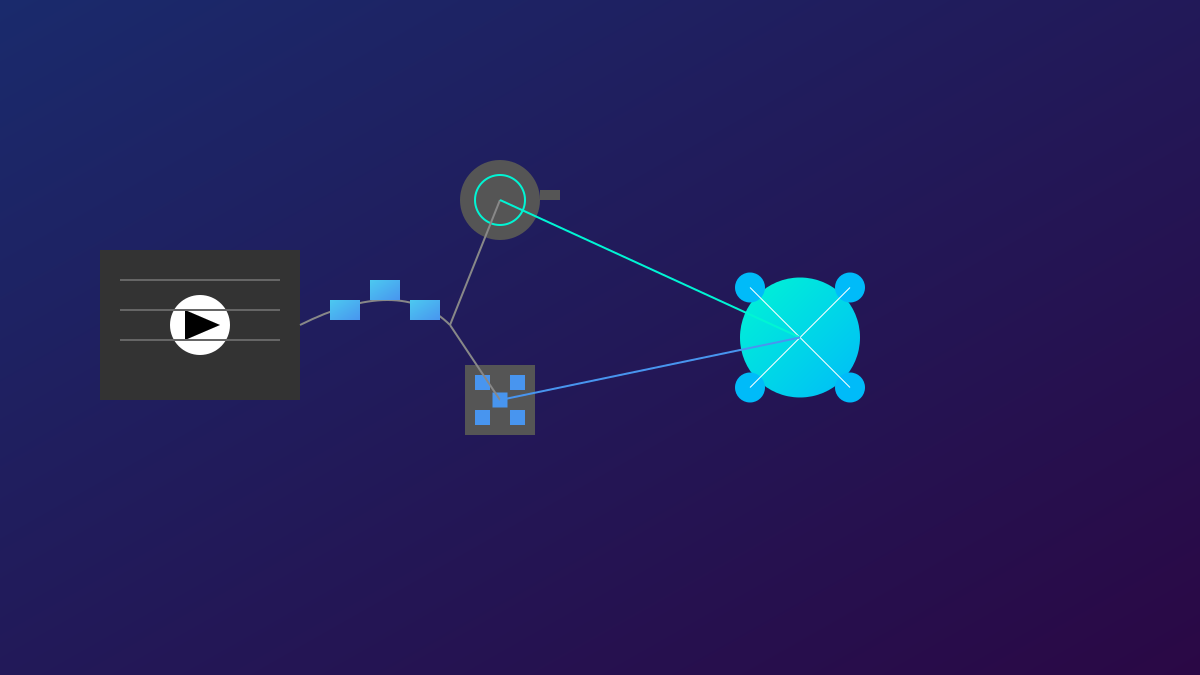
vid2llm is an open-source tool focused on intelligently converting video content into frame sequences suitable for processing by multimodal large language models. It offers features like intelligent sampling, scene detection, OCR extraction, and provides SDK-level support for video understanding applications.

视频处理多模态大语言模型帧提取OCR场景检测
Published 2026-06-02 18:14Recent activity 2026-06-02 18:22Estimated read 6 min
vid2llm: An Intelligent Tool for Converting Videos to Multimodal LLM-Ready Frames
1

Section 01

[Introduction] vid2llm: An Intelligent Tool for Converting Videos to Multimodal LLM-Ready Frames

vid2llm is an open-source tool maintained by leozitogs (GitHub link: https://github.com/leozitogs/vid2llm, released on 2026-06-02). It focuses on converting videos into frame sequences processable by multimodal large language models (such as GPT-4V, Claude3, etc.). Core features include intelligent sampling (dynamically adjusting density), scene detection and segmentation, OCR text extraction, and SDK-level output formats, providing support for video understanding applications.


2

Section 02

Technical Background and Challenges in Video Understanding

Development of Multimodal Large Language Models

In recent years, models like GPT-4V, Claude3 Opus, and Gemini Pro Vision have been able to process images and text, but their direct support for videos is limited, requiring preprocessing into frame sequences.

Challenges in Video Understanding

  • Extract key frames from long videos without losing information
  • Maintain frame temporal relationships and contextual coherence
  • Process multimodal information such as text and audio
  • Optimize input length to fit the model's context window
3

Section 03

Key Technical Implementation Points

Optimization of Sampling Strategy

Combine multiple strategies: motion-based sampling (increase sampling at places with intense motion), content-based sampling (detect scene changes via visual feature similarity), time-based sampling (uniform temporal coverage), and adaptive compression (adjust sampling rate based on model window).

Scene Detection Algorithms

Combine histogram difference method (fast detection of sudden changes), deep learning features (semantic feature similarity comparison), and optical flow analysis (capture motion patterns).

OCR Integration

Seamlessly integrate modern OCR engines like PaddleOCR and EasyOCR to extract text content from videos.

4

Section 04

Application Scenarios

vid2llm's application scenarios include:

  1. Video Content Analysis: Automatically analyze educational videos, meeting recordings, etc., to generate structured summaries
  2. Intelligent Video Q&A: Build video Q&A systems for multimodal LLMs
  3. Video Retrieval and Recommendation: Achieve precise retrieval and personalized recommendations based on content semantics
  4. Content Moderation and Compliance: Detect sensitive content and copyright information
  5. Accessibility Services: Generate text descriptions of videos for visually impaired users
5

Section 05

Comparison with Other Tools (Evidence)

Feature vid2llm Traditional Video Processing Simple Frame Extraction
Intelligent Sampling
Scene Detection Partial Support
OCR Integration Requires Extra Configuration
SDK-Ready Output
Multimodal Optimization

This comparison shows that vid2llm outperforms traditional tools and simple frame extraction in terms of intelligence, integration, and multimodal adaptation.

6

Section 06

Summary and Outlook

vid2llm combines traditional video processing technology with the needs of multimodal LLMs, providing infrastructure support for video understanding applications. As the capabilities of multimodal large models improve and application scenarios expand, such preprocessing tools will become more important in the video AI ecosystem. In the future, we look forward to more intelligent video understanding solutions that can truly 'understand' video content.

