Zing Forum

Reading

ThinkJEPA: A Dual-Path Embodied Prediction Framework Combining Visual-Language Reasoning Capabilities with Latent World Models

ThinkJEPA proposes an innovative dual-path architecture that combines the Qwen3-VL-Thinking visual-language model as a high-level semantic reasoner with the JEPA branch as a low-level dynamic controller to achieve efficient embodied intelligence prediction.

ThinkJEPA具身智能视觉语言模型JEPA世界模型Qwen3-VL双路径架构机器人学习
Published 2026-05-01 04:30Recent activity 2026-05-01 04:50Estimated read 7 min
ThinkJEPA: A Dual-Path Embodied Prediction Framework Combining Visual-Language Reasoning Capabilities with Latent World Models
1

Section 01

Introduction: ThinkJEPA—A Dual-Path Embodied Prediction Framework Integrating Visual-Language Reasoning and World Models

ThinkJEPA proposes an innovative dual-path architecture that combines the Qwen3-VL-Thinking visual-language model (high-level semantic reasoner) with the JEPA branch (low-level dynamic controller) to address the disconnect between high-level semantic reasoning and low-level physical execution in the field of embodied intelligence, opening up new directions for the development of embodied intelligence.


2

Section 02

Background: The Gap Between Reasoning and Execution in Embodied Intelligence

In the field of embodied intelligence, traditional methods often separate high-level semantic reasoning from low-level physical execution: Large Visual-Language Models (VLMs) excel at scene understanding and planning but are weak in handling continuous dynamics and physical consistency; world models like JEPA can capture video dynamics but lack high-level semantic understanding capabilities. This gap is a long-standing challenge.

3

Section 03

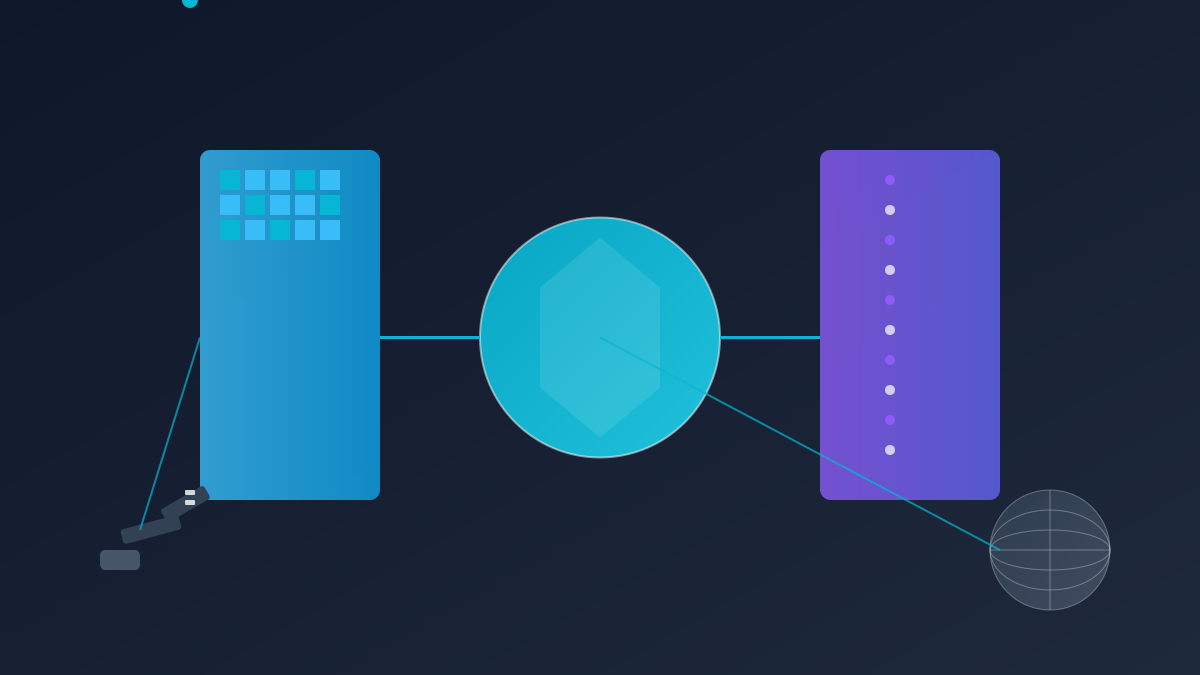
Dual-Path Architecture: Simulating the Division of Labor Between the Cerebral Cortex and Cerebellum

ThinkJEPA's design is inspired by the division of labor in the human nervous system and includes two core branches:

VLM-Thinker Branch (High-Level Semantic Reasoning)

Based on the Qwen3-VL-Thinking model, it is responsible for high-level semantic understanding of complex scenes, long-range intent planning and reasoning, and providing pyramid-shaped high-level guidance signals.

JEPA Branch (Low-Level Dynamic Control)

Based on the V-JEPA2 architecture, it focuses on modeling continuous dynamics between video frames, maintaining physical consistency and kinematic constraints, and providing fast local correction capabilities.

The two branches collaborate through a conditional mechanism: the JEPA branch receives guidance signals from the VLM branch when predicting future trajectories, enabling seamless integration of high-level intent and low-level execution.

4

Section 04

Technical Implementation and Training Process

The training process of ThinkJEPA is elaborate, leveraging the complementary characteristics of the two branches:

  1. Cache Preprocessing: Use the Qwen3-VL model to extract high-level semantic features from videos and store them as precomputed caches;
  2. Dual-Branch Training: The JEPA predictor receives video features and VLM guidance signals to learn to predict future trajectories;
  3. End-to-End Optimization: Optimize the entire framework through standard supervised learning.

The project provides open-source implementations, including cache generation scripts, the EgoDex dataset evaluation suite, the Hugging Face cache dataset, and the V-JEPA2 dependency subtree.

5

Section 05

Experimental Environment and Reproducibility Support

The project team provides detailed reproducibility guidelines, supporting two environment configurations:

Training/Evaluation Environment (Python3.11 recommended): PyTorch2.10+CUDA12.8, decord, opencv-python, timm, etc.; Cache Extraction Environment (Python3.10 recommended): transformers5.2.0+qwen-vl-utils, torchcodec for efficient video decoding.

The decoupled design allows users to quickly reproduce results using precomputed caches directly or build the feature extraction process from scratch.

6

Section 06

Application Prospects and Domain Significance

The significance of ThinkJEPA for the field of embodied intelligence:

  1. It proves that the reasoning capabilities of visual-language models can be effectively injected into world models, breaking through the limitation of traditional world models' lack of semantic understanding;
  2. The dual-path architecture provides a feasible solution for the collaboration between long-range planning and real-time control, suitable for scenarios such as robot manipulation and autonomous driving;
  3. Open-source release and detailed documentation lower the barrier to reproducibility, promoting further research in the field.
7

Section 07

Conclusion: Future Outlook of the Dual-Path Framework

ThinkJEPA represents an important step forward for embodied intelligence towards a "brain + cerebellum" collaborative architecture. With the improvement of VLM capabilities and advances in world model training technology, this dual-path framework that integrates high-level reasoning and low-level control is expected to become the standard paradigm for next-generation embodied intelligence systems.

