Zing Forum

Reading

Remote Intelligent Programming System: Realizing Remote Control of AI Programming Assistants via Telegram and GitHub

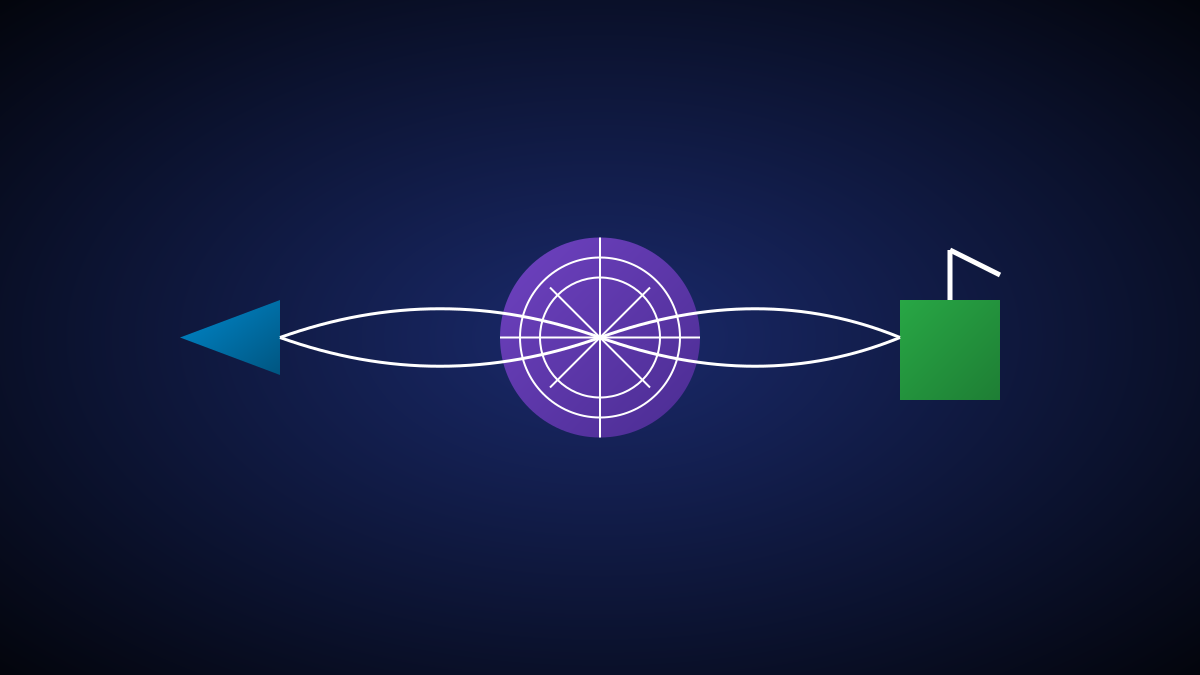
The remote-agentic-coding-system project innovatively integrates AI programming assistants with Telegram and GitHub, enabling the ability to remotely control AI coding agents and providing developers with flexible workflows and persistent session support.

AI编程助手Telegram BotGitHub集成远程开发智能体系统
Published 2026-03-31 23:15Recent activity 2026-03-31 23:19Estimated read 6 min
Remote Intelligent Programming System: Realizing Remote Control of AI Programming Assistants via Telegram and GitHub
1

Section 01

Remote Intelligent Programming System: Realizing Remote Control of AI Programming Assistants via Telegram and GitHub

The remote-agentic-coding-system project innovatively integrates AI programming assistants with Telegram and GitHub, enabling remote control of AI coding agents and providing developers with flexible workflows and persistent session support. This article will introduce it from aspects such as background, architecture, technical implementation, and application scenarios.


2

Section 02

Background: Limitations of Traditional AI Programming Tools and Remote Needs

With the advancement of large language models in code generation capabilities, AI programming assistants have become an important part of developers' toolchains. However, traditional tools are mostly IDE plugins or local applications, which have limitations in mobile scenarios or remote collaboration. This project proposes a new paradigm for remotely controlling AI coding agents through instant messaging platforms and version control systems.

3

Section 03

Core Architecture and Functions: Remote Control Closed Loop of Telegram + GitHub

The core of the system is to decouple the AI programming assistant from local to a remote service. Key components include:

  • Telegram Bot Integration: Implementing an instant messaging interface via API, allowing developers to send commands and interact remotely through any Telegram device.
  • GitHub Workflow Integration: Deeply integrating the GitHub API to support operations such as reading repositories, creating branches, submitting changes, and initiating PRs, forming a complete development closed loop.
  • Persistent Session Management: Supporting long-term session states, maintaining context, project agreements, and task progress to provide a coherent collaboration experience.
4

Section 04

Key Technical Implementation Points: Security, Asynchrony, and Context Synchronization

The project needs to address three major challenges:

  • Security and Permission Control: Implementing identity authentication, operation authorization, and sensitive information protection to ensure that only authorized users can control the agent and the operation scope is limited.
  • Asynchronous Task Processing: Designing a reliable asynchronous queue to support task status query, progress notification, and failure retry.
  • Context Synchronization: Ensuring consistent session states across multiple clients (e.g., Telegram mobile and web), solving issues of message ordering, conflicts, and real-time synchronization.
5

Section 05

Application Scenarios: Mobile Development, Team Collaboration, and DevOps Enhancement

This model opens up multiple scenarios:

  • Mobile Development Scenario: Send requirements via mobile phone during commuting, and the code is ready when returning to the office, improving time efficiency.
  • Team Collaboration Enhancement: Share Telegram groups to interact with AI, and sync results to GitHub, lowering collaboration barriers so non-technical personnel can also participate.
  • Continuous Integration Assistance: As part of CI/CD, automatically analyze build failures, generate repair suggestions, and submit patches to optimize DevOps workflows.
6

Section 06

Limitations and Considerations: Security, Efficiency, and Cost Concerns

Points to note during use:

  • Security Risks: Granting remote services access to repositories requires careful evaluation of trust boundaries.
  • Interaction Efficiency: Pure text asynchronous interaction for complex tasks may not be as efficient as real-time feedback from local IDEs.
  • Cost Considerations: Long-term AI sessions and frequent GitHub API calls will incur resource costs.
7

Section 07

Conclusion: The Path to Ubiquitous AI Programming Assistants

The remote-agentic-coding-system demonstrates the possibility of AI programming assistants evolving toward 'ubiquity'. By integrating AI agents with daily communication tools and workflow platforms, it lowers the threshold for AI-assisted programming and provides a more flexible way of working. With the development of multimodal models and agent technologies, such remote collaboration models may become more common in the software development field.

