Zing Forum

Reading

Synergia: A Community-Driven Distributed LLM Inference Cluster

An open-source distributed LLM inference cluster project that integrates computing resources through community collaboration to deliver low-cost, highly available large language model inference services.

分布式推理大语言模型社区协作GPU集群去中心化开源项目
Published 2026-05-07 06:42Recent activity 2026-05-07 09:29Estimated read 6 min
Synergia: A Community-Driven Distributed LLM Inference Cluster
1

Section 01

Synergia: Introduction to the Community-Driven Distributed LLM Inference Cluster

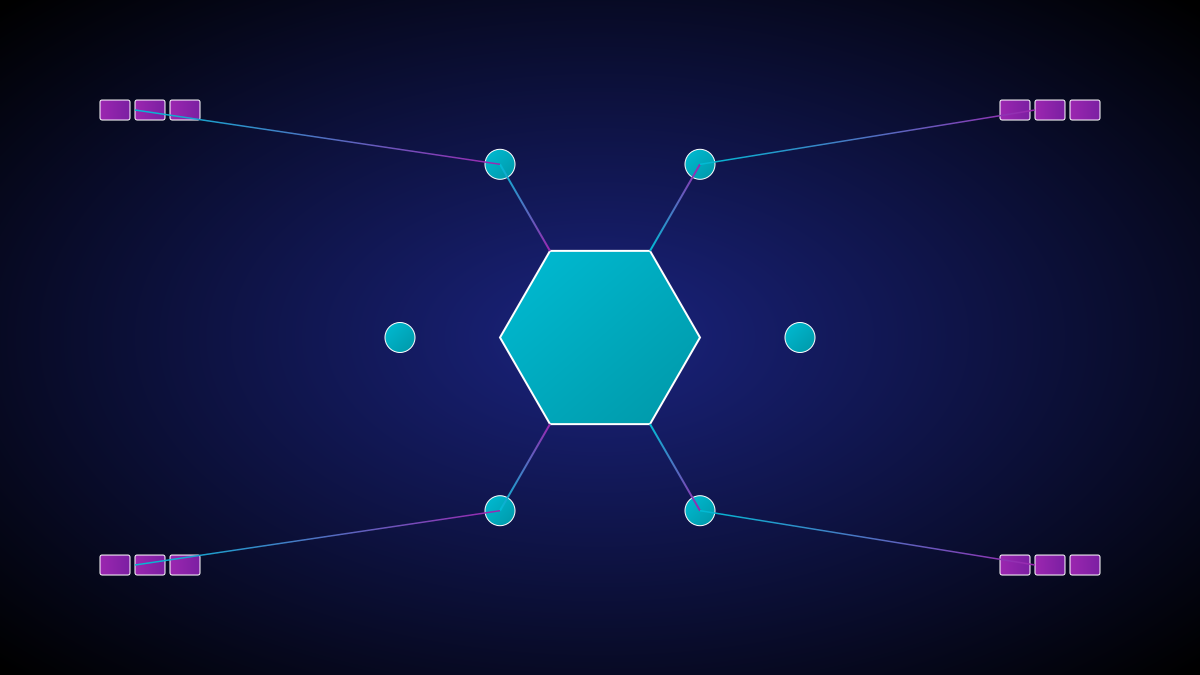
Synergia is an open-source distributed LLM inference cluster project aimed at integrating computing resources through community collaboration to solve the high-cost problem of deploying large models for individual developers and small teams, enabling low-cost, highly available large language model inference services. Its core features include decentralized resource aggregation, intelligent task scheduling, security and privacy protection, and community governance mechanisms.


2

Section 02

Project Background: Cost Dilemma of Large Model Deployment

As the parameter scale of large language models (LLMs) continues to grow, deploying a complete model on a single machine requires increasingly high hardware specifications. Individual developers and small teams find it difficult to afford the cost of purchasing and maintaining high-end GPU servers, thus an urgent need for low-cost alternative solutions.

3

Section 03

Core Approach: Architecture Design and Technical Highlights

Core Architecture Design

  • Decentralized resource aggregation: Allows any node with suitable hardware to join, sharing costs, enabling elastic scaling, and improving fault tolerance
  • Intelligent task scheduling: Routes requests based on cluster load, model distribution, and other factors, supporting cross-node model sharding execution
  • Security and privacy protection: End-to-end encryption, local preprocessing (zero-knowledge proof in planning)

Technical Highlights

  • Model parallelism and pipeline parallelism: Tensor parallelism (single layer across multiple cards), pipeline parallelism (different layers across multiple nodes), dynamic sharding
  • Heterogeneous hardware support: Masks differences between GPUs like RTX4090/A100, maximizing device utilization
  • Low-latency optimization: Quantization compression, KV Cache reuse, predictive preloading
4

Section 04

Community Governance and Participation Methods

Community Governance

  • Proof of contribution mechanism: Node providers earn points based on online duration, response speed, etc., which can be redeemed for priority usage rights
  • Open-source collaboration: Code hosted on GitHub, decisions made via public discussion and voting

Participation Methods

  • Hardware requirements: NVIDIA GPU with 8GB+ VRAM
  • Network requirements: Stable public network with upload speed ≥10Mbps
  • Software environment: Docker/K8s support
  • Registration process: GitHub authentication + node initialization
5

Section 05

Application Scenarios and Project Comparison

Application Scenarios

  • Academic research: Low-cost access to large models, supporting experimental verification
  • Startup MVP: Rapid product validation, reducing entrepreneurial risks
  • Edge computing supplement: Serves as a cloud backup for processing complex inferences

Comparison with Similar Projects

Feature Synergia Traditional Cloud Services Other Distributed Projects
Cost Extremely low (community sharing) High Medium
Privacy Controllable Dependent on service provider Controllable
Customization High Limited Medium
Availability Dependent on community High SLA Medium
6

Section 06

Challenges and Future Outlook

Current Challenges

  • Cross-region node communication latency bottleneck
  • Design of sustainable incentive mechanisms
  • Output consistency control across different hardware nodes

Future Directions

  • Support more open-source models (Llama, Mistral, Qwen, etc.)
  • Introduce federated learning to enable model fine-tuning under privacy protection
  • Develop lightweight mobile clients
7

Section 07

Project Summary

Synergia is an important attempt at democratizing AI infrastructure. Through community collaboration and open-source spirit, it enables ordinary developers to access large model inference capabilities at the level of large tech companies. For developers interested in AI democratization and distributed systems, it is worth in-depth research and participation.

