Zing Forum

Reading

superRA: An Agent Workflow Automation Tool for Economic Research

An out-of-the-box agent workflow framework designed for economic research, helping researchers automate repetitive tasks such as literature review, data analysis, and report generation.

经济学研究代理工作流文献综述计量分析自动化研究科研工具数据分析
Published 2026-04-24 13:48Recent activity 2026-04-24 13:53Estimated read 6 min
superRA: An Agent Workflow Automation Tool for Economic Research
1

Section 01

superRA: An Out-of-the-Box Agent Workflow Framework for Economic Research Automation

superRA is an agent workflow framework specifically designed for economic research, adopting an out-of-the-box concept. It aims to address the pain points of time-consuming and error-prone repetitive tasks in traditional research processes, as well as the lack of domain expertise in general AI tools. It can automate processes such as literature review, data processing and analysis, and report generation, helping researchers improve efficiency.


2

Section 02

Traditional Pain Points in Economic Research and Barriers to AI Empowerment

Traditional economic research involves multiple links such as literature review, data collection, and econometric analysis, requiring manual execution of a large number of repetitive tasks (e.g., literature retrieval, data cleaning), which is time-consuming and prone to human errors. General AI assistants, due to their lack of economic domain knowledge, struggle to accurately understand needs and process professional data. The absence of domain-specific tools has become a major barrier to AI empowerment.

3

Section 03

Core Positioning and Layered Architecture Design of superRA

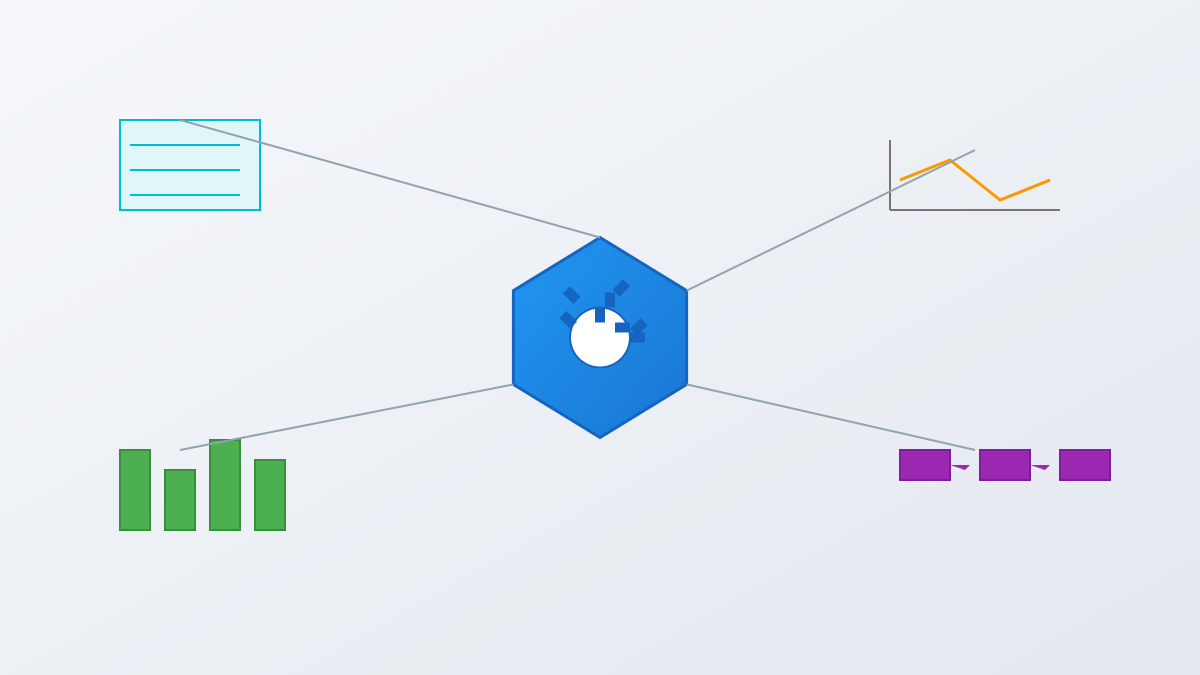
superRA is positioned as a dedicated agent workflow framework for the field of economic research, which is out-of-the-box and requires no complex configuration. Its layered architecture includes: the bottom tool layer (encapsulating data source interfaces such as World Bank and FRED, and analysis tools such as Stata and R econometric packages); the middle agent layer (professional agents for literature retrieval, data analysis, code generation, etc.); and the top orchestration layer (coordinating multiple agents to complete tasks). The architecture is modular and scalable, supporting tool replacement and agent customization.

4

Section 04

Implementation of Key Automation Features of superRA

  1. Automated literature review: Retrieval from multiple databases (JSTOR, SSRN, CNKI, etc.), deduplication and clustering, core viewpoint extraction, citation relationship analysis, automatic PDF download and key chart extraction;
  2. Data processing and analysis: Understanding common economic data formats, automatic cleaning, variable construction, descriptive statistics, recommending econometric methods and generating code, automatic robustness testing;
  3. Result presentation: Generating tables and charts that conform to top journal formats, checking standardization, and supporting automatic generation of structured reports.
5

Section 05

Applicable Scenarios and Core Value of superRA

Applicable scenarios include: systematic literature review (quickly grasping the current state of the field), large-scale data analysis (integration of multiple data sources and complex variable construction), teaching assistance (helping students get started with empirical analysis), and policy research reports (producing data-driven analysis in a short time). The core value is to significantly improve research efficiency and reduce the burden of repetitive work.

6

Section 06

Limitations and Precautions for Using superRA

Notes: The analysis code generated by AI needs manual review, and the choice of econometric methods should be based on economic theory; the literature review may miss important literature or misunderstand viewpoints, requiring researchers to check; in terms of data security, when processing sensitive data in the cloud, it is necessary to understand the security measures, and local deployment is recommended for confidential data.

7

Section 07

Future Outlook of superRA

With the improvement of large model capabilities and the accumulation of domain data, superRA will become more intelligent and professional, and may realize full-process assistance from research ideas to paper drafts in the future. However, the originality and critical thinking of research still depend on humans, and the role of AI is to amplify researchers' capabilities rather than replace thinking.

