Zing Forum

Reading

RunAgent: A Constraint-Guided Execution Framework for Natural Language Plans

This article introduces RunAgent, a multi-agent plan execution platform that enables step-by-step execution of natural language plans through constraints and evaluation criteria. The system outperforms baseline LLMs and the state-of-the-art PlanGEN method on the Natural-plan and SciBench datasets.

RunAgent计划执行多智能体约束引导自然语言处理工作流自动化错误纠正智能体语言
Published 2026-05-02 01:29Recent activity 2026-05-04 10:22Estimated read 8 min
RunAgent: A Constraint-Guided Execution Framework for Natural Language Plans
1

Section 01

[Introduction] RunAgent: A Constraint-Guided Execution Framework for Natural Language Plans

This article introduces RunAgent—a multi-agent plan execution platform that enables step-by-step execution of natural language plans through constraints and evaluation criteria, aiming to bridge the gap between the expressiveness of natural language and the certainty of execution. The system outperforms baseline LLMs and the state-of-the-art PlanGEN method on the Natural-plan and SciBench datasets.

2

Section 02

Problem Background: The Gap Between Natural Language and Deterministic Execution

Humans rely on targeted plans to solve problems, but large language models (LLMs) are still unreliable in executing structured workflows. Core contradiction: Natural language is highly expressive but lacks execution certainty; programming languages are certain but not user-friendly for non-technical users. Existing methods face four major challenges:

  1. Semantic ambiguity: Natural language descriptions have multiple interpretations
  2. Execution monitoring: Difficulty ensuring each step is executed as expected
  3. Error recovery: Lack of systematic error correction mechanisms when steps fail
  4. Context management: Difficulty filtering information during long-term execution
3

Section 03

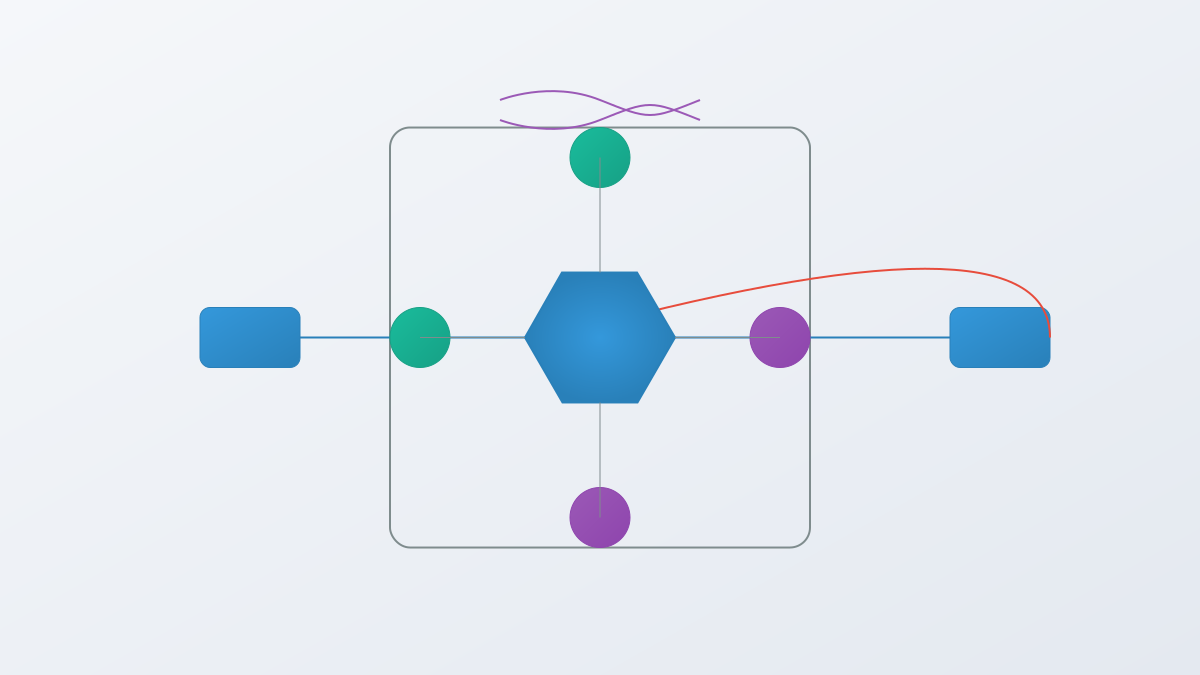
Detailed Architecture of the RunAgent Framework

Core Design Philosophy

RunAgent connects the expressiveness of natural language with the certainty of programming languages to achieve precise execution.

Explicit Control Structures

Define an agent language that includes IF (conditional branching), GOTO (jump loops), and FORALL (batch processing) to eliminate natural language ambiguity.

Constraint-Guided Execution

  • Step-level validation: Verify the syntax, semantics, and compliance of each step with clear acceptance criteria
  • Dynamic constraint derivation: Independently derive validation constraints from task descriptions and examples

Multi-Strategy Execution Selection

Choose strategies based on step characteristics: LLM reasoning (creative steps), tool calls (external APIs/databases), code generation and execution (precise calculations)

Error Correction Mechanism

Multi-layer error correction: Instant anomaly detection, automatic retry for recoverable errors, strategy switching, and human intervention when necessary

Intelligent Context Filtering

Retain information relevant to the current step to avoid context inflation
4

Section 04

Experimental Evaluation: Performance of RunAgent

Test Datasets

  • Natural-plan: A benchmark for natural language plan execution, including daily tasks and complex workflows
  • SciBench: A scientific computing benchmark requiring precise calculations and multi-step reasoning

Performance Comparison

Compared with baselines: basic LLMs, PlanGEN (state-of-the-art planning method) RunAgent advantages:

  • Significant improvement on Natural-plan
  • Outperforms all comparison methods on SciBench
  • Excellent performance in multi-step coordination and precise execution tasks
5

Section 05

Technical Depth: Constraint Guidance and Multi-Agent Collaboration

Reasons for the Effectiveness of Constraint Guidance

  1. Clear success criteria: Each step has clear completion standards
  2. Early error detection: Problems are caught before propagation
  3. Explainable failures: Points out specific unmet constraints

Multi-Agent Collaboration Architecture

  • Parsing Agent: Converts natural language plans into structured representations
  • Execution Agent: Responsible for step execution
  • Validation Agent: Checks whether results meet constraints
  • Coordination Agent: Manages processes and error recovery
6

Section 06

Application Scenarios: From Business to Scientific Research and Education

Business Process Automation

  • Customer service processes: Understand requests and execute standard responses
  • Data processing pipelines: Convert analyst descriptions into automated workflows
  • Compliance checks: Execute complex regulatory verifications

Scientific Experiment Design

  • Convert experimental protocols into automated workflows
  • Ensure steps are executed according to standards
  • Automatically record processes and results

Educational Assistance

  • Help students understand task decomposition
  • Provide step-by-step guidance and instant feedback
  • Adjust teaching strategies
7

Section 07

Limitations and Future Directions: Areas for Improvement of RunAgent

Current Limitations

  1. Plan complexity: Parsing and executing extremely complex nested plans is challenging
  2. Domain knowledge: Requires a lot of background knowledge for professional fields
  3. Real-time adaptation: Adaptability to dynamic environments needs to be enhanced

Future Research Directions

  1. Learning optimization: Learn from execution history to optimize constraint derivation
  2. Human-machine collaboration: Tightly integrate human feedback
  3. Cross-domain transfer: Transfer execution strategies to new domains