Zing Forum

Reading

Building a Hybrid RNN Language Model from Scratch: In-depth Practice of Word Embeddings, Recurrent Neural Networks, and Self-Attention

A complete personal language model implementation project that combines word embeddings, RNN, and self-attention mechanisms, covering the entire workflow of data loading, training, and validation, and providing experimental comparisons of multi-size models and loss curve analysis.

RNN语言模型自注意力词嵌入深度学习自然语言处理序列建模机器学习
Published 2026-04-05 05:45Recent activity 2026-04-05 05:47Estimated read 6 min
Building a Hybrid RNN Language Model from Scratch: In-depth Practice of Word Embeddings, Recurrent Neural Networks, and Self-Attention
1

Section 01

Introduction: In-depth Practice of Building a Hybrid RNN Language Model from Scratch

This project builds a hybrid language model combining word embeddings, RNN, and self-attention mechanisms from scratch, covering the entire workflow of data loading, training, and validation. Through experimental comparisons of multi-size models and loss curve analysis, it helps developers deeply understand the essence of sequence modeling and has irreplaceable educational value.


2

Section 02

Project Background and Motivation

In an era where Large Language Models (LLMs) dominate the current AI field, many developers' understanding of underlying mechanisms often stays at the level of calling ready-made APIs. The author of this project chose a more educational path: building a complete language model from scratch, and deeply understanding the essence of sequence modeling by personally implementing word embeddings, RNN, and self-attention mechanisms. This "reinventing the wheel" practice method has irreplaceable value for learners who want to truly master the core technologies of natural language processing.

3

Section 03

Technical Architecture Overview

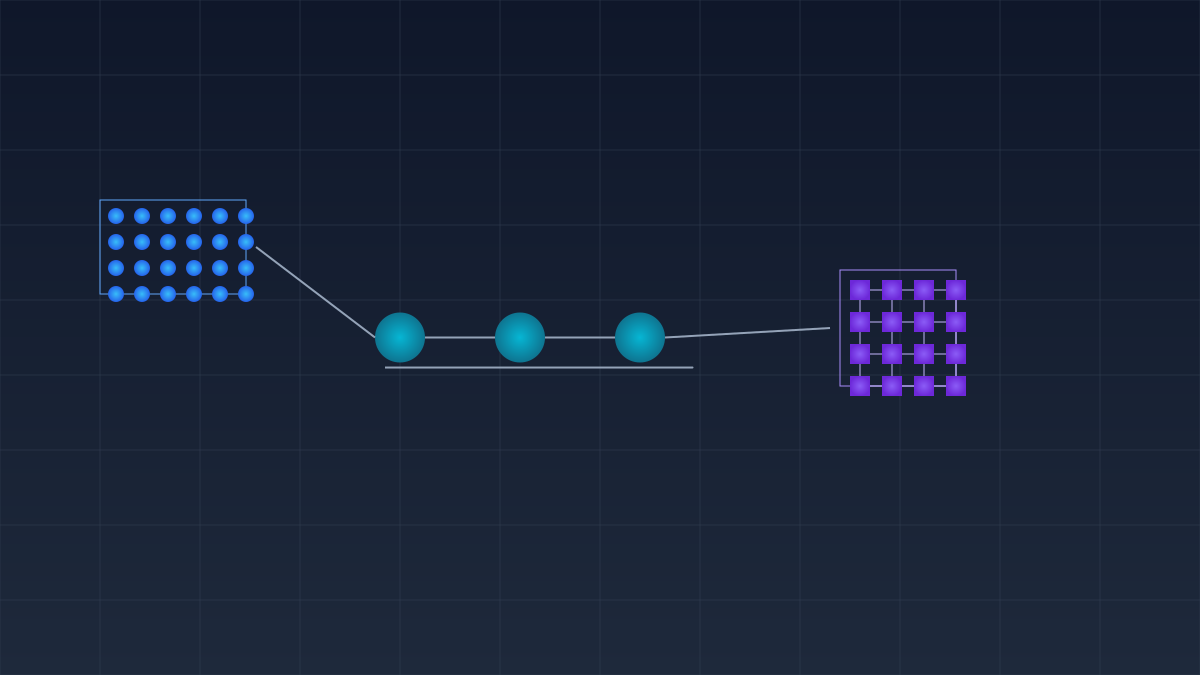
The project adopts a hybrid architecture design, integrating three core technologies:

Token Embeddings Layer: Maps discrete vocabulary to a continuous vector space to capture semantic relationships.

Recurrent Neural Network (RNN): Models sequence temporal dependencies, transmits historical information through hidden states, and intuitively demonstrates the core idea of sequence modeling.

Self-Attention Mechanism: Dynamically focuses on different positions in the sequence, calculates correlation weights between tokens, and breaks through the limitation of long-distance dependency attenuation in RNN.

4

Section 04

Training and Validation System

The project builds a complete experimental workflow:

Data Pipeline: An efficient data loading module that supports preprocessing, tokenization, batching, etc.

Training Loop: Includes forward propagation, backpropagation, learning rate scheduling, and validation steps to prevent overfitting.

Multi-size Experiments: Adjust hyperparameters to observe the relationship between model capacity and performance, and conduct systematic ablation experiments to understand model behavior.

Visualization Analysis: Records loss curves to intuitively reflect the rationality of learning rates, convergence status, and overfitting issues.

5

Section 05

Practical Significance and Insights

The value of the project lies not only in code implementation but also in providing a complete blueprint for a "minimum viable language model":

  • Intuitively understand the data flow of language models
  • Debug and observe intermediate outputs of each component
  • Facilitate experimental modifications (e.g., replacing GRU/LSTM, adjusting the number of attention heads)
  • Establish an understanding of the underlying mechanisms of modern large models
6

Section 06

Limitations and Expansion Directions

As an educational project, there is room for optimization:

  • Efficiency Optimization: The efficiency of pure Python implementation of RNN is limited; PyTorch built-in operators can be considered.
  • Architecture Upgrade: Try bidirectional RNN, multi-layer stacking, residual connections, etc.
  • Pretraining Strategy: Explore larger corpora and longer training cycles.
  • Downstream Tasks: Expand to text classification, machine translation, etc.
7

Section 07

Conclusion

In today's era of convenient API calls, implementing a language model by hand may seem "inefficient", but it brings irreplaceable in-depth understanding. This project demonstrates the process of building a text generation AI system from basic components, and is a highly valuable learning material for developers who want to truly "understand" NLP.

