Zing Forum

Reading

ProofSketch: Automatically Generating Structured Mathematical Proof Outlines Using Reasoning Models

This article introduces the ProofSketch project, demonstrating how to use Xiaomi's MiMo reasoning model to convert informal mathematical propositions into structured proof outlines, making the proof process auditable and verifiable through Abstract Syntax Trees (AST) and dependency graphs.

数学证明自动推理MiMo模型结构化输出形式化验证AI辅助证明
Published 2026-05-23 18:39Recent activity 2026-05-23 18:54Estimated read 6 min
ProofSketch: Automatically Generating Structured Mathematical Proof Outlines Using Reasoning Models
1

Section 01

ProofSketch Project Guide: Generating Structured Mathematical Proof Outlines Using Reasoning Models

The ProofSketch project uses Xiaomi's MiMo reasoning model to convert informal mathematical propositions into structured proof outlines. Its core goal is to address the challenges in learning and generating mathematical proofs: traditional formalization tools (such as Lean and Coq) have a steep learning curve, while large language models produce unstable outputs with a lack of structure. By generating Abstract Syntax Trees (AST) that include strategies, steps, dependency relationships, and confidence levels, ProofSketch makes the proof process auditable and verifiable, striking a balance between full formalization and free text.


2

Section 02

Background: Existing Challenges in Mathematical Proofs and the Birth of ProofSketch

Mathematical proofs are a difficult point for learners; even simple propositions (such as the sum of two even numbers being even) require rigorous understanding of definitions, strategy selection, and step organization. Traditional proof assistants require mastery of complex formal languages, while proof texts generated by large language models have issues of unstable outputs and hidden errors. ProofSketch aims to fill the gap between full formalization and free text generation.

3

Section 03

Core Methods and Technical Architecture: From Propositions to Structured AST

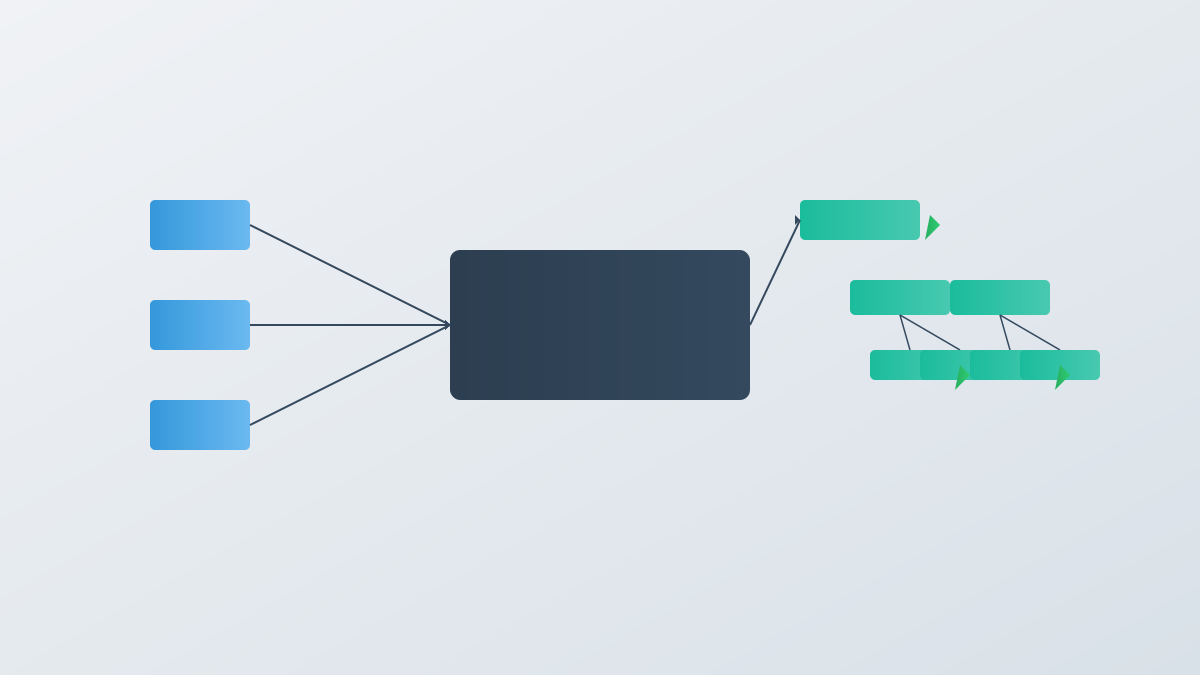
ProofSketch treats proof writing as a reasoning task, using Xiaomi's MiMo reasoning model to output structured ProofOutline AST instead of free text. The input is an informal proposition, and the output includes 6 proof strategies (direct proof, induction, etc.), an ordered list of steps (with explicit justifications), a step dependency graph, markers for unclosed gaps, and confidence levels. The technical architecture is: MiMo generates AST → Python deterministic renderer → Markdown/JSON output.

4

Section 04

Practical Example Analysis: Proof Outline for 'The Sum of Two Even Numbers Is Even'

Taking 'the sum of two even numbers is even' as an example, the outline generated by ProofSketch uses the direct proof strategy (confidence level 0.95). The steps include: assuming a and b are even → converting to 2j and 2k based on definitions → algebraic operation to get 2(j+k) → concluding it is even. Each step is annotated with justifications (such as definitions, algebraic laws) and dependency relationships. Its features are clear strategies, ordered steps, explicit justifications, visual dependencies, and quantified confidence levels.

5

Section 05

Comparison with Existing Tools: Positioning and Advantages of ProofSketch

Comparison with existing tools:

Feature GPT-4 Free Text Lean/Coq ProofSketch
Structured AST No Yes Yes
Strategy Selection Yes N/A Yes
Explicit Gap Marking Partial Yes Yes
Step Justifications Partial Yes Yes
Learning Curve Low High Medium
ProofSketch is positioned as an intermediate solution; although it is not a proof checker, explicit gap marking makes errors easier to detect.
6

Section 06

Technical Implementation Details and Usage Methods

In terms of technical implementation, the project uses Pydantic to define the ProofOutline schema to ensure correct formatting. Usage methods include:

  1. Command-line tool: supports Markdown/JSON output;
  2. Python library: integrate to generate outlines;
  3. Configure MiMo API: set the key and model via environment variables. The model explicitly marks unclosed gaps and does not hide errors.
7

Section 07

Future Plans and Summary: A New Paradigm for AI-Assisted Mathematics Education

Future plans include a Lean4 Stub renderer, step dependency graph visualization, and adversarial checking. Summary: ProofSketch helps learners understand reasoning logic by deconstructing the proof process, providing an easy-to-use structured solution for mathematics education, formal verification beginners, and researchers. Its hybrid architecture provides a reference for the design of other AI-assisted tools.

