Zing Forum

Reading

Single-PDF Document RAG System: Building a Lightweight Knowledge Q&A Engine

This article introduces an open-source RAG (Retrieval-Augmented Generation) project focused on single PDF documents, explaining its implementation principles, technical architecture, and application scenarios to help developers quickly build document Q&A systems.

RAGPDFretrieval-augmented generationvector searchdocument QAembedding
Published 2026-04-14 22:16Recent activity 2026-04-14 22:22Estimated read 6 min
Single-PDF Document RAG System: Building a Lightweight Knowledge Q&A Engine
1

Section 01

Single-PDF Document RAG System: Guide to Lightweight Knowledge Q&A Engine

This article introduces the open-source project Single-PDF-RAG, a lightweight RAG system focused on single PDF documents, designed to help developers quickly build document Q&A engines. The project simplifies the deployment process, supports multiple models and flexible deployment methods, and is suitable for scenarios such as academic research, contract review, etc.


2

Section 02

RAG Technical Background and Project Introduction

Overview of RAG Technology

Retrieval-Augmented Generation (RAG) is one of the mainstream architectures for large language models. By combining external knowledge retrieval with generation models, it solves the problems of knowledge lag and hallucinations in pure generation models. The core is to first retrieve relevant document fragments and then generate answers.

Project Introduction

Single-PDF-RAG focuses on single PDF document Q&A scenarios, simplifying the deployment process. Developers can build a Q&A interface for any PDF in a few minutes, which is different from complete RAG systems that require complex knowledge base management.

3

Section 03

System Architecture and Key Technical Implementation Points

System Architecture

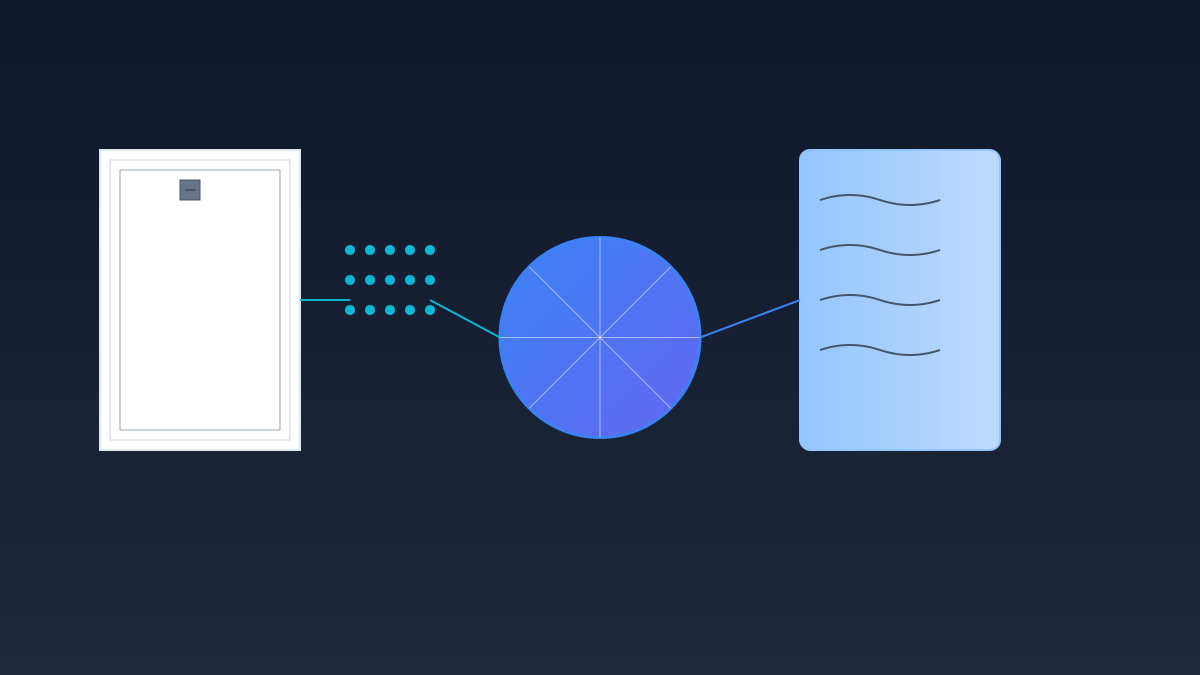
  1. Document Parsing Layer: Use PDF libraries to extract content (text, tables) and split into text chunks; 2. Vector Index Construction: Text chunks are converted to vectors via embedding models and stored in a vector database, supporting sentence-transformers and OpenAI API; 3. Retrieval Module: Convert the question to a vector query, retrieve similar text chunks and filter to return Top-K; 4. Generation Module: Combine the retrieved fragments and the question into a prompt, send to LLM (supports local Ollama/LM Studio or cloud APIs).

Key Technical Implementation Points

  • Text Chunking: Fixed length, semantic chunking, overlapping chunking;
  • Retrieval Optimization: Hybrid retrieval (vector + keyword), reordering, query expansion;
  • Prompt Engineering: Guide the model to answer based on context, cite sources, and handle cases where results are insufficient.
4

Section 04

Core Features and Application Scenarios

Core Features

  1. Plug-and-play: Only need a PDF file to start Q&A;
  2. Multi-model support: Flexibly switch between embedding and LLM models;
  3. Context management: Handle long document window limitations;
  4. Streaming output: Generate answers in real time;
  5. Lightweight deployment: No need for complex database middleware.

Application Scenarios

Academic paper research, contract document review, product manual query, educational material learning, legal document analysis, etc.

5

Section 05

Deployment Methods

The project provides multiple deployment options: 1. Local run (for privacy-sensitive scenarios); 2. Docker container (one-click deployment, environment isolation); 3. Streamlit interface (user-friendly web interaction); 4. API service (programmatic calls).

6

Section 06

Limitations and Improvement Directions

Current version limitations: Focused on single-document scenarios, limited ability for cross-document association queries. Future improvement directions: Multi-document joint indexing, conversation history management, multi-modal support (chart/image understanding), incremental update mechanism.

7

Section 07

Summary

Single-PDF-RAG demonstrates the simplicity of RAG technology implementation. Through reasonable architecture design, it makes complex AI applications easy to use, and is an ideal starting point for developers to quickly verify the RAG concept or build lightweight document Q&A systems.

