Zing Forum

Reading

Oryx: A New Hybrid Model Architecture with Dynamic Attention Mechanism Switching in Sequences

Researchers propose the Oryx architecture, which breaks through the static alternation design paradigm of traditional hybrid models, enabling sequence-level dynamic mixer switching with over 90% parameter sharing. At the 1.4B scale, it outperforms single-mixer baselines, providing new ideas for long-sequence modeling.

大语言模型注意力机制状态空间模型Mamba混合架构序列建模高效推理长上下文
Published 2026-05-28 01:26Recent activity 2026-05-28 23:51Estimated read 4 min
Oryx: A New Hybrid Model Architecture with Dynamic Attention Mechanism Switching in Sequences
1

Section 01

Oryx Architecture: A New Breakthrough in Hybrid Models with Dynamic Attention Switching

Researchers propose the Oryx architecture, which breaks through the static alternation design paradigm of traditional hybrid models, enabling sequence-level dynamic mixer switching with over 90% parameter sharing. At the 1.4B scale, it outperforms single-mixer baselines, providing new ideas for long-sequence modeling. The original authors are the Oryx research team, and the source is arXiv (published on 2026-05-27, link: http://arxiv.org/abs/2605.28769v1).


2

Section 02

Background: Dilemmas of Attention Mechanisms and Limitations of Hybrid Architectures

The Softmax attention mechanism is the cornerstone of large models, but its computational complexity grows quadratically, leading to high costs for long-sequence processing. Linear recurrent models (e.g., Mamba) are efficient but lag behind Transformers in long-context retrieval/learning tasks. Existing hybrid architectures are mostly static designs (inter-layer alternation or fixed ratios), assuming all tokens have the same needs, which is inconsistent with real-world scenarios.

3

Section 03

Oryx Core Design: Sequence-Level Dynamic Switching and Parameter Sharing

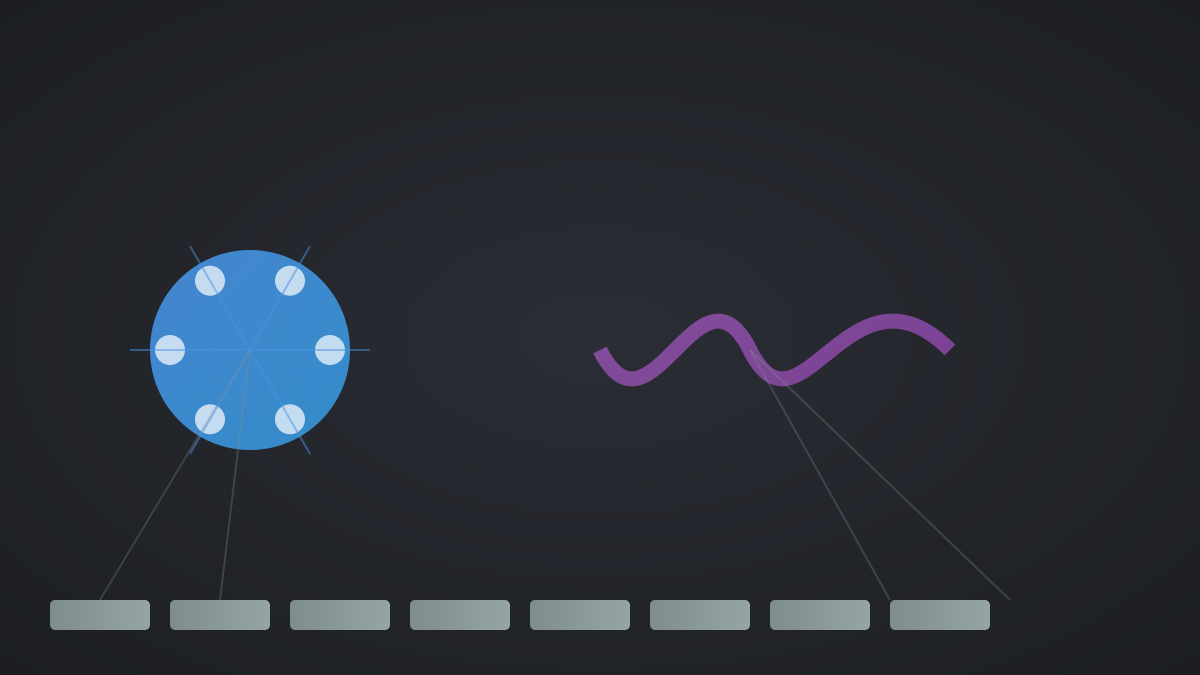
Oryx dynamically switches mixers (e.g., attention/linear recurrent mechanisms) at the sequence dimension. Its core innovation is over 90% parameter sharing—different mixers operate on the same internal representations instead of independent spaces, which not only reduces the total number of parameters but also allows selecting the optimal mechanism based on token needs.

4

Section 04

Experimental Validation: Performance of Oryx

At the 1.4B scale, Oryx instances outperform single-mixer baselines on average language modeling tasks (improvement ≥0.7 percentage points). In retrieval tasks, using attention mode for less than 10% of tokens is sufficient to achieve Transformer baseline performance, enabling context understanding with low overhead.

5

Section 05

Technical Insights and Future Directions

Oryx reveals that attention and linear recurrent models can share representations, breaking traditional perceptions. Sequence-level mixing allocates resources more finely than static inter-layer mixing, reducing costs while maintaining performance. It provides a path for large model practitioners: reducing inference costs without sacrificing long-context capabilities, suitable for scenarios like long document processing and code generation.

6

Section 06

Limitations and Unresolved Challenges of Oryx

Dynamic switching introduces routing decision overhead (needs actual deployment evaluation); 90% parameter sharing may limit expressive power for specific tasks; the optimal ratio and scheduling of hybrid training strategies still need to be explored.

