Zing Forum

Reading

Dual Cross-Attention Graph Learning Framework: A New Method for Multimodal MRI Depression Detection

The study proposes a dual cross-attention multimodal fusion framework that explicitly models the bidirectional interactions between structural MRI and functional MRI. It achieves an accuracy of 84.71% on the REST-meta-MDD dataset, providing a new tool for the objective diagnosis of depression.

抑郁症检测多模态融合结构MRI功能MRI交叉注意力图神经网络
Published 2026-04-11 17:19Recent activity 2026-04-14 10:23Estimated read 5 min
Dual Cross-Attention Graph Learning Framework: A New Method for Multimodal MRI Depression Detection
1

Section 01

Introduction: Dual Cross-Attention Framework Aids Multimodal MRI Depression Detection

The study proposes a dual cross-attention multimodal fusion framework that explicitly models the bidirectional interactions between structural MRI and functional MRI. It achieves an accuracy of 84.71% on the REST-meta-MDD dataset, providing a new tool for the objective diagnosis of depression. By combining cross-modal attention with graph learning, this framework improves recognition accuracy and provides clues for understanding the neural mechanisms of depression.


2

Section 02

Challenges in Depression Diagnosis and the Need for Multimodal Fusion

Depression diagnosis has long relied on subjective assessments, which face issues such as subjectivity, heterogeneity, and difficulty in early identification. Neuroimaging shows that depression is associated with changes in brain structure and function, but a single modality cannot capture the complexity. Structural MRI (static anatomy) and functional MRI (dynamic activity) need to be combined to fully reflect the brain state, and effectively integrating heterogeneous information is a core challenge.

3

Section 03

Design Details of the Dual Cross-Attention Framework

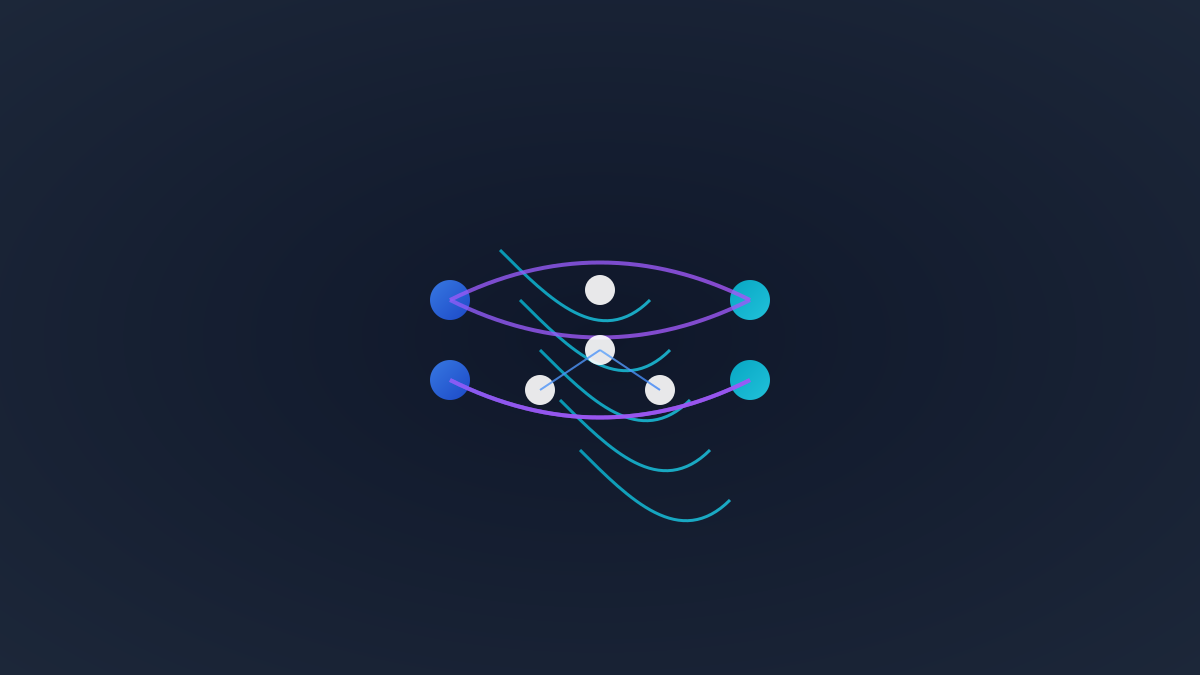
The core innovation of the framework is the explicit modeling of bidirectional interactions between structural and functional MRI: the cross-attention mechanism allows the model to dynamically focus on cross-modal relevant features (e.g., structural abnormalities corresponding to functional changes); the graph learning component uses the graph structure of brain networks to capture topological patterns (community structure, central nodes, etc.), which is different from traditional feature concatenation methods.

4

Section 04

Experimental Setup and Performance

The experiment was validated on the REST-meta-MDD multi-center dataset, using 10-fold stratified cross-validation to avoid bias, and testing multiple brain atlases to evaluate robustness. Results: Accuracy of 84.71%, sensitivity of 86.42%, specificity of 82.89%, etc.; it outperforms traditional feature cascading on functional atlases, and is comparable to existing methods on structural atlases.

5

Section 05

Robustness of the Method and Mechanistic Insights

The method remains competitive under different brain atlas configurations, demonstrating potential for clinical application. Mechanistic insights: Cross-attention reveals structure-function coupling; graph learning supports the view that depression is a system-level disorder; multimodal imaging can serve as an objective biomarker, promoting precision psychiatry.

6

Section 06

Limitations and Future Research Directions

Study limitations: The sample may have selection bias, the model lacks interpretability, and the cross-sectional design cannot track the disease course. Future directions: Integrate more modalities (DTI, PET), develop interpretable models, and conduct prospective clinical validation to enhance clinical application value.

