Zing Forum

Reading

Architecture Analysis of a Multimodal Visual Question Answering System Based on LongCLIP and Qwen3

This article provides an in-depth analysis of an open-source multimodal visual question answering (VQA) system combining LongCLIP visual encoding and the Qwen3 language model, exploring its technical architecture, implementation principles, and application scenarios.

多模态AI视觉问答VQALongCLIPQwen3大语言模型计算机视觉开源项目
Published 2026-05-20 03:15Recent activity 2026-05-20 03:17Estimated read 9 min
Architecture Analysis of a Multimodal Visual Question Answering System Based on LongCLIP and Qwen3
1

Section 01

[Introduction] Core Analysis of the Open-Source Visual Question Answering System Based on LongCLIP and Qwen3

This article provides an in-depth analysis of an open-source multimodal visual question answering (VQA) system that combines LongCLIP visual encoding and the Qwen3 language model, exploring its technical architecture, implementation principles, and application scenarios. By integrating advanced visual encoders and powerful language models, this system offers practical technical references for developers and demonstrates the potential of multimodal AI in VQA tasks.


2

Section 02

Background: The Rise of Multimodal AI and Visual Question Answering Tasks

With the rapid development of large language model (LLM) technology, AI is evolving from single-modal to multimodal fusion. Visual Question Answering (VQA), as one of the core tasks of multimodal AI, requires systems to simultaneously understand image content and natural language questions and generate accurate answers. The open-source system introduced in this article is a practical achievement under this trend.

3

Section 03

Technology Selection: Combined Advantages of LongCLIP and Qwen3

This system is open-sourced by developer muhammadahmadr704-sys, with the core goal of building an intelligent system that can understand images and answer questions. The technology selection reflects mainstream trends:

  • Visual Encoding Layer: LongCLIP (an improved version of CLIP) is optimized for long text and complex visual scenes, expanding the context window and improving the attention mechanism to capture finer-grained visual features.
  • Language Understanding Layer: Qwen3 (the latest version of Alibaba's Tongyi Qianwen) has significantly improved multilingual understanding and reasoning capabilities, serving as the language backbone to understand questions and generate coherent answers.
4

Section 04

System Architecture Design: Optimized Implementation of the Encoder-Decoder Paradigm

The system follows the encoder-decoder paradigm with the following detailed optimizations:

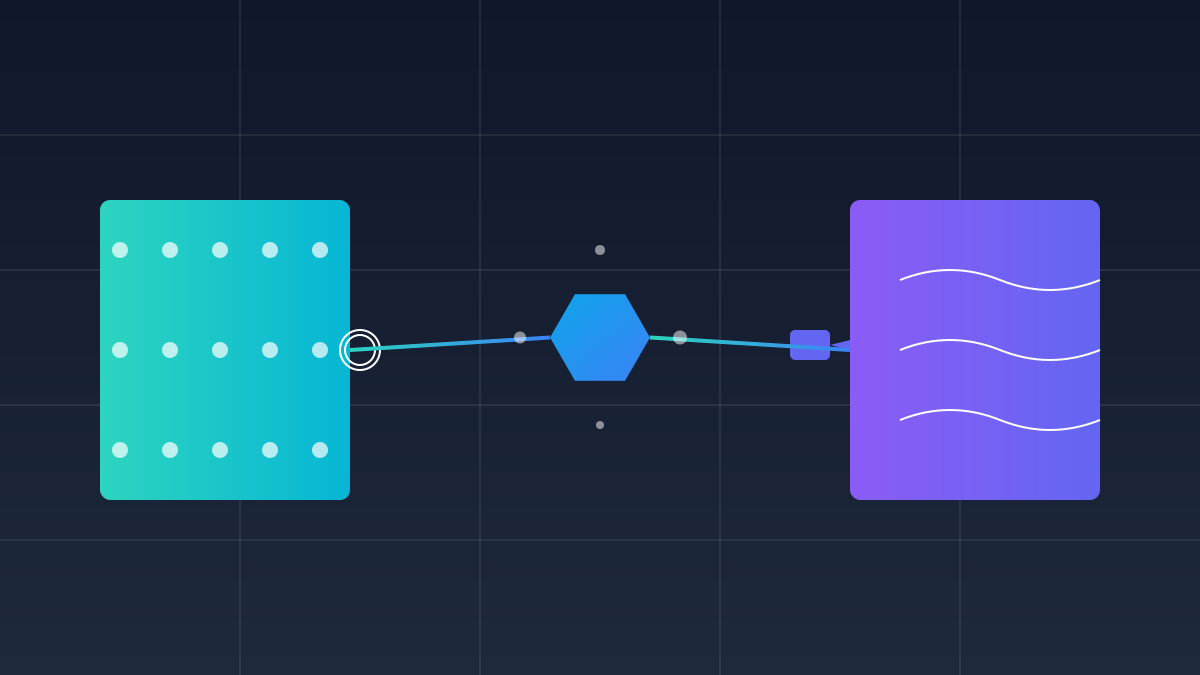
  1. Visual Feature Extraction: The LongCLIP visual encoder converts raw pixels into high-dimensional semantic vectors, capturing objects, scenes, relationships, and attributes while leveraging its visual-language alignment knowledge.
  2. Multimodal Fusion: A projection layer maps visual features to the language model's embedding space, achieving cross-modal alignment and allowing Qwen3 to process both text and visual tokens simultaneously.
  3. Answer Generation: The fused multimodal representation is input into Qwen3 to generate answers autoregressively, supporting simple yes/no questions and complex multi-step reasoning queries.
5

Section 05

Key Technical Implementation Details

Core details in the system implementation:

  • Visual-Language Alignment: A lightweight projection layer approach is used to reduce computational resource requirements while maintaining performance, avoiding the high cost of end-to-end training.
  • Context Window Management: LongCLIP's long context capability handles high-resolution images and complex scenes, dynamically adjusting the granularity of feature extraction to balance performance and computational overhead.
  • Inference Optimization: Technologies such as KV caching and quantization acceleration may be used to reduce response latency and adapt to deployment on resource-constrained edge devices.
6

Section 06

Application Scenarios and Practical Use Cases

This system can be applied in multiple scenarios:

  • Educational Assistance: Students upload screenshots of textbooks/exercise problems, and the system understands the content and answers questions, supporting personalized learning.
  • Visual Content Analysis: In social media monitoring and e-commerce product analysis, it automatically understands images and answers business questions, improving review efficiency.
  • Intelligent Customer Service: Combined with an enterprise's product image library, it answers customers' questions about product appearance and functions, providing an intuitive experience.
  • Accessibility Assistance: It provides image description and Q&A services for visually impaired users to help them understand their surroundings.
7

Section 07

Technical Limitations and Improvement Directions

Limitations of the system and directions for improvement:

  • Fine-Grained Understanding: The understanding of small-font text and complex textures needs to be improved; higher-resolution visual encoders or OCR modules can be introduced.
  • Multi-Image Reasoning: Currently designed for single images, with limited support for cross-image comparison reasoning; the organization of visual features needs to be redesigned.
  • Hallucination Problem: It may generate incorrect answers; confidence estimation and answer verification mechanisms can be introduced to mitigate this.
8

Section 08

Open-Source Ecosystem and Conclusion

As an open-source project, this system provides practical references for researchers and developers; its code structure, model integration, and engineering details can serve as a starting point for complex multimodal applications. The community can expand it by: integrating visual encoders like SAM/DINOv2, trying language models like Llama/Mistral, and adding domain adaptation layers for healthcare/industry, etc. The combination of LongCLIP and Qwen3 represents a practical multimodal technology stack with good performance. This project provides an excellent entry point and experimental platform for developers in the multimodal AI field, and we look forward to more intelligent and general visual understanding systems in the future.

