Zing Forum

Reading

llmviz: Visualizing the Thinking Process of Large Language Models

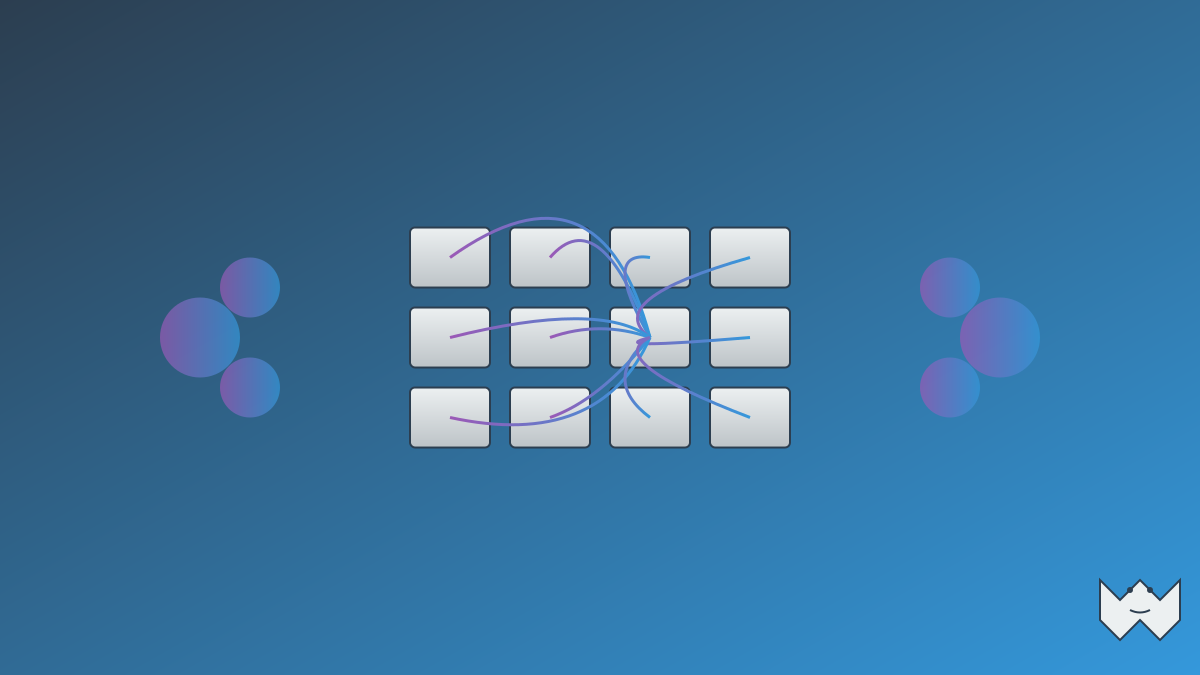
llmviz is an educational interactive visualization tool that allows users to intuitively observe the internal working mechanisms of large language models (LLMs), comprehensively displaying the LLM reasoning process from word embedding to attention mechanisms, inter-layer transmission to output generation.

大语言模型可视化Transformer注意力机制LLM教育深度学习神经网络GitHub
Published 2026-06-14 02:40Recent activity 2026-06-14 02:49Estimated read 7 min
llmviz: Visualizing the Thinking Process of Large Language Models
1

Section 01

[Introduction] llmviz: An Educational Tool for Visualizing LLM Thinking Processes

llmviz is an educational interactive visualization tool maintained by clebervisconti, designed to uncover the internal working mechanisms of large language models (LLMs). As a sister project of NeuraNetViz, it provides a complete process visualization from input processing to output generation, helping users intuitively understand the LLM reasoning process. The project source is GitHub (link: https://github.com/clebervisconti/llmviz), and the update date is 2026-06-13. Its core value lies in breaking the LLM black box, making abstract algorithms accessible, and it is suitable for developers, learners, and researchers.


2

Section 02

Background: The LLM Black Box Problem and the Birth of llmviz

In the era of rapid AI technology development, LLMs have become core components of many applications, but most developers and learners still feel unfamiliar with their internal principles, as if facing a black box. The emergence of llmviz is precisely to break this information asymmetry, making the complex working mechanisms of LLMs intuitive and easy to understand through visualization.

3

Section 03

Core Visualization Content of llmviz

llmviz's visualization covers key stages of LLM processing:

  1. Word Embedding Layer: Shows text conversion to numerical representation, where semantically similar words cluster in the embedding space;
  2. Positional Encoding: Demonstrates how positional information generated by sine and cosine functions combines with word embeddings to distinguish word order differences;
  3. Attention Mechanism: Uses heatmaps to show the interaction of queries, keys, values, and the evolution of attention weights;
  4. Multi-Head Attention: Shows the parallel computing process, where different heads capture different semantic relationships;
  5. Feed-Forward Network and Layer Normalization: Shows the transformation and refinement of information during deep propagation in the network;
  6. Output Generation: Shows the probability distribution generated by hidden states and the impact of sampling strategies on output.
4

Section 04

Educational Value and Target Audience of llmviz

llmviz is designed for learners at different levels:

  • Beginners: Establish an intuitive understanding of the Transformer architecture through interactive demonstrations and understand the power of the attention mechanism;
  • Advanced Learners: Observe the behavioral patterns of different layers and attention heads in depth, and understand the construction of hierarchical representations;
  • Researchers: Verify model behavior hypotheses and observe how specific inputs activate different parts of the network.
5

Section 05

Technical Implementation and Relationship with NeuraNetViz

In terms of technical implementation, llmviz uses a modern front-end technology stack and has features such as responsive design (adapting to multiple devices), real-time computing (real-time observation of custom text), and layered display (from overview to neuron activation values). As a sister project of NeuraNetViz, it inherits the former's design concept, is optimized for LLMs, and is more professional and detailed in displaying language model-specific mechanisms such as causal masking and KV caching.

6

Section 06

Significance of llmviz for AI Education Popularization

llmviz is of great significance for AI education popularization: traditional papers and textbooks are difficult to convey the intuitive feeling of dynamic processes, while interactive visualization fills this gap. It converts abstract mathematical formulas into observable and operable visual elements, greatly reducing the cognitive burden of understanding the Transformer architecture, and is a valuable auxiliary tool for learners of natural language processing or deep networks.

7

Section 07

Summary and Learning Recommendations

llmviz represents an important development direction of AI educational tools—lowering the threshold for learning complex technologies through visualization, and providing valuable resources for developers, researchers, and students who want to understand the working principles of LLMs. It is recommended to learn by combining llmviz's visualization content with the classic paper "Attention Is All You Need", where theory and intuitive presentation mutually confirm each other to improve learning efficiency.

