Zing Forum

Reading

LLM Enables Intelligent Orchestration of the Physical World via MCP and MQTT Bridging

This article introduces an innovative architectural solution that enables local large language models (LLMs) to communicate bidirectionally with physical devices and digital services via the Model Context Protocol (MCP) and MQTT protocol, achieving AI's ability to intelligently orchestrate the real world.

LLMMCPMQTT物联网AI编排智能家居物理世界AIModel Context Protocol
Published 2026-05-08 02:14Recent activity 2026-05-08 02:18Estimated read 6 min
LLM Enables Intelligent Orchestration of the Physical World via MCP and MQTT Bridging
1

Section 01

[Main Post/Introduction] Core Solution for LLM to Enable Intelligent Orchestration of the Physical World via MCP and MQTT Bridging

This article presents an innovative architecture that allows local large language models (LLMs) to communicate bidirectionally with physical devices and digital services via the Model Context Protocol (MCP) and MQTT protocol, enabling AI to intelligently orchestrate the real world. The core advantages of this solution include decoupling, scalability, security, and real-time performance, providing a secure and flexible path for LLMs to connect to the physical world.


2

Section 02

Background and Motivation: Challenges and Solution Ideas for LLMs Connecting to the Physical World

As LLM capabilities grow, AI needs to explore connections with the physical world. However, traditional IoT control faces security risks such as complex API encapsulation or direct exposure of devices. MCP, as an open standard by Anthropic, establishes a standardized communication bridge between AI and external tools; MQTT is the de facto standard for lightweight IoT messaging protocols. Combining the two can build a secure and flexible LLM-physical world interaction architecture.

3

Section 03

Core Architecture: Three-Layer Design and Bidirectional Communication Mechanism

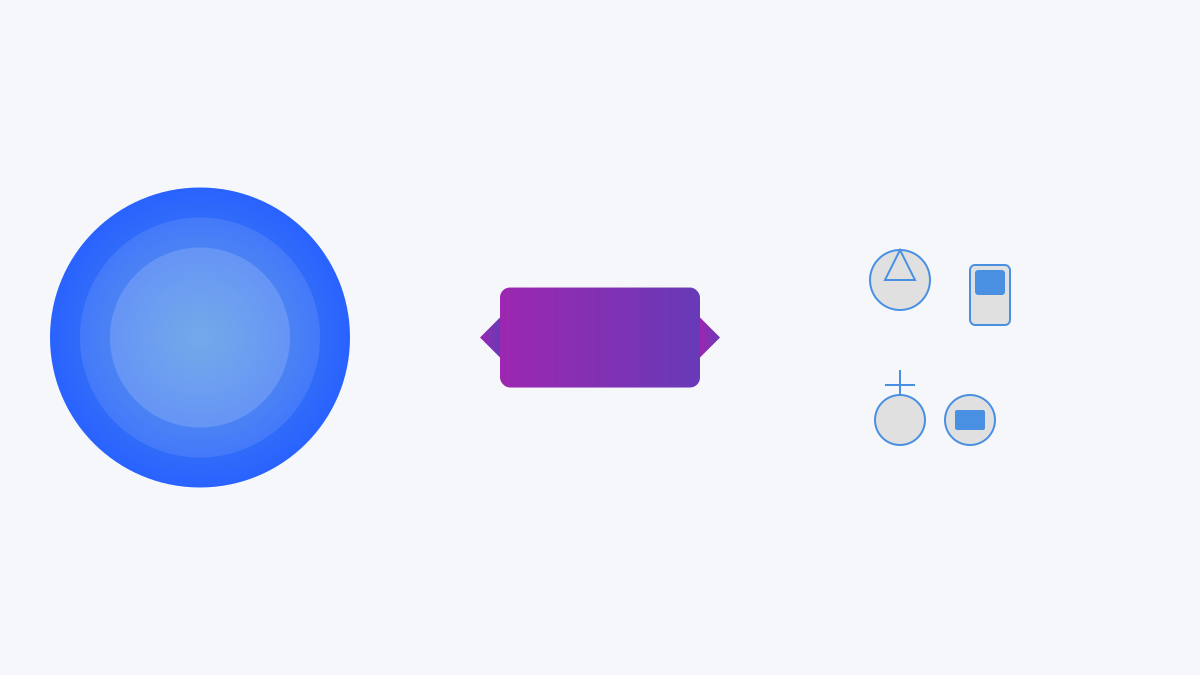
The system adopts a three-layer architecture: 1. LLM Layer (local open-source models like Llama and Mistral, interacting via MCP clients); 2. MCP Bridging Layer (a Python-implemented MCP server that converts LLM tool calls into MQTT messages and returns device responses); 3. Device Layer (physical devices and digital services connected via MQTT). Bidirectional communication: LLM → Device (e.g., the command 'Turn on the living room light' is converted into an MQTT topic message); Device → LLM (sensor data is reported to MQTT, which the MCP subscribes to and returns to the LLM).

4

Section 04

Key Technical Implementation Points: MCP Tools, MQTT Topics, and Python Bridging Layer

MCP Tool Definition: Standardized tools include list_devices (list devices), get_device_status (get status), control_device (control device), and subscribe_sensor (subscribe to sensor streams), with parameters described using JSON Schema following MCP specifications. MQTT Topic Design: Uses the structure {location}/{device_type}/{device_id}/{action} (e.g., home/living_room/light_01/set) and supports wildcard batch subscriptions. Python Implementation: An asynchronous application (asyncio + paho-mqtt) including asynchronous architecture, connection pool management, message caching, and error handling.

5

Section 05

Application Scenario Examples: Smart Home, Industrial Monitoring, and Digital-Physical Collaboration

  1. Smart Home: User natural language commands (e.g., 'Turn on the air conditioner and close the curtains when the temperature exceeds 26°C') are processed by the LLM calling tools to complete control;
  2. Industrial Monitoring: Poll sensor status, issue alerts and generate maintenance suggestions when anomalies occur;
  3. Digital-Physical Collaboration: Automatic printing of email attachments, adjusting meeting room environments based on calendar events, and controlling ventilation using weather and sensor data.
6

Section 06

Technical Challenges and Solutions: Latency, Security, and Reliability

Latency Optimization: Preloading device status, asynchronous tool calls, local LLM deployment; Security Considerations: MQTT ACL (access control), MCP permission control, command verification, audit logs; Reliability Assurance: Disconnection reconnection, message persistence (QoS1/2), heartbeat detection.

7

Section 07

Future Directions and Conclusion: Promoting AI Evolution from Chatbots to Intelligent Agents

Future Directions: Multimodal expansion (combining visual models), edge computing optimization, standardization promotion, federated learning; Conclusion: This project provides a practical reference for the integration of AI and the physical world, lowering the integration threshold. With the popularization of the MCP ecosystem and MQTT, it is expected to be applied in scenarios such as smart homes and industrial automation, promoting the evolution of AI towards intelligent agents.

