Zing Forum

Reading

Hoovik: Architecture Design and Technical Implementation of a Distributed Intelligent Meeting Platform

An in-depth analysis of the technical architecture of the Hoovik distributed intelligent meeting platform, covering core modules such as WebRTC peer-to-peer video communication, multimodal emotion reasoning, speaker-aware transcription, RAG-driven meeting record retrieval, and AI-generated meeting insights.

WebRTC多模态AI情绪识别语音识别RAG会议智能PyTorch向量检索
Published 2026-06-04 02:15Recent activity 2026-06-04 02:21Estimated read 9 min
Hoovik: Architecture Design and Technical Implementation of a Distributed Intelligent Meeting Platform
1

Section 01

Introduction to the Hoovik Distributed Intelligent Meeting Platform

Hoovik: Distributed Intelligent Meeting Platform

This project is a distributed intelligent meeting platform, with core modules including WebRTC peer-to-peer video communication, multimodal emotion reasoning, speaker-aware transcription, RAG-driven meeting record retrieval, and AI-generated meeting insights.

Original Author and Source

2

Section 02

Project Background and Positioning

With the increasing popularity of remote collaboration today, video conferencing has become the main way for teams to communicate. However, traditional meeting tools often only provide basic audio and video functions, lacking in-depth understanding of meeting content and intelligent processing capabilities. The Hoovik project was born to solve this pain point—it is a distributed intelligent meeting platform that aims to bring revolutionary experience improvements to meeting scenarios through multimodal AI technology.

The core vision of this project is to transform "passive recording" into "active intelligence", enabling every meeting to generate retrievable, analyzable, and actionable knowledge assets. By integrating cutting-edge machine learning technology with mature distributed system architecture, Hoovik provides a new technical paradigm for modern team collaboration.

3

Section 03

Overall Architecture Overview

Hoovik adopts a microservices architecture design, decoupling different functional modules into independent service units, consisting of the following core subsystems:

Frontend Interaction Layer

Built based on the React framework, it provides an intuitive user interface, supporting real-time video grid layout, screen sharing, chat messages, and other functions. Users can participate in meetings via browsers without installing additional clients.

Backend Service Layer

Uses Node.js to implement business logic processing, user authentication, session management, and other basic functions; integrates high-performance Python services built with FastAPI to specifically handle computationally intensive AI reasoning tasks.

Data Storage Layer

Uses MongoDB as the main document database to store user information, meeting metadata, transcription text, etc.; Redis serves as the cache layer and message queue, supporting high-speed real-time data reading/writing and event distribution.

4

Section 04

Analysis of Core Technical Features

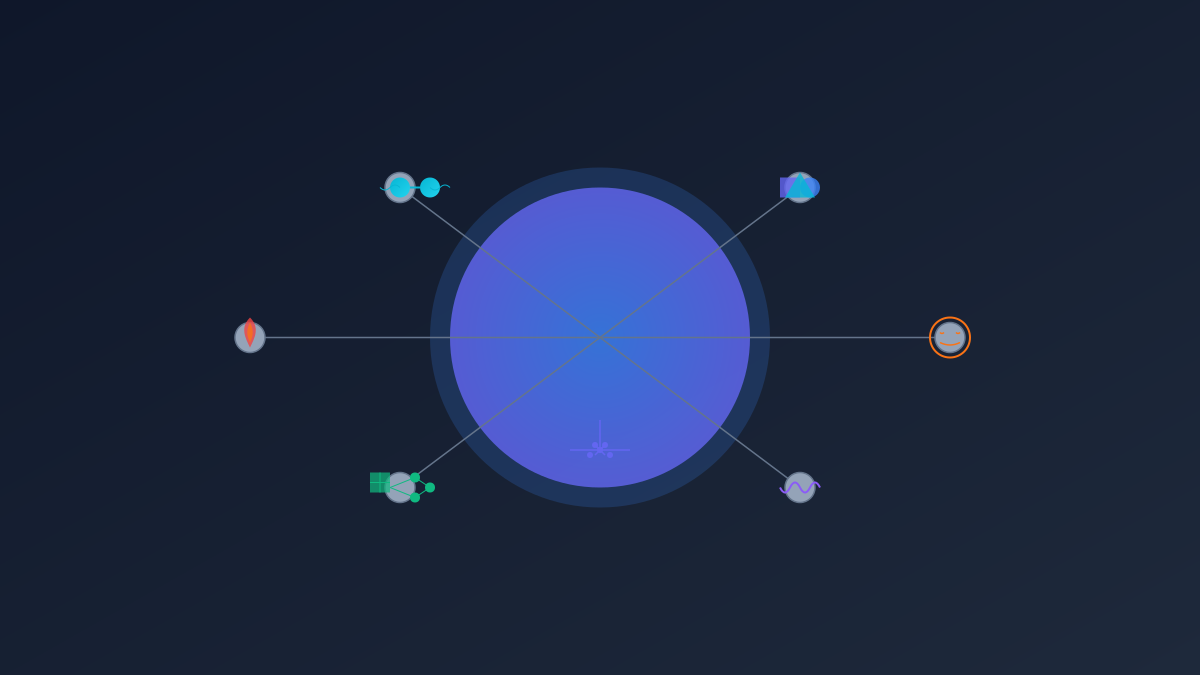
WebRTC Peer-to-Peer Video Communication

Uses WebRTC to implement browser-to-browser peer-to-peer communication, with advantages including reducing server relay pressure, SRTP encrypted transmission guarantee, ICE framework handling complex network environments, and dynamically adjusting bitrate and resolution to ensure a smooth experience.

Multimodal Emotion Reasoning Engine

Based on the PyTorch framework, it integrates computer vision and natural language processing models: extracts facial expression feature vectors from video streams, extracts acoustic features from audio streams, and outputs emotion classification results through joint modeling. Multimodal fusion improves accuracy and robustness.

Speaker-Aware Transcription System

Through voiceprint recognition technology, it first performs speaker diarization, then transcribes each segment to generate labeled text, facilitating subsequent retrieval and personalized insights.

RAG-Driven Meeting Record Retrieval

Uses the Nomic embedding model to convert transcription text into vector storage. When users query, it first retrieves relevant segments, injects them into large language model prompts to generate answers, supporting semantic matching and traceable information.

AI-Generated Meeting Insights

Automatically generates structured reports based on transcription and emotion analysis results, including meeting duration statistics, key topic extraction, decision item identification, emotion trend analysis, speech fairness assessment, etc. Visual presentation helps grasp meeting quality.

5

Section 05

Technical Selection Considerations

Hoovik's tech stack balances practicality and forward-looking:

  • React and Node.js ensure development efficiency and ecosystem support;
  • FastAPI provides an asynchronous framework for Python AI services;
  • PyTorch is the de facto standard in the deep learning field;
  • Redis and MongoDB combination balances performance and flexibility;
  • Nomic embedding model is open-source, reducing costs and protecting data privacy, suitable for enterprise-level deployment.
6

Section 06

Application Scenarios and Value

Hoovik is suitable for multiple scenarios:

  • Distributed teams: provides intelligent collaboration experience;
  • Training scenarios: emotion analysis helps instructors understand students' status;
  • Customer interviews: automatic transcription and insights improve research efficiency;
  • Compliance industries: on-premise deployment ensures data sovereignty.
7

Section 07

Summary and Outlook

Hoovik demonstrates the potential of multimodal AI in meeting scenarios, integrating WebRTC, deep learning, vector retrieval, and other technologies to build a feature-rich platform.

In the future, we can expect the introduction of real-time multilingual translation, intelligent meeting assistants, predictive meeting suggestions, and other functions. It is a noteworthy open-source project for AI-empowered collaboration tools.


