Zing Forum

Reading

GNAA: A Two-Stage Framework for Verifiable Reasoning Based on Graph Neural Action Architecture

An experimental two-stage agent network project that constructs observable reasoning and evaluation processes for small language models through multi-node collaboration, judgment backtracking, and tool enhancement.

多智能体小型语言模型两阶段推理图神经网络RAG智能体协作MCP协议GAIA基准
Published 2026-05-16 11:06Recent activity 2026-05-16 11:19Estimated read 4 min
GNAA: A Two-Stage Framework for Verifiable Reasoning Based on Graph Neural Action Architecture
1

Section 01

[Introduction] GNAA: A Two-Stage Framework for Verifiable Reasoning for Small Language Models

GNAA is an experimental two-stage agent network project. Addressing the pain point of insufficient support for small language models in resource-constrained scenarios, it constructs an observable and verifiable reasoning process through multi-node collaboration, judgment backtracking, and tool enhancement, reducing reliance on a single strong model.


2

Section 02

Project Background and Core Objectives

Existing LLM multi-agent solutions rely on strong models and lack sufficient support for resource-constrained scenarios. The goal of GNAA is to build an observable reasoning chain that connects agent candidate answers, judgment scores, tool evidence, etc., while maintaining reasoning quality and reducing dependence on a single model.

3

Section 03

Two-Stage Architecture Design

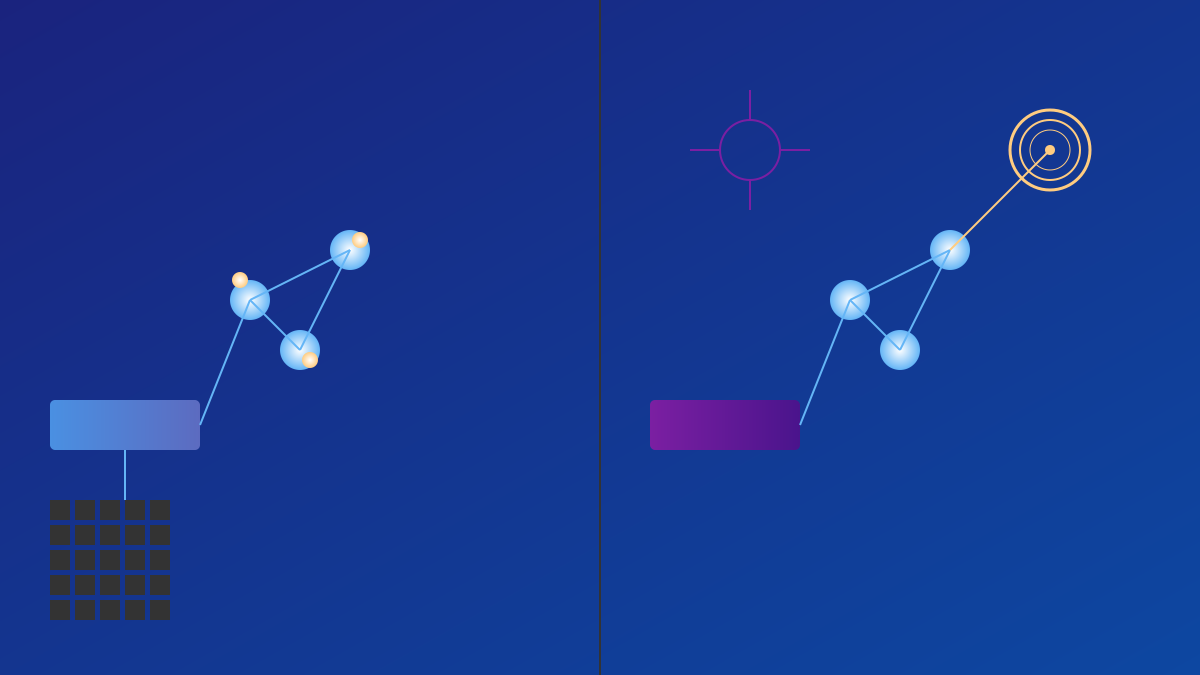
  1. First stage: Multi-agent parallel generation of candidate answers (breadth-first exploration), adjust node weights and backtrack through judgment perception scores to identify key reasoning paths;
  2. Second stage: Select top-k nodes and equip them with tools like search/RAG/memory to complete answers, integrate results through a solver + critic strategy to achieve self-correction.
4

Section 04

Memory and Retrieval Augmentation System

The memory system includes three types: working memory (short-term context), episodic memory (case reuse), and semantic memory (error avoidance); RAG is based on the Qdrant vector database, supporting efficient semantic retrieval to compensate for the knowledge gaps of small models.

5

Section 05

Protocol Support and Evaluation Benchmarks

Protocols support MCP/A2A/ANP, seamlessly integrating into the agent ecosystem; evaluation adapts to GAIA (real reasoning) and BFCL (function call). Local GAIA data is located at test/data/gaia/2023/, and a dataset loader is provided for easy debugging.

6

Section 06

Technical Implementation Details

Layered architecture: core/llm.py supports OpenAI-compatible interfaces, flexibly switching between backends like Ollama/vLLM; environment variables support multi-platform APIs; built-in tools include a secure calculator (AST parsing), search, memory, etc. Terminal tools are recommended to be used under control.

7

Section 07

Current Status and Outlook

The project is in the development stage. Core modules are available, but package imports/test entry points are pending improvement; maintainers have optimization plans, and its architectural direction provides an exploration path for enhancing the capabilities of small models.

8

Section 08

Summary

GNAA enhances capabilities through systematic design. The two-stage architecture + judgment backtracking + multi-tool collaboration form a small model enhancement solution, providing a reference paradigm for deploying agents in resource-constrained environments.

