Zing Forum

Reading

FoE: The Forest of Errors Effect Reveals the 'First Solution is Optimal' Phenomenon in Large Reasoning Models

The study discovers that large reasoning models exhibit the counterintuitive phenomenon of 'first solution being optimal'. It proposes the Forest of Errors (FoE) theory to explain this phenomenon, and based on this, designs the RED framework. By optimizing the first solution and pruning subsequent errors, it achieves a maximum 19% performance improvement and a 37.7%-70.4% reduction in token consumption.


FoE错误森林大推理模型首个方案最优RED框架推理优化测试时扩展token效率DeepSeek-R1错误检测
Published 2026-04-03 19:03Recent activity 2026-04-06 10:50Estimated read 5 min
FoE: The Forest of Errors Effect Reveals the 'First Solution is Optimal' Phenomenon in Large Reasoning Models
1

Section 01

【Main Floor】FoE: The Forest of Errors Effect Reveals the 'First Solution is Optimal' Phenomenon in Large Reasoning Models and the RED Optimization Framework

This study reveals the counterintuitive phenomenon of 'first solution being optimal' in large reasoning models. It proposes the Forest of Errors (FoE) theory to explain this phenomenon and designs the RED framework. By optimizing the first solution and pruning subsequent errors, it achieves a maximum 19% performance improvement and a 37.7%-70.4% reduction in token consumption.

2

Section 02

Background: Counterintuitive Discovery of 'First Solution is Optimal' in Large Reasoning Models

In recent years, large reasoning models (LRMs) represented by DeepSeek-R1 have improved complex reasoning capabilities through multi-path exploration, which is considered a key factor in their excellent performance. However, the latest research finds that the first generated solution is often the best, and subsequent alternative solutions are not only not better but may even have negative impacts, challenging the test-time scaling law that 'more candidate solutions lead to better results'.

3

Section 03

Method: Forest of Errors (FoE) Theoretical Framework

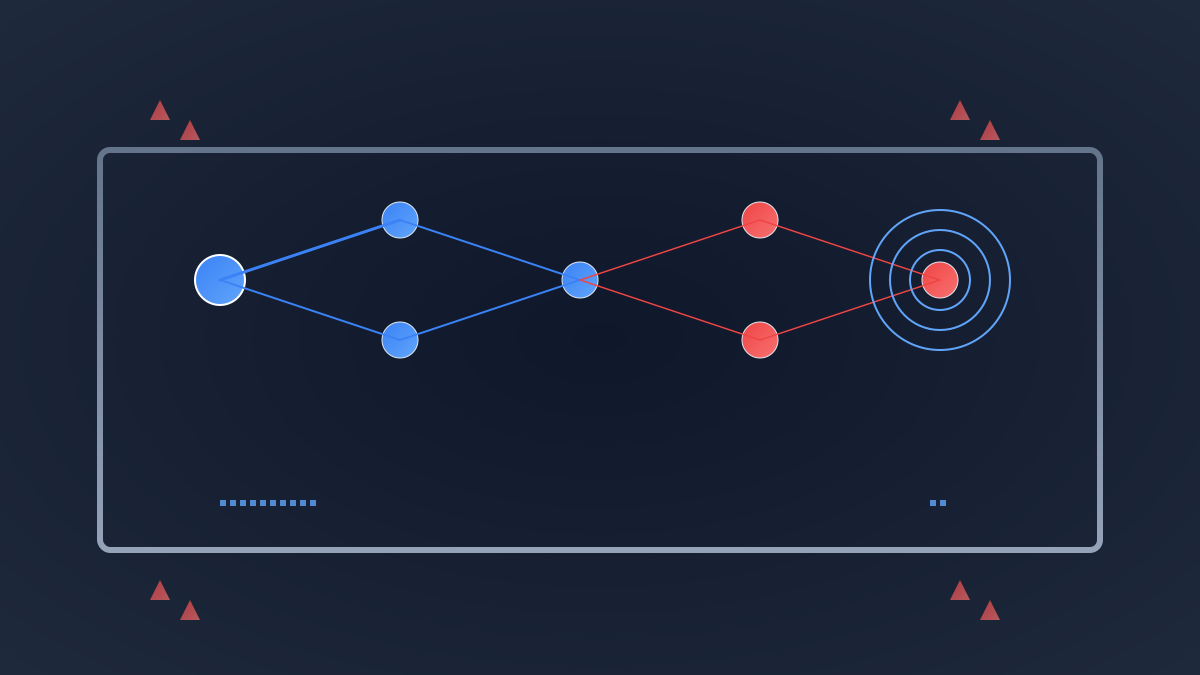
To explain the 'first solution is optimal' phenomenon, the study proposes the Forest of Errors (FoE) theory: Errors in reasoning paths grow synchronously with test time, and errors are interrelated and progressive, forming a forest-like structure. Early errors (tree roots) will have a chain effect on subsequent branches, leading to more error accumulation. This theory is supported by empirical analysis and mathematical modeling.

4

Section 04

Method: RED Framework — Refine the First Solution and Prune Subsequent Errors

Based on the FoE theory, the study designs the RED (Reasoning Error Detection) framework:

  1. Refining First: Identify and correct potential errors in the first solution to suppress the growth of the error forest from the source;
  2. Discarding Subs: Prune subsequent error solutions through double consistency checks to avoid invalid exploration and focus resources on valuable paths.
5

Section 05

Evidence: Experimental Results of RED Framework's Dual Improvement in Performance and Efficiency

The RED framework was validated on 5 benchmark tests and 6 models of different scales, compared with 8 baseline methods:

  1. Performance: Up to 19.0% improvement in reasoning accuracy;
  2. Efficiency: 37.7%-70.4% reduction in token consumption;
  3. FoE Metrics: Significantly reduced the size of the error forest, verifying the effectiveness of its design principles.
6

Section 06

Conclusion: Rethink the Test-Time Scaling Law and Pursue Intelligent Computing

The FoE study challenges the test-time scaling law that 'more test-time computing resources improve performance': When the error growth brought by expansion exceeds the benefits, more computing will instead have negative effects. It suggests that reasoning strategies need to be redesigned to pursue intelligent computing rather than simply increasing resources, especially applicable to resource-constrained scenarios.

7

Section 07

Future Directions and Practical Significance: Application Prospects of FoE and RED

Theoretical Contribution: FoE provides a new framework for reasoning failure analysis, and the 'first solution is optimal' phenomenon challenges existing reasoning paradigms; Future Directions: Refine the FoE mathematical model, explore error propagation laws across different tasks, and extend to tasks such as code generation; Practical Significance: RED reduces reasoning costs and response speed, suggesting that optimizing the first solution is more effective than generating more alternatives, which helps in the commercial deployment and large-scale application of large models.
