Zing Forum

Reading

Doc2Atom: A Compositional Parametric Memory Framework Revolutionizing Long-Document Reasoning

This paper proposes Doc2Atom, which decomposes documents into semantically typed knowledge atoms and compiles them into independent micro-LoRA adapters to enable query-specific dynamic composition. It outperforms the Doc-to-LoRA baseline on six QA benchmarks while reducing the memory cost of document internalization.

上下文蒸馏LoRA长文档处理知识原子参数化记忆文档问答组合式推理内存优化LLM效率
Published 2026-06-11 01:58Recent activity 2026-06-11 11:30Estimated read 10 min
Doc2Atom: A Compositional Parametric Memory Framework Revolutionizing Long-Document Reasoning
1

Section 01

Introduction: Core Breakthroughs of Doc2Atom in Revolutionizing Long-Document Reasoning

Original Authors and Source

  • Original Authors/Maintainers: Paper author team (standard arXiv authorship)
  • Source Platform: arXiv
  • Original Title: Doc-to-Atom: Learning to Compile and Compose Memory Atoms
  • Original Link: http://arxiv.org/abs/2606.12400v1
  • Publication Time: 2026-06-10

Core Insights

This paper proposes the Doc2Atom compositional parametric memory framework, which decomposes documents into semantically typed knowledge atoms and compiles them into independent micro-LoRA adapters to achieve query-specific dynamic composition. This framework outperforms the Doc-to-LoRA baseline on six QA benchmarks while significantly reducing the memory cost of document internalization, revolutionizing the way long-document reasoning is done.


2

Section 02

Background: Challenges in Long-Document Processing and Limitations of Existing Methods

Computational Dilemma of Long-Document Processing

Large Language Models (LLMs) face a quadratic complexity bottleneck in their attention mechanism when processing long documents; as input sequences grow, computational and memory costs increase sharply.

Rise of Context Distillation

To address this issue, the "context distillation" method compresses document information into model parameters, avoiding long-sequence processing during inference. The core is to pre-internalize documents into parameters, and only load compressed representations during inference.

Limitations of Doc-to-LoRA

Doc-to-LoRA generates a document-specific LoRA adapter via a single forward pass, but has three major issues:

  1. Irrelevant query interference: A single adapter mixes multi-topic information, leading to scattered answers or hallucinations;
  2. Limited compositional recall: Difficult to combine multiple parts of information to handle complex queries;
  3. Poor scalability for long documents: Information volume growth exceeds the capacity of a single adapter.
3

Section 03

Doc2Atom Framework: Knowledge Atomization and Dynamic Composition Design

Core Idea: Knowledge Atomization

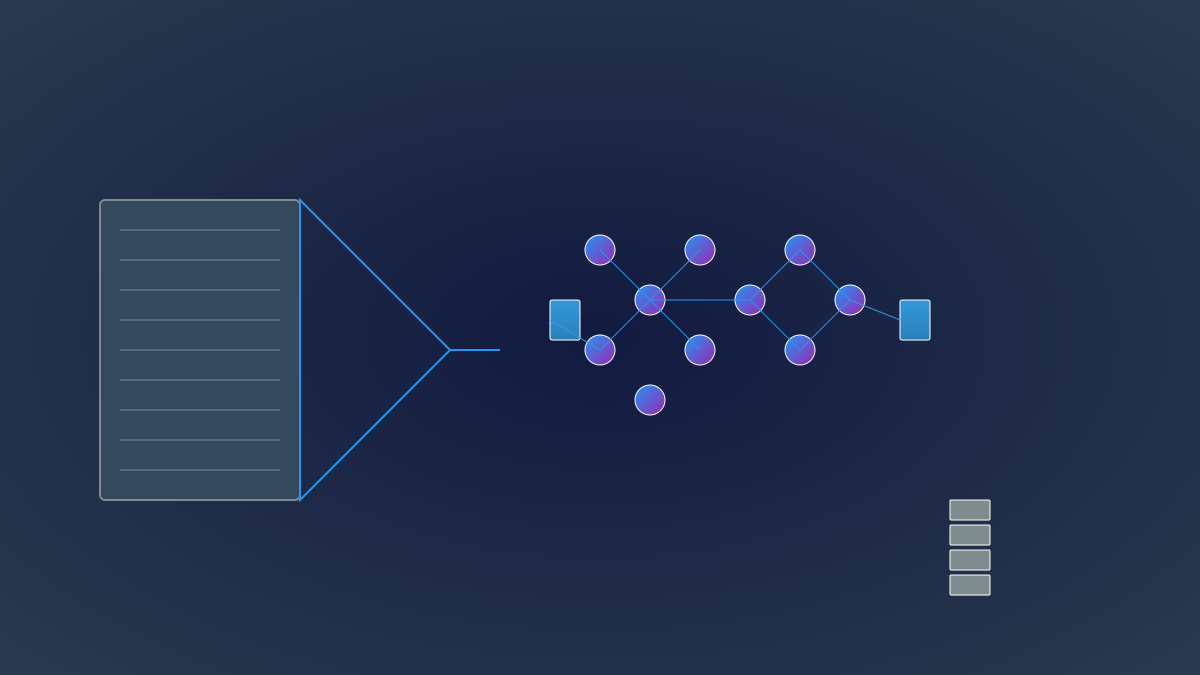
Doc2Atom decomposes documents into knowledge atoms—semantically typed sub-units, each containing coherent concepts and semantic labels, which can be independently compiled into parameters and dynamically combined.

System Architecture

  1. Document Decomposer: Segments documents into atoms based on semantics, annotates types, and optimizes boundaries;
  2. Atom Compiler: Compiles each atom into a lightweight micro-LoRA adapter, associated with a source retrieval key;
  3. Query Router: Analyzes queries, selects relevant atoms, and assembles a composite adapter to inject into the base model.

End-to-End Training

Trained via multi-objective distillation:

  • Atom quality: Ensure atoms accurately encode segment information;
  • Routing accuracy: Train the router to select relevant atoms;
  • Compositional ability: Handle multi-atom composition for complex queries;
  • Efficiency optimization: Minimize computational costs. Training data is automatically generated, including atom-question-answer pairs, complex queries, and negative samples.
4

Section 04

Experimental Validation: Performance and Efficiency Advantages of Doc2Atom

Benchmark Datasets

Validated on six QA benchmarks: Natural Questions, HotpotQA, MS MARCO, NarrativeQA, QASPER, DocRED.

Key Results

  1. Performance improvement: Outperforms Doc-to-LoRA on all benchmarks, with an average increase of over 10% (e.g., HotpotQA +12.7%, NarrativeQA +15.2%);
  2. Memory efficiency: Parameters for storing the same information are reduced by 40-60%, and only a few micro-LoRA adapters are loaded during inference, with more obvious advantages for long documents.

Ablation Studies

  • Atomization itself improves performance, proving decomposition reduces interference;
  • Dynamic routing further enhances performance;
  • Semantic type annotation contributes significantly (performance drops by 15% without annotation);
  • Micro-LoRA is more efficient than standard LoRA.
5

Section 05

In-depth Analysis: Sources of Doc2Atom's Effectiveness

Four Key Advantages

  1. Information isolation: Atoms physically isolate irrelevant information, eliminating interference;
  2. Compositional flexibility: Dynamic routing combines atoms on demand to handle simple/complex queries;
  3. Parameter efficiency: Micro-LoRA requires only hundreds of parameters, with total parameters far lower than a single adapter;
  4. Interpretability: Selected atoms can be viewed to understand the basis for the model's answers.
6

Section 06

Application Scenarios: Diverse Practical Domains of Doc2Atom

Core Application Scenarios

  1. Enterprise knowledge base QA: Dynamically combine atoms for products, technologies, customer cases, etc.;
  2. Legal document analysis: Adapt to structured atoms like contract clauses and precedents;
  3. Academic paper assistant: Combine atoms for abstracts, methods, experiments, etc., on demand;
  4. Multi-document reasoning: Unified indexing of cross-document atoms, supporting cross-document information combination.
7

Section 07

Limitations and Future Research Directions

Current Limitations

  1. Decomposition quality: Automatic decomposition may be imprecise;
  2. Type system: Predefined/learned type systems have limited coverage;
  3. Routing errors: The router may select wrong atoms;
  4. Training cost: End-to-end training requires large resources.

Future Directions

  1. Adaptive decomposition: Learn optimal decomposition strategies;
  2. Hierarchical atoms: Support hierarchical structures from chapters → paragraphs → sentences;
  3. Cross-document association: Identify semantic associations between atoms from different documents;
  4. Incremental updates: Support partial updates of documents;
  5. Multimodal extension: Cover multimodal documents like images and tables.
8

Section 08

Conclusion: Implications of Doc2Atom for Long-Document Reasoning

Doc2Atom represents an important advancement in the field of context distillation, solving the fundamental limitations of monolithic adapters through atomization and dynamic composition. Its "LEGO brick"-style information organization approach opens up new possibilities for long-document reasoning. As LLMs expand their applications in knowledge-intensive tasks, Doc2Atom will become a key infrastructure for efficiently utilizing massive document information.

