Zing Forum

Reading

CollabVR: A New Paradigm for Collaborative Reasoning Between Vision-Language Models and Video Generation Models

CollabVR addresses the drift and simulation errors of single models in long-range tasks by closed-loop coupling of Vision-Language Models (VLM) and Video Generation Models (VGM), enabling more reliable goal-oriented video reasoning.

视觉语言模型视频生成模型多模态推理协同智能目标导向任务视频理解AI 智能体
Published 2026-05-08 16:43Recent activity 2026-05-08 16:49Estimated read 5 min
CollabVR: A New Paradigm for Collaborative Reasoning Between Vision-Language Models and Video Generation Models
1

Section 01

CollabVR: Introduction to the New Paradigm of Collaborative Reasoning Between Vision-Language and Video Generation Models

CollabVR addresses the drift and simulation errors of single models in long-range tasks by closed-loop coupling of Vision-Language Models (VLM) and Video Generation Models (VGM), enabling more reliable goal-oriented video reasoning. Its core lies in building a closed-loop collaborative architecture between VLM and VGM, allowing each to leverage their strengths (VLM handles reasoning, decision-making, and verification; VGM handles visual simulation), and improving the reliability of complex task completion through a verification-feedback mechanism.


2

Section 02

Background: Limitations of Single Models in Goal-Oriented Video Tasks

In goal-oriented video tasks, single models suffer from capability mismatch: VLMs excel at logical reasoning but are weak in visual simulation, while VGMs can render short videos but lack reasoning ability. This leads to two failure modes: long-range drift (difficulty maintaining consistency in multi-step tasks) and mid-segment simulation errors (local errors propagate backward and worsen subsequent frames).

3

Section 03

Core Idea of CollabVR: Closed-Loop Collaborative Architecture Between VLM and VGM

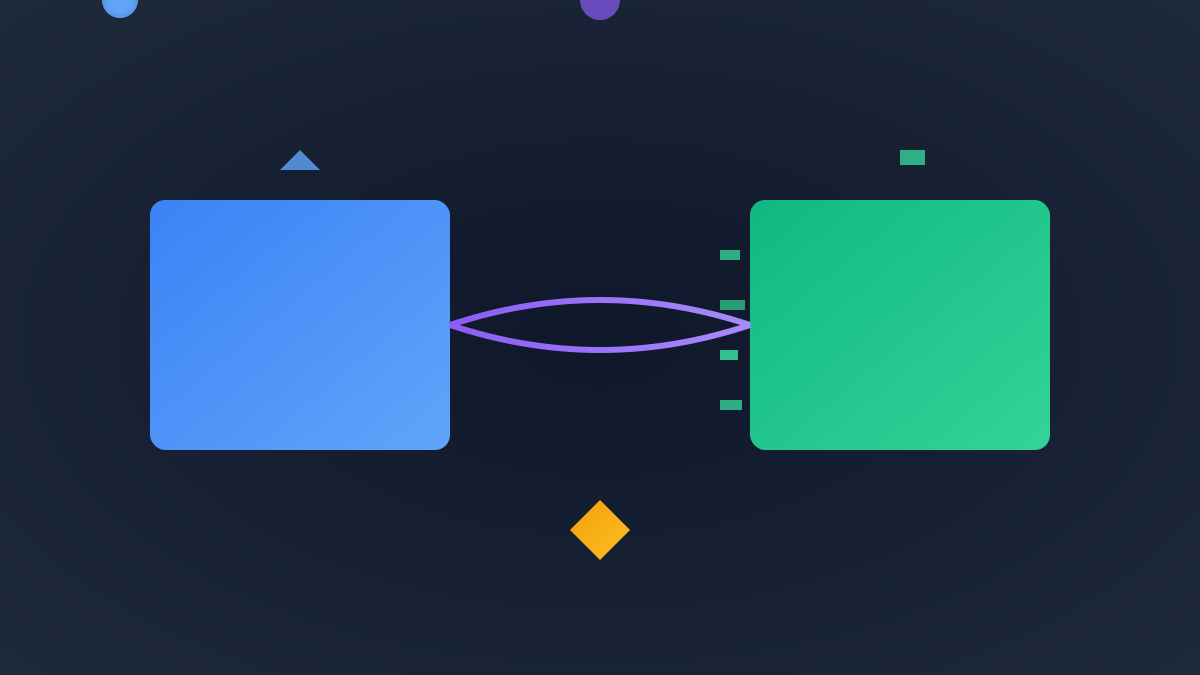
The innovation of CollabVR lies in its closed-loop collaborative architecture: VLM plans immediate actions, VGM renders the results, and VLM simultaneously verifies the quality of the generated segments. If verification fails, it dynamically selects a recovery strategy. It includes two core modules: M1 Progressive Planning Module (adaptive sub-step selection to address long-range drift) and M2 Verification Regeneration Module (updates prompts and resamples after diagnosing failures to handle mid-segment simulation errors).

4

Section 04

CollabVR Execution Flow: Verification-Driven Iterative Mechanism

Execution flow at each time step: 1. VLM generates actions; 2. VGM renders video segments; 3. VLM verifies the segments and diagnoses failure modes; 4. Routes to M1 or M2 based on results; 5. Iterates until the task is completed or the budget limit is reached. This flow avoids the traditional one-way execution mode and ensures a verification signal at each step.

5

Section 05

Technical Implementation and Evaluation: Support for Multiple VGM Backends and Benchmark Testing

The code implementation supports mainstream VGM backends such as Veo3.1 and VBVR-Wan2.2. The reasoning pipeline includes planner/verifier prompt templates and video reasoning optimizations. Evaluations will be conducted on benchmarks like Gen-ViRe and VBVR-Bench, covering task scenarios from simple to complex, to comprehensively assess reasoning ability and robustness.

6

Section 06

Research Significance and Future Outlook: A New Direction for Multimodal Collaboration

CollabVR represents a new direction for multimodal model collaboration, proving that models with different capabilities can collaborate complementarily rather than being stacked. Its 'expert collaboration' paradigm is more practical than all-in-one models. It provides a new solution idea for the video field and is expected to expand to scenarios such as robot operation and virtual environment interaction.

