Zing Forum

Reading

CGAP: A New Paradigm of Structured Reasoning System for Urban Planning Case Transfer

The CGAP system addresses the challenge of cross-context transfer of international urban planning experiences through three stages of explicit reasoning—scenario modeling, case retrieval, and difference analysis—breaking through the limitations of traditional RAG and Agent Workflow.

城市规划案例迁移结构化推理RAGAgent Workflow知识迁移
Published 2026-05-11 00:44Recent activity 2026-05-11 00:52Estimated read 14 min
CGAP: A New Paradigm of Structured Reasoning System for Urban Planning Case Transfer
1

Section 01

【Introduction】CGAP: A New Paradigm of Structured Reasoning for Urban Planning Case Transfer

CGAP (Case-based Geospatial Adaptation Planner) system addresses the challenge of cross-context transfer of international urban planning experiences through three stages of explicit reasoning—scenario modeling, case retrieval, and difference analysis—breaking through the limitations of traditional RAG and Agent Workflow, and providing a new structured reasoning paradigm for urban planning case transfer.

2

Section 02

Practical Dilemmas in Urban Planning Case Transfer

Urban planning is a highly context-dependent discipline. A planning scheme that succeeds in one city often faces 'acclimatization' issues when directly copied to another city. This incompatibility stems from the complexity of urban systems: each city has unique geographical conditions, historical contexts, population structures, economic levels, cultural habits, and governance systems.

Traditional case learning methods usually stay in the simple mode of 'finding similar cases - referencing and drawing lessons'. Planners need to manually analyze a large number of cases, identify transferable elements, and evaluate the feasibility of local adaptation. This process is time-consuming and labor-intensive, and heavily relies on personal experience, making it difficult to ensure systematicity and consistency.

In recent years, Retrieval-Augmented Generation (RAG) and Agent Workflow technologies have provided new tools for case retrieval and knowledge application. However, these methods often expose obvious limitations when dealing with complex tasks like urban planning that require high structure and deep reasoning: single retrieval can hardly capture the deep structure of cases, and simple Agent workflows lack explicit modeling of transfer logic.

3

Section 03

Core Architecture and Intermediate Representation Design of CGAP

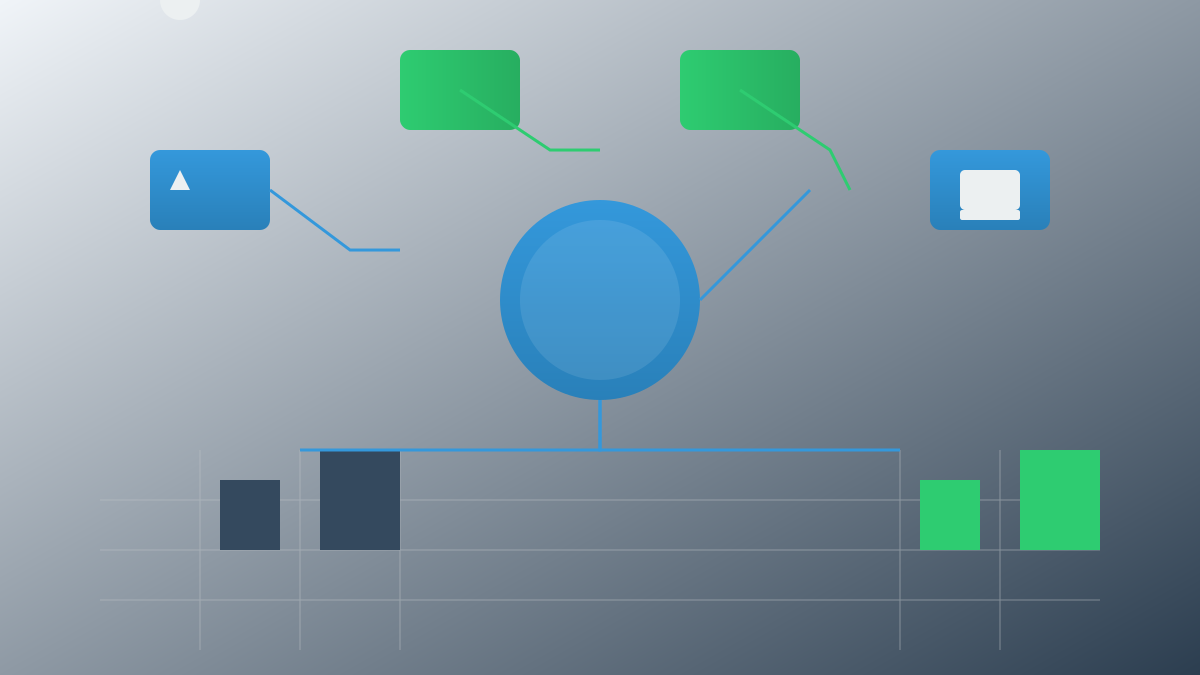
The design philosophy of the CGAP system is to decompose the case transfer process into three explicit reasoning stages, each with clear inputs, outputs, and verification standards.

The first stage is Scenario Modeling. The system first performs structured modeling of the target city's current situation, extracting key urban feature dimensions such as population density, transportation network, land use, economic industries, and ecological environment. The core task of this stage is to convert unstructured urban descriptions into intermediate representations that can be used for calculation and comparison.

The second stage is Case Retrieval. Based on the results of scenario modeling, the system retrieves potential reference cases from the case library. Unlike the simple similarity matching of traditional RAG, CGAP's retrieval considers multi-dimensional feature matching and introduces a transferability scoring mechanism, prioritizing cases that are similar to the target city in key dimensions and have achieved success in specific planning goals.

The third stage is Difference Analysis. This is the most distinctive part of CGAP. The system not only finds similar cases but also deeply analyzes the structural differences between the source case city and the target city, identifying which successful elements can be directly transferred, which need to be adjusted according to local conditions, and which are completely inapplicable. The results of difference analysis are output in a structured way, providing clear basis for planning decisions.

A key innovation of CGAP lies in its systematic use of Intermediate Representations. In traditional LLM applications, information usually flows at the natural language level, relying on the model's context understanding ability for implicit reasoning. This approach is prone to information loss and broken reasoning chains when dealing with complex tasks.

CGAP defines structured intermediate representation formats for each reasoning stage. The scenario modeling stage outputs standardized urban feature vectors; the case retrieval stage outputs a list of cases with metadata; the difference analysis stage outputs structured transfer suggestions. These intermediate representations not only improve the accuracy of information transmission but also allow each stage of the system to be independently verified and optimized.

More importantly, the intermediate representation mechanism enables CGAP to integrate multiple information sources and reasoning tools. For example, scenario modeling can combine Geographic Information System (GIS) data, statistical data, and text descriptions; case retrieval can integrate vector databases and rule engines; difference analysis can call specialized comparison algorithms and domain knowledge bases. This modular architecture greatly improves the system's flexibility and scalability.

4

Section 04

Comparative Advantages of CGAP Over Traditional Methods

Compared to traditional RAG methods, CGAP's explicit reasoning process provides stronger interpretability. Users can clearly see how the system starts from the target city description, finds relevant cases, and derives transfer suggestions. This transparency is particularly important for high-risk decision-making scenarios like urban planning.

Compared to simple Agent Workflow, CGAP's structured design provides better context stability. Through the explicit transfer of intermediate representations, the system avoids the context drift problem common in long dialogue histories. The output of each stage is structurally verified to ensure the quality of information entering the next stage.

In addition, CGAP's modular architecture makes it easy to integrate domain knowledge. Urban planning involves a large number of professional rules, standards, and best practices. These can be embedded into each reasoning stage in a structured way, without relying on LLM to implicitly learn from training data.

5

Section 05

Application Scenarios and Practical Value of CGAP

The design concept of CGAP originates from urban planning, but its methodology has broader applicability. Any decision-making scenario involving case transfer, experience reference, or context adaptation may benefit from this structured reasoning method.

In practical applications, CGAP can help planners quickly understand relevant cases worldwide and systematically evaluate the applicability of different schemes under local conditions. For planning management departments, the structured analysis results provided by CGAP can serve as decision support materials, improving the scientificity and transparency of planning reviews.

For academic research, CGAP's case library and reasoning framework provide new tools for comparative urban studies. Researchers can systematically analyze the similarities and differences between different cities on specific planning issues and identify key factors affecting planning success.

6

Section 06

Technical Implementation and Future Development Directions

From a technical perspective, the implementation of CGAP integrates multiple AI technologies: natural language processing for text information extraction, knowledge graphs for case relationship modeling, retrieval systems for similar case discovery, and large language models for reasoning and generation. This integration of multiple technology stacks reflects an important trend in current AI application development: a single technology is difficult to solve complex problems, and systematic architecture design is crucial.

The open-source release of the project provides a foundation for community contributions and continuous improvement. Knowledge accumulation in the urban planning field is a long-term process, and the quality and coverage of the case library directly affect the system's practicality. An open platform can attract planners and researchers worldwide to participate in knowledge building.

Future development directions may include: expanding the geographical coverage and thematic depth of the case library; optimizing the expressive ability of intermediate representations to support finer-grained feature descriptions; introducing more multi-modal data such as satellite images, street view photos, and 3D urban models; and developing interactive interfaces to support collaborative analysis between planners and the system.

7

Section 07

Conclusion: The Value of Combining AI with Domain Knowledge

The CGAP project demonstrates how to deeply combine advanced AI technology with domain expertise to solve complex problems in practical applications. It reminds us that the value of technical tools lies not only in their own advancement but also in how to adapt and optimize them according to the characteristics of specific problems. In important fields like urban planning that are related to people's well-being, this rigorous, systematic, and interpretable methodology is particularly important.


