Zing Forum

Reading

AVIA: An Intelligent Predictive Maintenance and Diagnosis Framework for Industrial and Autonomous Driving Systems

AVIA combines deep learning with agent workflow to provide interpretable predictive maintenance solutions for industrial equipment and autonomous driving systems, bridging the gap between high-performance black-box models and engineering decision-making.

预测性维护智能体工作流深度学习自动驾驶工业AI异常检测故障诊断可解释AI
Published 2026-05-01 16:43Recent activity 2026-05-01 17:20Estimated read 6 min
AVIA: An Intelligent Predictive Maintenance and Diagnosis Framework for Industrial and Autonomous Driving Systems
1

Section 01

Introduction to the AVIA Framework: Bridging the Gap Between Black-Box Models and Engineering Decision-Making

AVIA (Autonomous Vehicle Intelligence Agent) is an intelligent predictive maintenance and diagnosis framework for industrial equipment and autonomous driving systems. Its core lies in combining deep learning with agent workflow to resolve the contradiction between high-performance black-box models and interpretable engineering decisions in traditional predictive maintenance, providing actionable maintenance recommendations and facilitating the shift from reactive repair to proactive prevention.


2

Section 02

Background: Core Challenges in Predictive Maintenance

In modern industry and autonomous driving, equipment failures can lead to catastrophic consequences. Traditional predictive maintenance systems face a dilemma: either use high-performance but hard-to-interpret black-box deep learning models, or rely on interpretable but low-performance traditional statistical methods. Engineering teams not only need prediction results but also need to understand the root causes of failures and corresponding countermeasures. This dual demand for interpretability and operability has driven the development of a new generation of intelligent diagnosis frameworks.

3

Section 03

AVIA Technical Architecture: Fusion Design of Deep Learning and Agents

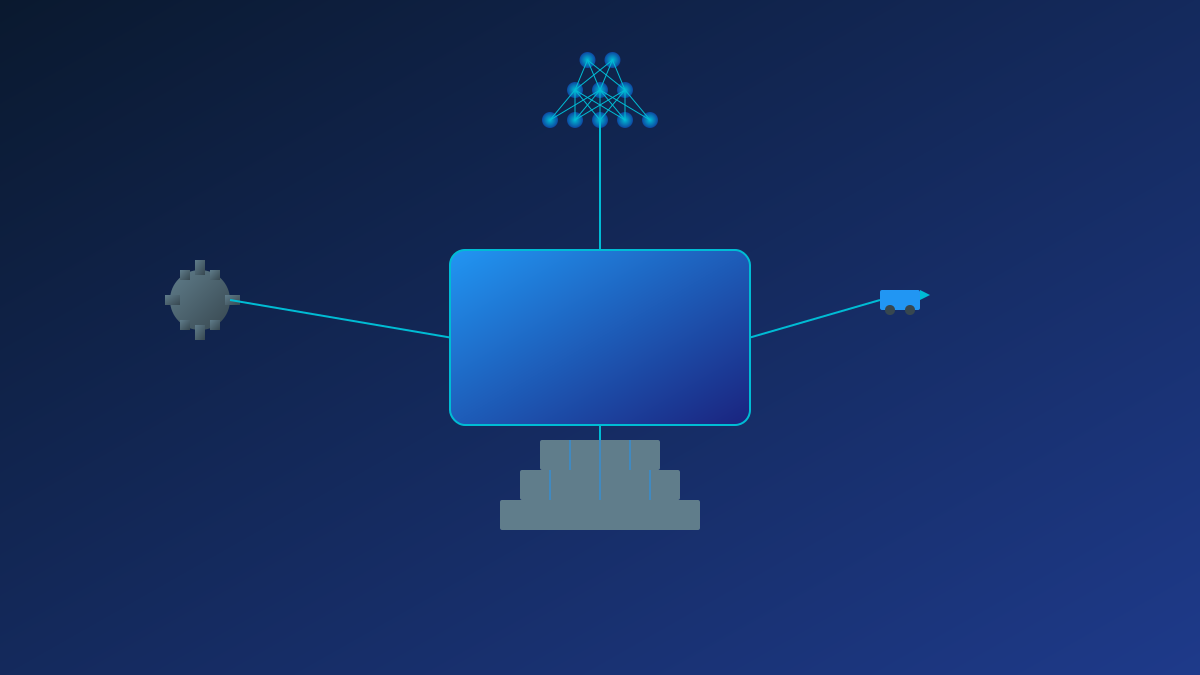
AVIA adopts a hybrid architecture consisting of three parts: multi-modal data fusion, deep anomaly detection layer, and agent reasoning layer:

  1. Multi-modal data fusion: Processes sensor time-series data (vibration, temperature, etc.), log event data, visual detection data, and environmental context;
  2. Deep anomaly detection layer: Uses Variational Autoencoder (VAE) to learn normal patterns, Temporal Convolutional Network (TCN) to capture temporal dependencies, and attention mechanism to locate key windows and channels of anomalies;
  3. Agent reasoning layer: Implements four core functions: root cause analysis, impact assessment, maintenance decision-making, and knowledge accumulation.
4

Section 04

AVIA Application Scenarios: Implementation in Autonomous Driving and Industrial Equipment

Autonomous driving fleet management: Real-time health monitoring, predictive scheduling, safety risk assessment, component lifespan prediction; Industrial equipment maintenance: Reducing unplanned downtime, optimizing maintenance costs, extending asset lifespan, knowledge transfer (encoding senior engineers' experience into diagnostic rules).

5

Section 05

Four Technical Advantages of Agent Workflow

AVIA chooses an agent architecture instead of an end-to-end black-box model, which has four advantages:

  • Interpretability: Diagnostic conclusions can be traced back to reasoning steps and evidence chains, meeting audit and certification requirements;
  • Intervenability: Engineers can intervene at key nodes, inject domain knowledge or correct judgments;
  • Scalability: New failure types can be introduced by adding agent roles or rules without retraining the entire model;
  • Robustness: When a subsystem fails, the agent network can complete tasks through alternative paths.
6

Section 06

Open Source Ecosystem and Future Development Directions

Open source ecosystem: Modular design (separation of core and industry implementations), plugin system (supports data source/model/visualization access), case library (community-shared failure modes), simulation environment (digital twin offline testing); Future outlook: Federated learning (cross-organization privacy-preserving knowledge sharing), edge deployment (on-vehicle/on-site real-time reasoning), digital twin integration (accurate remaining lifespan prediction), autonomous maintenance (automatic resource scheduling and robot execution).

7

Section 07

Conclusion: Insights from AVIA for Industrial AI Transformation

AVIA demonstrates the potential of agent workflow in industrial AI. Its innovations lie in the cross-fusion of deep learning pattern recognition capabilities and engineering domain knowledge, as well as the combination of data-driven methods and human decision-making wisdom. For industrial and transportation enterprises exploring AI transformation, AVIA provides a valuable technical blueprint.

