Zing Forum

Reading

AI-Powered ETL Pipeline: Intelligent Data Engineering Practice Based on Large Language Models

An open-source project integrating large language models and data engineering, which uses the Groq API for intelligent schema inference, combines PostgreSQL and Streamlit to build a modern ETL process, and demonstrates the innovative application of LLMs in the traditional data engineering field.

ETL数据工程大语言模型GroqPostgreSQLStreamlit模式推断数据管道
Published 2026-05-04 03:37Recent activity 2026-05-04 03:51Estimated read 5 min
AI-Powered ETL Pipeline: Intelligent Data Engineering Practice Based on Large Language Models
1

Section 01

Introduction to the AI-Powered ETL Pipeline Project

This open-source project integrates large language models (via Groq API), PostgreSQL, and Streamlit to build an intelligent ETL process. It addresses pain points of traditional ETL such as tedious schema inference, complex transformation logic, and insufficient documentation and observability, demonstrating the innovative application of LLMs in the data engineering field.


2

Section 02

Pain Points of Traditional ETL and AI Opportunities

Traditional ETL faces three major pain points: tedious schema inference (manual structure analysis is error-prone), complex transformation logic (hard-coded rules are difficult to maintain), and insufficient documentation and observability (black-box operation). The emergence of large language models provides a new solution to these problems, and this project is a practice of this idea.

3

Section 03

Overview of the Project's Three-Tier Architecture

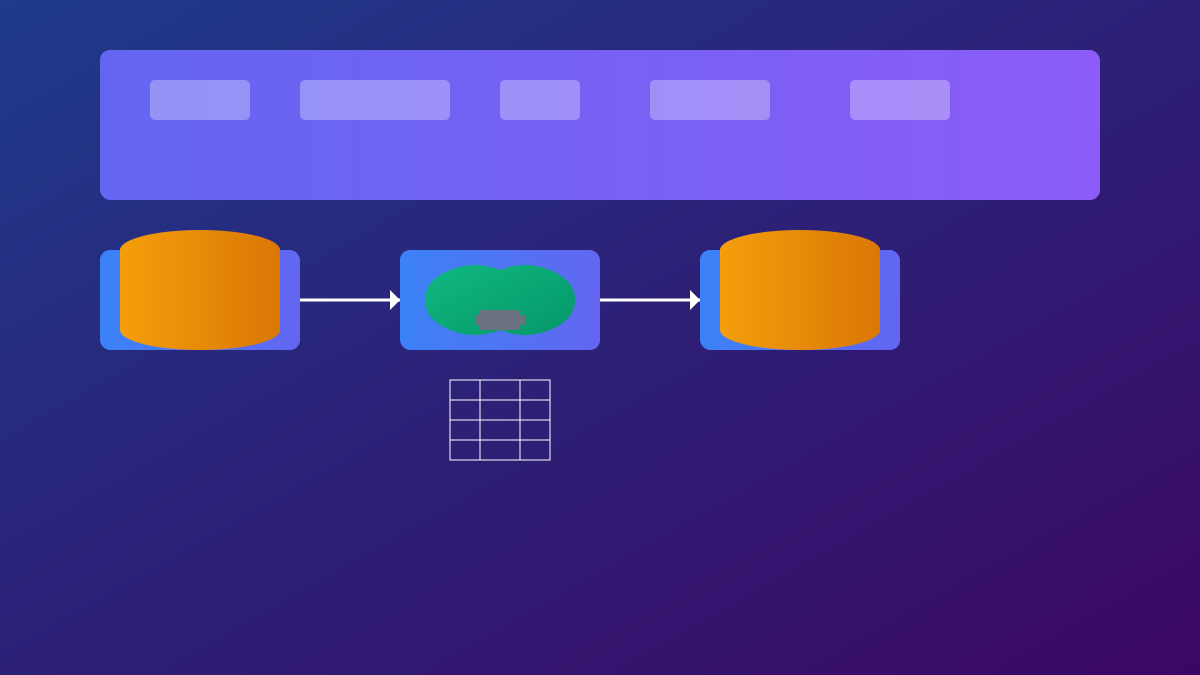
The project builds a modern three-tier ETL architecture: The extraction layer supports multiple data sources such as CSV/JSON/Excel and is designed with pluggable connectors; The intelligent transformation layer is the core innovation, integrating the Groq API to realize automatic schema inference and transformation suggestions; The loading and visualization layer stores data into PostgreSQL and provides monitoring and exploration capabilities through Streamlit.

4

Section 04

Implementation of Groq and LLM Schema Inference

Groq was chosen because its sub-millisecond inference speed adapts to the frequent call scenarios of ETL. The LLM schema inference process: sample data → format few-shot prompts → Groq API returns schema definitions including field descriptions, data types, and metadata. It can handle complex situations such as mixed date formats and reduce manual intervention.

5

Section 05

Roles of PostgreSQL and Streamlit

PostgreSQL serves as a data hub, with rich data types, an extended ecosystem (PostGIS/pg_trgm, etc.), ACID guarantees, and incremental loading mechanisms; The Streamlit dashboard provides ETL operation monitoring, data quality indicator display, interactive data exploration, and LLM inference log recording functions.

6

Section 06

Practical Application Scenarios of the Project

The project demonstrates value in multiple scenarios: rapid data integration (shortening the integration time of heterogeneous data sources to hours), data lake modernization (automatically inferring schemas to generate data catalogs), prototype verification (helping data scientists analyze quickly), and continuous data quality monitoring (intelligent anomaly detection).

7

Section 07

Limitations and Future Directions

Limitations: LLM schema inference may have errors and require expert review; the cost of calls for large-scale datasets needs to be controlled. Future directions: support more LLM providers, incremental schema evolution, data lineage tracking, and vector database integration.

8

Section 08

Project Significance and Outlook

This project represents a trend in data engineering: embedding LLM intelligence into traditional processes, proving that LLMs can improve data processing efficiency at the infrastructure layer. It provides a practical reference for data engineers, and with the advancement of LLM technology, AI-driven data tools are expected to become industry standards.