Zing Forum

Reading

acpus: A Dynamic Workflow Orchestrator for Agents

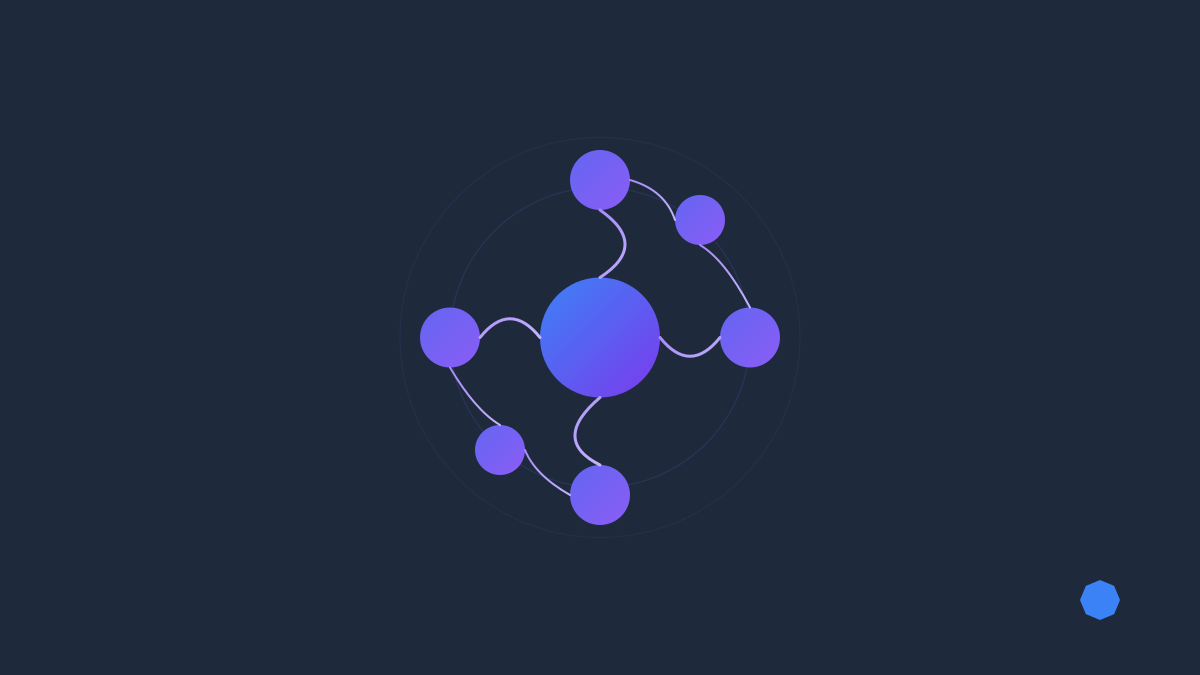
acpus is a dynamic workflow orchestration tool designed for AI agents, supporting flexible task scheduling and multi-agent collaboration.

AI Agentworkflow orchestrationmulti-agentdynamic workflowLLMGitHub
Published 2026-06-13 19:17Recent activity 2026-06-13 19:20Estimated read 6 min
acpus: A Dynamic Workflow Orchestrator for Agents
1

Section 01

acpus: A Dynamic Workflow Orchestrator for Agents (Main Floor Guide)

Project Basic Information

  • Original Author/Maintainer: kelvinschen
  • Source Platform: GitHub
  • Original Title: acpus
  • Original Link: https://github.com/kelvinschen/acpus
  • Source Publication/Update Time: 2026-06-13T11:17:30Z

Core Points

acpus is a dynamic workflow orchestration tool specifically designed for AI agents, aiming to solve flexibility and scalability issues in multi-agent collaboration. It supports dynamic task scheduling, native multi-agent collaboration, and a modular extensible architecture.


2

Section 02

Project Background: Challenges in Agent Collaboration and the Birth of acpus

With the improvement of Large Language Model (LLM) capabilities, AI agents have become the core of automated tasks. However, single agents have limited capabilities, making multi-agent collaborative orchestration a key challenge for developers. Traditional workflow tools are rigid and struggle to adapt to the dynamic nature of agent tasks, leading to the birth of the acpus project.

3

Section 03

Core Features and Design Philosophy: Dynamic Orchestration and Multi-Agent Support

Dynamic Task Scheduling

Supports dynamically adjusting execution paths at runtime based on the output of preceding tasks, adapting to the uncertainty and iterative nature of LLM tasks.

Multi-Agent Collaboration Support

Native mechanisms allow multiple agents to work collaboratively, focusing on specific subtasks, with the orchestrator distributing tasks and aggregating results.

Extensible Architecture

Modular design facilitates integration of custom agent types and task processors, adapting to scenarios from simple scripts to enterprise-level workflows.

4

Section 04

Application Scenarios and Practical Value: Intelligent Workflows Covering Multiple Domains

  • Automated Research Workflow: Coordinate agents for information retrieval, data analysis, report generation, etc., to complete academic/market analysis.
  • Complex Business Processing: Orchestrate professional agents to handle multi-step decision-making processes such as customer service and content moderation.
  • Intelligent Development Assistant: Coordinate agents for code generation, testing, documentation writing, etc., to form a development assistance workflow.
5

Section 05

Key Technical Implementation Points: State Management, Error Handling, and Performance Optimization

  • State Management: Maintain complex runtime states such as task progress, intermediate results, and branch decision points to ensure reliable orchestration.
  • Error Handling: Provide recovery mechanisms such as retries, rollbacks, and alternative paths to handle failures in multi-agent collaboration links.
  • Performance Optimization: Support parallel execution and asynchronous processing to improve the overall efficiency of multi-agent calls.
6

Section 06

Comparison with Existing Solutions: Differentiated Advantages Focused on Agent Scenarios

  • Compared to traditional workflow tools (Airflow/Prefect): More focused on agent scenarios, embracing the uncertainty of LLM tasks, and providing more flexible dynamic orchestration capabilities.
  • Compared to emerging agent frameworks: Positioned to focus more on orchestration and coordination between agents rather than the agents themselves, making it more efficient in handling complex multi-agent scenarios.
7

Section 07

Summary and Outlook: Future Direction of Agent Orchestration Tools

acpus represents an important development direction for agent workflow orchestration tools and is a solution worth exploring for developers building multi-agent systems. Future attention should be paid to its performance in production environments, the depth of integration with mainstream LLM platforms, and the construction of community ecology.

