Zing Forum

Reading

YOR Construction Schema Markup: Structured Data Practice for Local SEO

A case study of Schema.org structured data implementation by a construction company, demonstrating how to organize information, multi-location services, and license data via JSON-LD markup to enhance local search visibility and AI understandability.

Schema.orgJSON-LD本地SEO结构化数据建筑行业数字化多地点标记GitHub Actions搜索引擎优化
Published 2026-04-07 11:17Recent activity 2026-04-07 15:45Estimated read 6 min
YOR Construction Schema Markup: Structured Data Practice for Local SEO
1

Section 01

YOR Construction Schema Markup: Core Overview

YOR Construction Schema Markup: Core Overview

This open-source project by YOR Construction & Investments, Inc. demonstrates how to use Schema.org structured data (via JSON-LD) to enhance local SEO visibility and AI understandability. Key components include organization identity, multi-location service network, and service catalog markup. It serves as a reusable template for local service businesses to improve their search presence.


2

Section 02

Project Background

Project Background

Local service businesses (like construction companies) struggle to stand out in searches for terms like 'nearby plumber' or 'Los Angeles kitchen renovation'. This project addresses this by providing a systematic Schema.org implementation. Hosted on GitHub, it includes full JSON-LD markup and automation workflows, offering a ready-to-use solution for similar enterprises.

3

Section 03

Implementation Architecture & Technical Details

Implementation Architecture & Technical Details

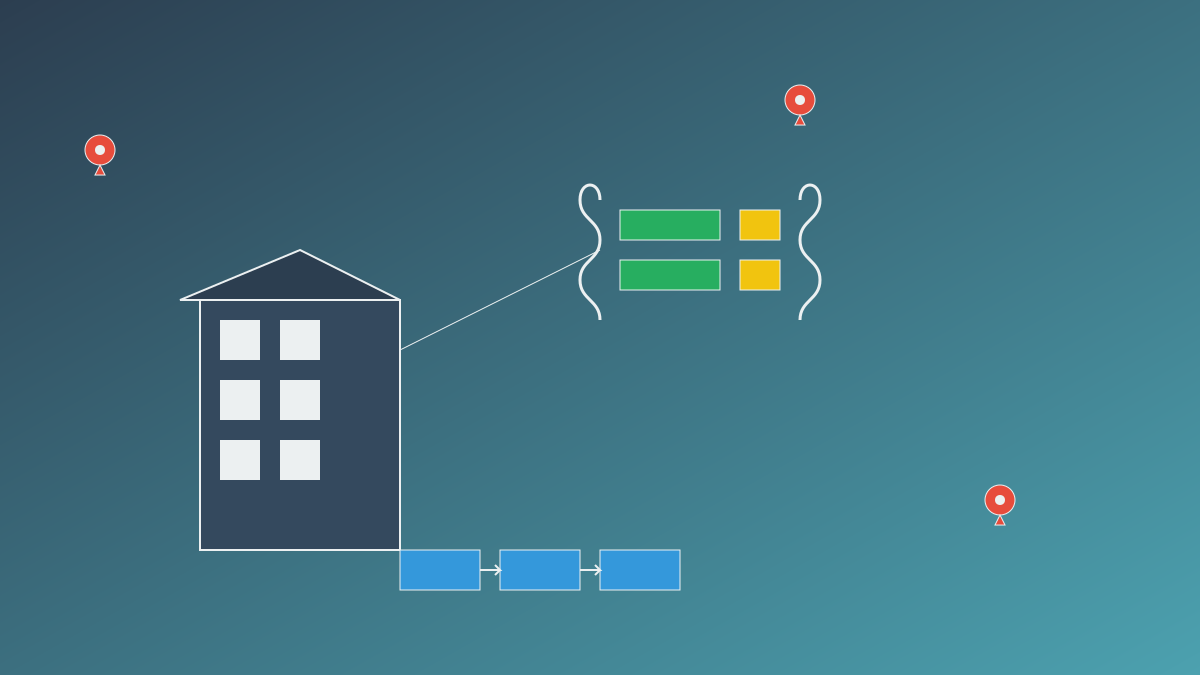
Organization Layer

Core Organization markup includes legal name, CSLB license (#978430), contact info, and website—establishing authoritative identity.

Multi-Location Network

Three LA service points (Valley Village, Van Nuys, Tarzana) have separate LocalBusiness tags with coordinates, service area polygons, hours, and location-specific details.

Service Catalog

Hierarchical Service tags cover residential (kitchen/bath/renovation), commercial, emergency repair, and permit assistance—with descriptions, price ranges, and project duration.

Technical Highlights

  • Schema validation via official tools
  • GitHub Actions CI/CD (auto-validate, check fields, update sitemap)
  • LLM-friendly design (standard types, clear fields, minimal nesting)
4

Section 04

Impact on Local SEO

Impact on Local SEO

After implementation, businesses see improvements:

  1. Rich Results: Higher CTR (20-30% vs standard results) with extended info (ratings, hours, services).
  2. Local Pack: Better chances to appear in Google’s Local Pack (critical for local searches).
  3. Voice Search: Supports precise answers for voice queries (e.g., 'Valley Village plumber').
5

Section 05

Reusable Methodology

Reusable Methodology

The project offers a transferable approach:

  1. Core to Extension: Start with Organization markup, then add locations/services.
  2. Data-Driven: Treat structured data as version-controlled assets.
  3. Validation First: Use tools to verify markup before deployment.
  4. Automation: CI/CD ensures data syncs with business changes. This model applies to restaurants, clinics, law firms, and other local services.
6

Section 06

Limitations & Compliance Notes

Limitations & Compliance Notes

  • Content Quality: Markup complements (not replaces) high-quality content.
  • NAP Consistency: Name/Address/Phone must be uniform across platforms.
  • Maintenance: Update data when business info changes.
  • Compliance: Markup must match visible page content (avoid 'markup cheating').
7

Section 07

Conclusion

Conclusion

YOR Construction’s project shows traditional local businesses can use structured data as digital infrastructure to boost visibility. For tech practitioners, it’s a forkable template; for business owners, it proves small enterprises can compete digitally. Structured data is no longer optional—it’s essential for AI and search readiness.

