Zing Forum

Reading

WeatherForecast: An End-to-End Weather Data Prediction System — A Full-Process Practice from Data Collection to ML Prediction

Explore a complete weather data prediction project covering the full implementation process of data collection, storage, and machine learning prediction, demonstrating how to build a practical meteorological prediction system using a modern tech stack.

天气预测机器学习数据管道时间序列数据工程
Published 2026-05-28 13:15Recent activity 2026-05-28 13:20Estimated read 5 min
WeatherForecast: An End-to-End Weather Data Prediction System — A Full-Process Practice from Data Collection to ML Prediction
1

Section 01

[Introduction] Full-Process Practice of the WeatherForecast End-to-End Weather Prediction System

WeatherForecast is an end-to-end weather data prediction system covering data collection, storage, and machine learning prediction. It demonstrates how to build a practical meteorological prediction system using a modern tech stack and serves as an excellent case study for learning the integration of data engineering and machine learning.


2

Section 02

Project Background and Learning Value

Weather prediction is crucial for multiple industries such as agriculture, transportation, and energy. Traditional forecasting relies on physical models and supercomputers, while this project uses machine learning to build a lightweight and practical system. The project covers the complete lifecycle of data science, allowing learners to acquire core skills in data engineering (crawlers, databases, ETL), machine learning (feature engineering, model tuning), and software engineering (modular design, log processing).

3

Section 03

System Architecture and Core Methods

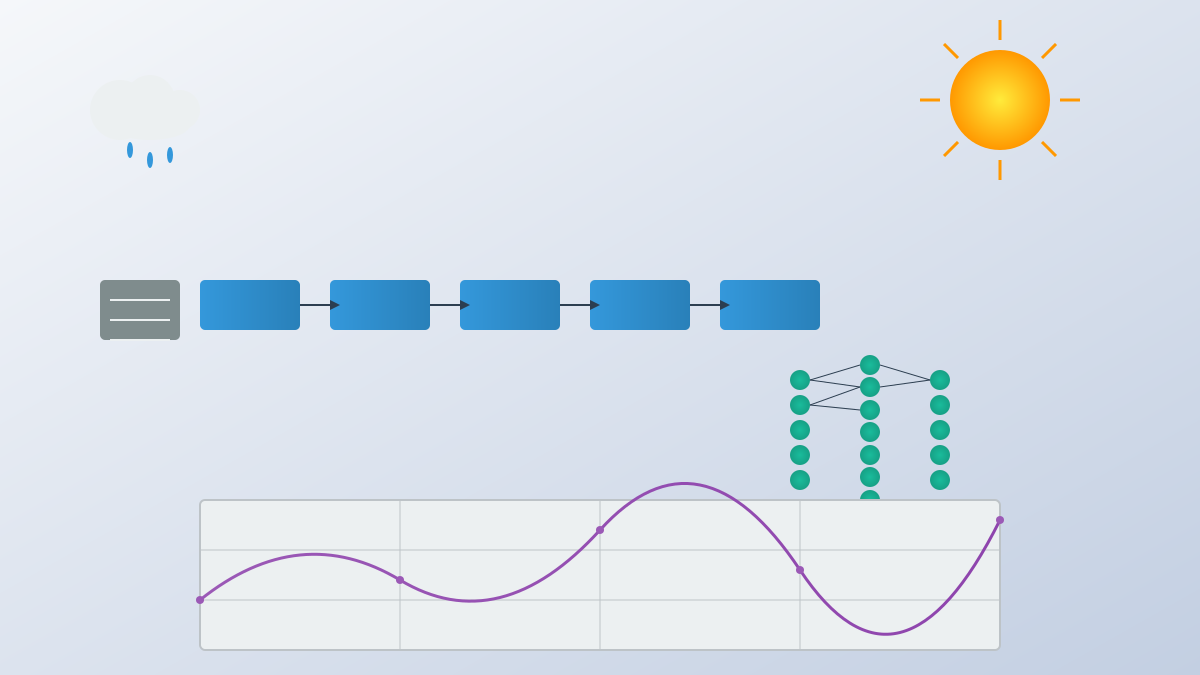
Adopting a data pipeline architecture, it consists of three layers:

  1. Data Collection Layer: Crawl public meteorological data (temperature, humidity, etc.) via crawlers; scheduled tasks + exception handling + data validation ensure data quality.
  2. Data Storage Layer: Use time-series databases (e.g., InfluxDB) for storage; split into raw, cleaned, and feature tables with version management support.
  3. Machine Learning Prediction Layer: Feature engineering (time/lag/statistical/combined features), model selection (ARIMA, XGBoost, LSTM, etc.), training process includes data splitting, tuning, cross-validation, and outputs short-term/medium-term/probabilistic predictions.
4

Section 04

Tech Stack Analysis

Speculated tech stack selection:

  • Programming Language: Python (Pandas, Scikit-learn, TensorFlow, etc.)
  • Data Collection: Scrapy/BeautifulSoup, Requests, APScheduler
  • Storage: PostgreSQL+TimescaleDB, SQLite, Parquet
  • MLOps: MLflow, FastAPI, Docker.
5

Section 05

Practical Application Scenarios

Applicable scenarios:

  1. Individual users: Reference for daily travel.
  2. Agriculture: Arrange farming activities and optimize water resource utilization.
  3. Energy: Estimate electricity load and optimize power generation plans.
  4. Logistics: Adjust routes to avoid delays due to severe weather.
6

Section 06

Challenges and Improvement Directions

Current challenges: Data quality (missing/anomalous values), model limitations (weak prediction of extreme weather), real-time requirements, insufficient interpretability. Improvement directions: Multi-source data fusion (satellite/radar), spatial prediction (regional grids), multi-task prediction (multi-variable), uncertainty quantification (probability distribution).

7

Section 07

Project Summary

WeatherForecast demonstrates the end-to-end process of modern data science solving practical problems. Although it cannot compare to professional meteorological systems, it provides a platform that can be learned, modified, and extended, which is of great significance for data science learners to improve their practical skills.

