Zing Forum

Reading

WaferAI: An Intelligent Wafer Defect Analysis System Combining Computer Vision and Large Language Models

An end-to-end semiconductor wafer defect detection and process optimization system integrating EfficientNet deep learning and the Claude large language model, providing a complete AI engineering solution from defect identification to root cause analysis and improvement recommendations.

半导体制造晶圆缺陷检测计算机视觉大语言模型EfficientNet工艺优化迁移学习工业AI
Published 2026-05-15 06:23Recent activity 2026-05-15 06:31Estimated read 8 min
WaferAI: An Intelligent Wafer Defect Analysis System Combining Computer Vision and Large Language Models
1

Section 01

WaferAI: Introduction to the Intelligent Wafer Defect Analysis System Combining Computer Vision and Large Language Models

WaferAI is an end-to-end intelligent semiconductor wafer defect analysis system that integrates computer vision (EfficientNet deep learning model) and large language models (Anthropic Claude). It provides a complete AI engineering solution from defect identification to root cause analysis and process improvement recommendations, aiming to address the pain points of low efficiency in defect detection and heavy reliance on expert experience in semiconductor manufacturing, thereby improving wafer yield and production efficiency.


2

Section 02

Background: Precision Challenges in Semiconductor Manufacturing and Limitations of Traditional Detection

Background: Precision Challenges in Semiconductor Manufacturing

Semiconductor manufacturing is one of the industries with the highest precision requirements globally. A single 300mm silicon wafer can produce hundreds of high-value chips, and the defect rate directly affects yield—each 1% drop in yield means millions of euros in losses for large fabs.

Limitations of Traditional Detection

Traditional defect detection can only identify defect types but cannot explain root causes or provide improvement suggestions. Root cause analysis relies on scarce and expensive senior experts; manual inspection is slow and lacks consistency, and junior engineers need several years of experience to provide effective recommendations.

3

Section 03

WaferAI Solution Architecture: A Four-Layer End-to-End Intelligent System

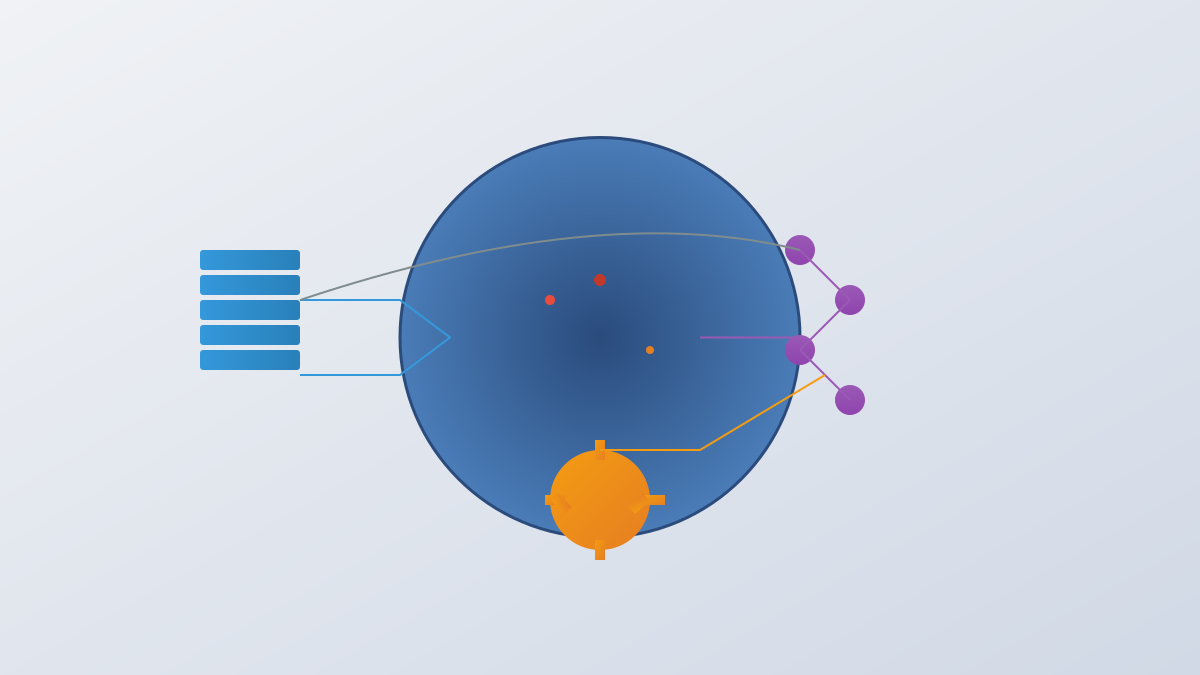
WaferAI has built a four-layer end-to-end intelligent decision support system:

  1. Image Preprocessing Layer: Uses OpenCV to standardize wafer images (size 96×96, normalization, RGB conversion) and extract metadata such as defect density and location;
  2. Defect Classification Layer: Based on the EfficientNetB0 transfer learning model, trained on the public WM-811K dataset (810,000+ wafer images), capable of identifying 9 types of defect patterns;
  3. AI Analysis Engine: Calls the Claude API to perform root cause analysis, action recommendations, process improvement, quality assessment, and yield loss estimation;
  4. Output Layer: Structured results (Pydantic), visualization (Matplotlib/Plotly), PDF reports (ReportLab), and interactive Q&A.
4

Section 04

Technical Implementation Details: Model Performance and Engineering Configuration

Model Performance

  • Deep learning framework: TensorFlow 2.x/Keras, with pre-trained EfficientNetB0 backbone;
  • Test accuracy of 96.4% (outperforming baseline CNN's 88.2% and ResNet50's 94.7%), F1 score of 0.92, and inference time of only 22 milliseconds;
  • Training configuration: 170,000+ labeled images, split into 70%/15%/15% for training/validation/test sets, weighted loss to handle class imbalance, and training on Google Colab T4 GPU for approximately 2 hours.

LLM Integration

Structured prompt engineering guides Claude to generate professional analysis. The complementarity between CV (pattern recognition) and LLM (knowledge reasoning) represents a new paradigm for industrial AI.

5

Section 05

Interpretability and Engineering Practice: Enhancing Trust and Usability

Interpretability

Integrates Grad-CAM visualization technology to generate heatmaps showing the model's focus areas, enhancing the interpretability of the black-box model and helping engineers understand the basis for decisions.

Engineering Support

  • Gradio interactive web interface for easy operation;
  • Docker containerization to ensure environment consistency;
  • Hugging Face Spaces for free cloud deployment;
  • PDF report generation to support professional documentation.
6

Section 06

Industry Value: Efficiency Improvement, Knowledge Transfer, and Yield Optimization

The industry value of WaferAI is reflected in three dimensions:

  1. Efficiency Improvement: Compresses hours of expert analysis into seconds, allowing junior engineers to receive expert-level guidance;
  2. Knowledge Transfer: Encapsulates expert experience via LLM to alleviate the talent gap in the semiconductor industry;
  3. Yield Optimization: Fast and accurate root cause analysis shortens process debugging cycles, directly translating into economic benefits.

Its application simulates the intelligent decision-making tools used by leading fabs such as ASML and TSMC.

7

Section 07

Tech Stack and Scalability: Future Development Path

Tech Stack

Covers mainstream tools such as Python 3.10+, TensorFlow 2.x, Anthropic Claude API, OpenCV, Scikit-learn, Gradio, Pydantic, and ReportLab.

Future Improvement Directions

  • Integrate real-time production line data streams;
  • Support multi-modal inputs (e.g., SEM images);
  • Integrate process parameter databases to improve root cause localization accuracy;
  • Develop edge deployment versions to meet data privacy requirements.
8

Section 08

Conclusion: The Implementation Path of AI Engineering in High-End Manufacturing

WaferAI demonstrates the implementation path of AI engineering in high-end manufacturing: it is not a simple stack of models, but an end-to-end solution built around real business scenarios. The integration of computer vision and large language models represents the evolutionary direction of industrial intelligence—enabling machines not only to 'see' problems but also to 'understand' them and 'suggest' solutions.

