Zing Forum

Reading

TensorFlow Beginner Course Practice: Complete Code Implementation from Basics to Deep Learning

This article introduces a complete code repository based on the Coursera TensorFlow Specialization course, covering basic project implementations in artificial intelligence, machine learning, and deep learning, suitable for beginners to systematically learn the TensorFlow framework.

TensorFlow深度学习机器学习神经网络卷积神经网络CNN图像分类迁移学习数据增强Keras
Published 2026-05-18 03:15Recent activity 2026-05-18 03:17Estimated read 6 min
TensorFlow Beginner Course Practice: Complete Code Implementation from Basics to Deep Learning
1

Section 01

Guide to the TensorFlow Beginner Course Practice Code Repository

The code repository introduced in this article is derived from the Coursera Specialization course Introduction to TensorFlow for Artificial Intelligence, Machine Learning, and Deep Learning (designed by the DeepLearning.AI team and created by Professor Andrew Ng's team). It covers complete project implementations from basic neural networks to deep learning (including CNN, image augmentation, transfer learning, etc.), suitable for beginners to systematically master the TensorFlow 2.x framework and lay a foundation for in-depth deep learning.


2

Section 02

Course Background and Learning Objectives

TensorFlow is one of the currently popular deep learning frameworks. The course corresponding to this code repository is designed by the DeepLearning.AI team and created by Professor Andrew Ng's team, aiming to help learners master the core concepts and practical applications of TensorFlow from scratch. Through step-by-step practical projects, the course enables learners to understand the principles of neural networks and learn to build machine learning models using TensorFlow 2.x, covering content from simple image classification to complex CNNs.

3

Section 03

Project Structure and Core Content Modules

The code repository includes all programming exercises and projects from the course, divided into 4 major modules:

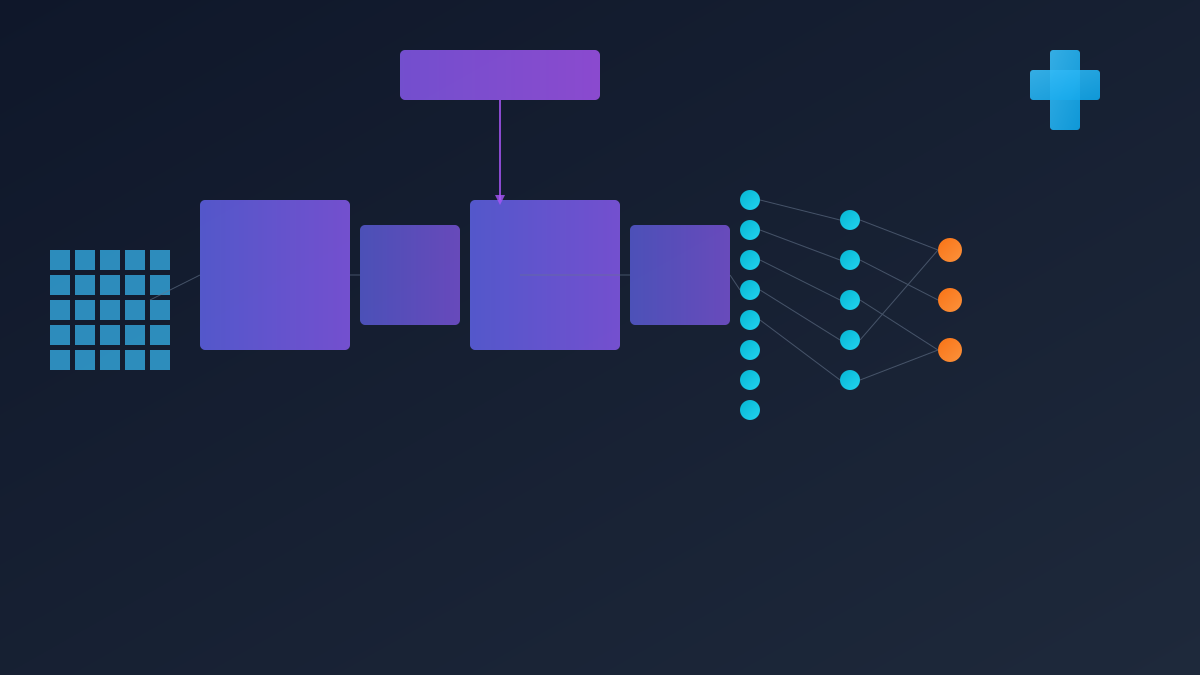
  1. Basic Neural Network Construction: Use the Keras API to build fully connected networks to process the Fashion MNIST dataset, covering the entire workflow of data preprocessing, model definition, training, and evaluation;
  2. Introduction to CNN: Build CNN models and compare the performance differences between fully connected and convolutional networks in image classification;
  3. Image Augmentation and Overfitting Handling: Use ImageDataGenerator to implement data augmentation such as random rotation and flipping to improve the generalization ability of the model;
  4. Transfer Learning Application: Load pre-trained models (e.g., Inception, ResNet), freeze some layers and fine-tune them to reduce training time and data requirements.
4

Section 04

Technical Implementation Details

All code is written based on TensorFlow 2.x, using Eager Execution mode and tf.keras high-level APIs (Sequential, Functional API); implement various Keras callback functions (ModelCheckpoint to save optimal weights, EarlyStopping to prevent overfitting, TensorBoard to visualize the training process); use the tf.data API to build efficient data pipelines (mapping, batching, prefetching) to maximize GPU utilization.

5

Section 05

Learning Value and Extended Applications

Target Audience: Machine learning beginners, career-changers, students, self-learners; Skill Improvement: TensorFlow framework proficiency, deep learning theoretical foundation, computer vision introduction, model tuning ability, engineering thinking; Extended Directions: Explore complex network architectures (ResNet, etc.), apply to NLP/time series prediction, model deployment (TensorFlow Serving/Lite), distributed training.

6

Section 06

Summary and Learning Recommendations

This code repository is an excellent learning resource that combines theory and practice, helping to build a solid foundation in deep learning. It is recommended that beginners complete the projects in the course order without skipping the basics; it is encouraged to conduct extended experiments (try different network structures, adjust hyperparameters, apply to own datasets). Deep learning requires systematic learning and continuous practice, and this repository is a gateway to the world of deep learning.

