Zing 论坛

正文

Talos:面向复杂业务工作流的自主AI架构系统

Talos是一个将知识大脑、编码代理和通信代理整合到统一AI原生系统中的自主业务架构平台,基于FastAPI构建,能够自主分流通信、自我修复数据并迭代代码以解决复杂业务工作流。

AI代理业务自动化FastAPI多代理系统MongoDB代码生成自主系统智能工作流
发布时间 2026/05/09 19:13最近活动 2026/05/09 19:19预计阅读 6 分钟
Talos:面向复杂业务工作流的自主AI架构系统
1

章节 01

Talos: Autonomous AI Architecture for Complex Business Workflows (导读)

Talos is an AI-native autonomous business architecture platform integrating knowledge brain, coding agent, and communication agent into a unified system. Built on FastAPI, it enables autonomous communication routing, self-repair of data, and iterative code generation to solve complex business workflows. This post breaks down its background, architecture, technical advantages, and application scenarios.


2

章节 02

Project Background & Design Philosophy

Traditional business automation tools are siloed (focusing on single domains like knowledge management or code generation), but real scenarios require synergy. Talos’s design philosophy aims to create an AI system that seamlessly switches between knowledge retrieval, code implementation, and communication coordination like human experts. Named after the Greek myth’s bronze giant (symbolizing reliability, automation, and protection), Talos considers multi-agent collaboration, state persistence, and self-repair from the architecture level.

3

章节 03

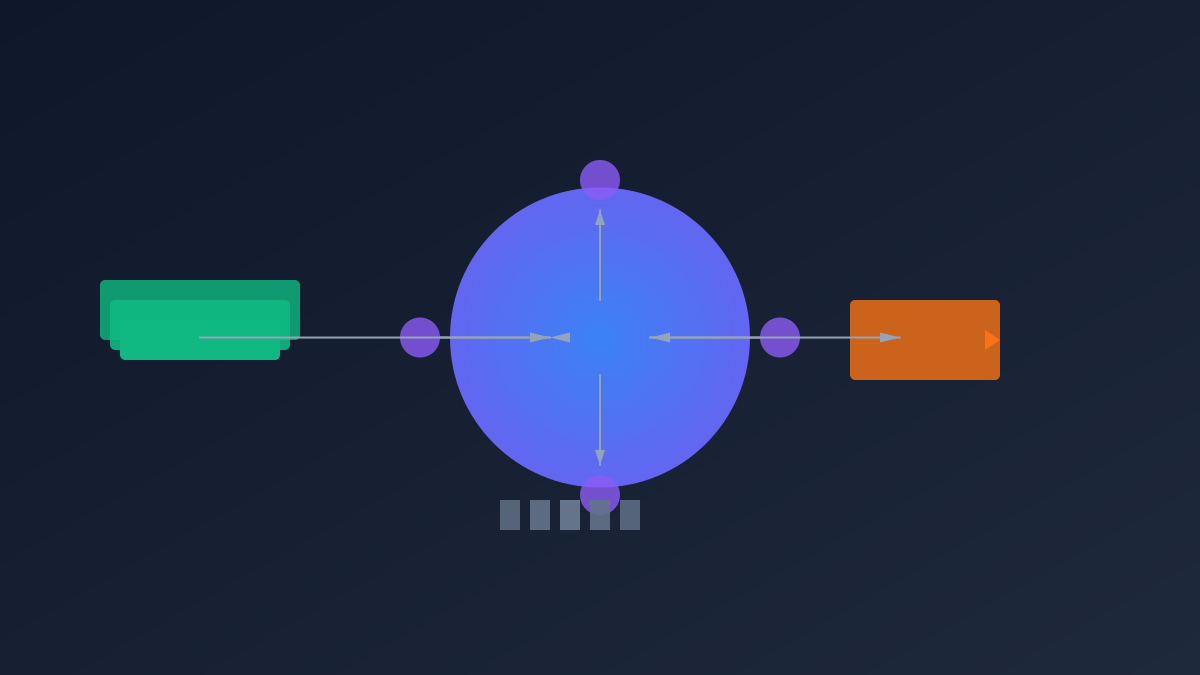
Core Architecture: Trinity of Agents

Talos’s core consists of three collaborative agents:

  1. Knowledge Brain: MongoDB-based memory center for semi-structured data, with semantic retrieval (vector DB + embedding models) to understand query intent beyond keywords.
  2. Coding Agent: FastAPI-powered execution engine with iterative code improvement (self-debugging on failure) and multi-language support.
  3. Comms Agent: External interaction window handling emails/IMs/tickets—intelligently routing messages and generating natural language responses.

Agents coordinate via a unified message bus.

4

章节 04

FastAPI’s Technical Advantages

Talos chooses FastAPI for:

  • Async native support: Efficiently handles concurrent long-running tasks (LLM responses, API calls).
  • Auto API docs: Generates OpenAPI-compliant docs via Pydantic models, lowering integration barriers.
  • Dependency injection: Decouples components for easy testing/extension.
  • High performance: Based on Starlette/Uvicorn, matching Node.js/Go’s production-level performance.
5

章节 05

Self-Repair & Continuous Learning

Talos’s self-repair capability: When code fails, it captures exceptions, retrieves relevant docs from the knowledge brain, generates fixes, and records the 'failure-repair' experience for future reference. This leads to continuous learning—system efficiency improves as it accumulates error cases and solutions, unlike traditional systems that degrade over time.

6

章节 06

Typical Application Scenarios

Talos applies to:

  • Customer support automation: Comms agent handles queries, knowledge brain retrieves history, coding agent generates scripts, comms agent sends replies.
  • Data pipeline maintenance: Monitors pipelines, diagnoses issues, auto-repairs, and notifies teams if needed.
  • DevOps assistance: Translates natural language requirements into code, tests, and deploys.
  • Business process orchestration: Coordinates cross-departmental flows (onboarding, procurement) with human approval nodes.
7

章节 07

Future Development Directions

Talos may expand in:

  • Multimodal support: Integrate image/audio/video processing for richer data handling.
  • Federated learning: Share knowledge across instances while protecting privacy.
  • Human-AI collaboration: Deepen hybrid modes with intuitive interfaces for human supervision.
  • Edge deployment: Sink agent capabilities to edge devices for lower latency.
8

章节 08

Summary & Key Takeaways

Talos marks a step from AI agents as 'toys' to practical 'tools' for business automation. Its unified architecture (knowledge + coding + comms) with self-repair offers a valuable open-source solution. For teams, its architecture design (combining AI capabilities into reliable systems) is as important as current features. With LLM advancements and cost reductions, such autonomous systems will find more use cases. Its open-source nature allows community customization for diverse industry needs.

