Zing Forum

Reading

System2Engine: Combating Large Model Hallucinations with a Three-Stage Cognitive Workflow

A multi-stage context pipeline built with Python, Gradio, and LiteLLM that effectively mitigates large language model hallucination issues by forcing the model to go through a structured three-stage cognitive process.

大语言模型幻觉缓解系统2思维PythonGradioLiteLLM认知工作流AI推理多阶段管道
Published 2026-05-23 00:45Recent activity 2026-05-23 00:49Estimated read 5 min
System2Engine: Combating Large Model Hallucinations with a Three-Stage Cognitive Workflow
1

Section 01

System2Engine: Mitigating Large Model Hallucinations with a Three-Stage Cognitive Workflow

The hallucination problem of large language models (LLMs) is a major obstacle to the implementation of AI applications. The System2Engine project proposes an innovative solution: by simulating human "System 2 thinking" (a slow, rational, deep thinking mode), it forces the model to go through a structured three-stage cognitive process, effectively mitigating hallucinations. Built with Python, Gradio, and LiteLLM, this project is a practical framework that can be integrated into production environments.


2

Section 02

Background: Large Model Hallucination Problem and System 2 Thinking Theory

Large model hallucinations manifest as generating content that seems reasonable but is actually incorrect. Psychologist Kahneman proposed the dual-system theory: System 1 is fast, intuitive, and automatic thinking, while System 2 is slow, rational, and deep thinking. Humans need to activate System 2 to solve complex problems, and System2Engine introduces this cognitive science concept into LLMs to prevent the model from giving answers "off the cuff".

3

Section 03

Technical Architecture: Multi-Stage Pipeline Design Based on Python Ecosystem

System2Engine is built on the Python ecosystem, with a tech stack including: Gradio for interactive web interfaces; LiteLLM for unified calls to multiple mainstream model backends; and a multi-stage pipeline that ensures the output of each stage provides valid input for the next. This architecture can be directly integrated into production environments, and developers can apply the anti-hallucination mechanism with simple configurations.

4

Section 04

Core Method: Detailed Explanation of the Three-Stage Cognitive Workflow

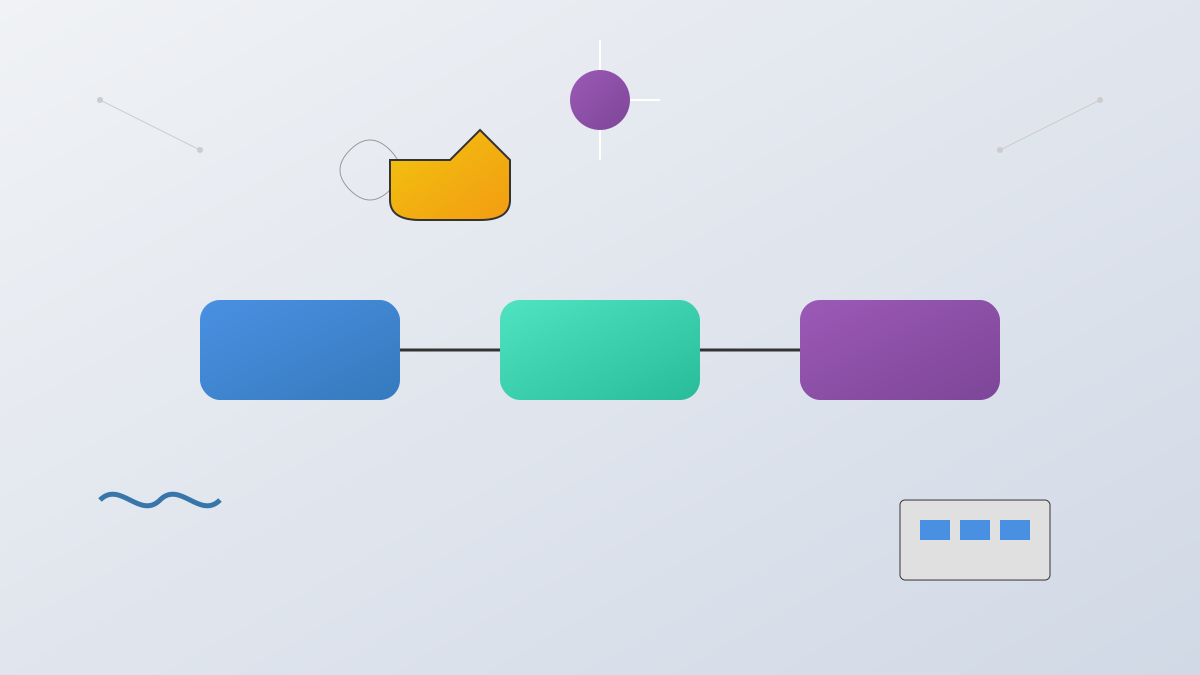
The core of System2Engine is the three-stage cognitive workflow: 1. Problem Decomposition and Understanding: Analyze the meaning, scope, and assumptions of the problem, and clarify known conditions and goals; 2. Intermediate Reasoning and Evidence Collection: Multi-step logical deduction, knowledge retrieval, hypothesis testing, and display of the reasoning chain; 3. Answer Synthesis and Verification: Generate the final answer based on the first two stages and perform self-verification (consistency check, boundary condition verification).

5

Section 05

Effect Mechanism: Key to Combating Hallucinations with the Three-Stage Process

The three-stage process mitigates hallucinations through the following mechanisms: 1. Forced Slowdown: Give the model more "thinking" time; 2. Explicit Reasoning: Intermediate steps make errors easier to detect; 3. Self-Correction: Each stage acts as a checkpoint to correct errors; 4. Structured Constraints: Reduce the model's "free play" space.

6

Section 06

Application Scenarios: Potential Value Areas of System2Engine

This solution applies to multiple fields: Education (cultivating systematic thinking), Research Assistance (literature review, experimental design), Business Decision-Making (strategic analysis, risk assessment), Code Generation (reducing logical errors), and Medical Consultation (improving answer credibility).

7

Section 07

Limitations and Future Development Directions

Current Limitations: Response delay (not suitable for real-time scenarios), dependence on the quality of prompt engineering, and restrictions on creative tasks. Future Directions: Dynamically adjust the number of stages, introduce external knowledge verification, multi-model voting, and lightweight deployment to reduce costs.

