Zing 论坛

正文

SyntheticMind v8:模块化认知AI系统的多轴推理架构

一个集成多智能体推理、物理数学引擎、记忆架构、世界建模与仿真的模块化认知AI系统,采用MAX-3D张量推理、BitDrop压缩和TurbVec混合后端,实现高效的结构化推理与上下文处理。

认知AI多智能体系统模型压缩结构化推理混合后端物理求解器模块化架构张量推理
发布时间 2026/06/11 00:00最近活动 2026/06/11 00:22预计阅读 5 分钟
SyntheticMind v8:模块化认知AI系统的多轴推理架构
1

章节 01

SyntheticMind v8: Overview of Modular Cognitive AI with Multi-Axis Reasoning

SyntheticMind v8 is a modular cognitive AI system integrating multi-agent reasoning, physical/mathematical engines, memory architecture, world modeling, and simulation. Its core innovations include MAX-3D tensor reasoning, BitDrop v3 compression, and TurbVec hybrid backend, enabling efficient structured reasoning and context processing. Key features: modular "cognitive runtime" design, 3D auxiliary mesh system, and integration of specialized helpers for various domains. Source: GitHub repo by thomaspricetj-hash (2026-06-10).


2

章节 02

Background & Project Design Philosophy

SyntheticMind v8 is designed as a "cognitive runtime" instead of a single model, decomposing reasoning into specialized collaborative components. It aims for structured reasoning, multi-round refinement, and efficient context handling via custom GPU kernels, TurbVec hybrid backend, and BitDrop v3 compression. Unlike monolithic models, it uses orchestrated modular components to handle complex tasks.

3

章节 03

Core Methods: MAX-3D, BitDrop, TurbVec

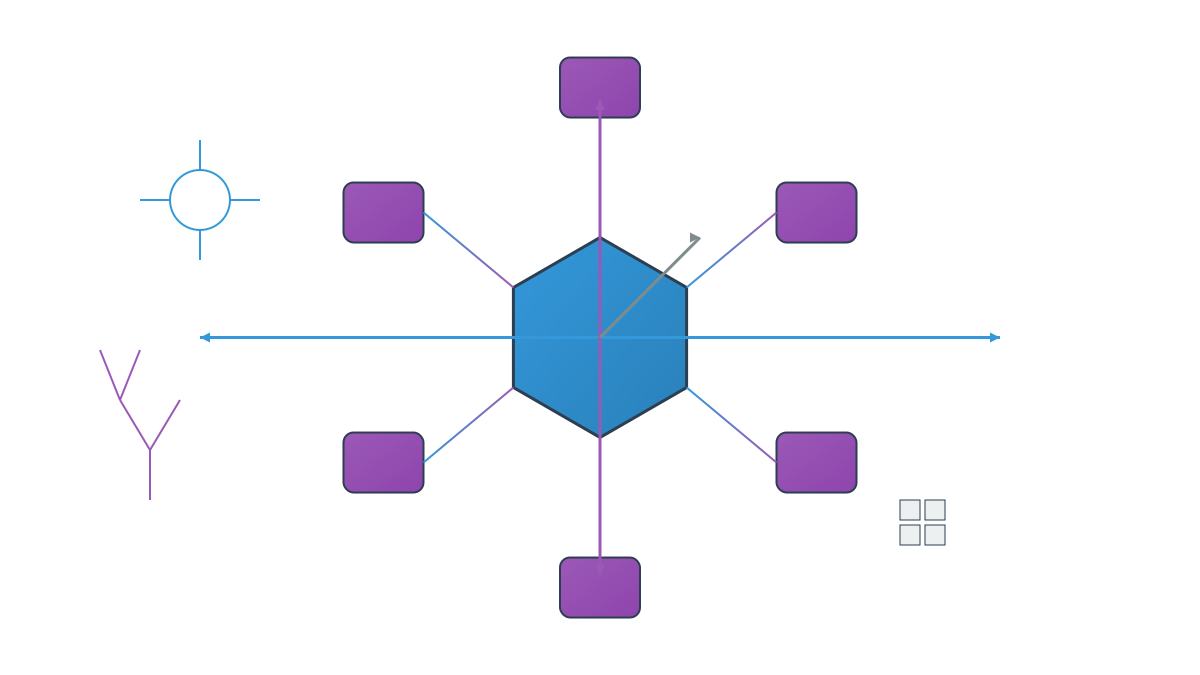
  • MAX-3D推理引擎: 3-axis tensor structure (X: sequence reasoning; Y: parallel expert mesh; Z: multi-round refinement) for multi-dimensional problem handling.
  • BitDrop v3 Compression: Byte-level compression with multi-pass collapse, entropy-aware routing, reversible 4-byte folding, PTS mapping, Bloom filter deduplication; optimized for NVIDIA RTX4090 to extend context length.
  • TurbVec Hybrid Backend: Local lightweight model first, then remote LLM if low confidence; Collapse-Expand pipeline (think in compressed domain) and auto-fallback mechanism.
4

章节 04

Specialized Components & Cognitive Coordination

  • 3D Auxiliary Mesh: Dynamic domain experts like PhysicsHelper3D (relativistic physics), MathHelper3D (symbolic/numerical math), LogicHelper3D, CodeHelper, etc.
  • ThinkingEngine: Central coordinator with multi-stage pipeline (domain detection → helper selection → micro-execution → structured reasoning → solver integration → answer refinement).
  • Memory Architecture: MemoryManager (short/long term), AIStore (persistent storage), MemoryHealer (cleanup inconsistent info).
  • Agent Ecosystem: PlannerAgent, ExecutorAgent, CriticAgent, etc., coordinated via Execution Engine.
5

章节 05

Application Scenarios & Design Principles

Design Principles:

  1. Deterministic local reasoning (privacy/reliability).
  2. Compression-first architecture (BitDrop integrated deeply).
  3. Multi-axis cognition (3D tensor).
  4. Modular specialization (independent helper optimization).
  5. Transparent structured reasoning (auditable steps).

Application Scenarios:

  • Scientific research (physics/math problem solving).
  • Complex code generation.
  • Education (concept explanation).
  • Decision support (multi-factor analysis).
  • Creative writing (world modeling-based narratives).
6

章节 06

Conclusion & Recommendations for Developers

SyntheticMind v8 represents a shift from monolithic models to modular, collaborative cognitive systems. Its integration of MAX-3D, BitDrop, and TurbVec balances deep reasoning and efficiency. For developers: it provides an extensible framework—customize/extend helper components to build AI systems capable of deep, structured reasoning for complex tasks.

