Zing Forum

Reading

Spider V2: An Intelligent Detection System for Industrial Oil Storage Tanks Based on Gaussian Process Regression

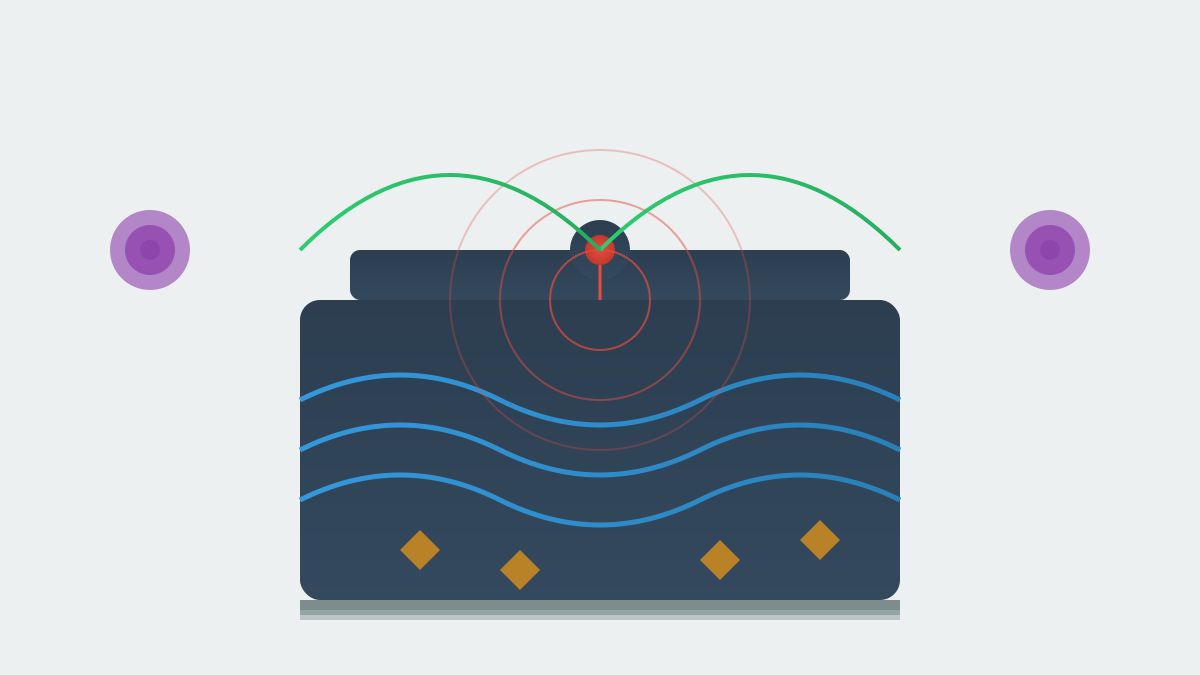
The Spider V2 backend is a FastAPI-based machine learning API designed specifically for industrial oil storage tank detection. The system uses Gaussian Process Regression algorithms to analyze ultrasonic sensor data, enabling corrosion detection and generating high-resolution contour maps, complying with the API 653 structural assessment standard.

高斯过程回归工业检测储油罐FastAPI机器学习超声波检测API 653腐蚀检测等高线图预测性维护
Published 2026-05-30 18:15Recent activity 2026-05-30 18:19Estimated read 9 min
Spider V2: An Intelligent Detection System for Industrial Oil Storage Tanks Based on Gaussian Process Regression
1

Section 01

Spider V2: Guide to the Intelligent Detection System for Industrial Oil Storage Tanks Based on Gaussian Process Regression

Spider V2 is a FastAPI-based machine learning API designed specifically for industrial oil storage tank detection. The system core uses Gaussian Process Regression algorithms to analyze ultrasonic sensor data, enabling corrosion detection and generating high-resolution contour maps. It complies with the API 653 structural assessment standard, providing data support for predictive maintenance. The project is maintained by muhammadowaistahir06-svg, with source code hosted on GitHub (Project link: https://github.com/muhammadowaistahir06-svg/spider-backend), and was released on May 30, 2026.


2

Section 02

Digital Challenges in Industrial Oil Storage Tank Detection

Oil storage tanks are key infrastructure in industries such as petroleum and chemical engineering, and their safety directly relates to production safety and environmental protection. Traditional detection relies on manual inspections and regular tank opening checks, which have problems like low efficiency, high cost, and inability to monitor in real time. With the development of industrial Internet of Things and machine learning technologies, intelligent detection systems based on sensor data have become an industry trend, and Spider V2 is a typical representative of this trend.

3

Section 03

Analysis of Spider V2's Core Technologies

Gaussian Process Regression (GPR)

As a non-parametric probabilistic model, GPR is suitable for small-sample, high-uncertainty scenarios. Its advantages include:

  • Uncertainty Quantification: Provides predicted values and reliability estimates;
  • Small Sample Learning: Can make reasonable predictions even with limited data, and can be updated as data accumulates;
  • Smooth Interpolation: Generates continuous surfaces based on discrete sensor data, suitable for creating corrosion distribution contour maps.

FastAPI Architecture

Using FastAPI as the web framework, its features include:

  • High Performance: Based on Starlette and Pydantic, supports asynchronous processing;
  • Type Safety: Natively supports Python type annotations;
  • Automatic Documentation: Built-in Swagger UI and ReDoc for easy integration.

API 653 Standard Compliance

Complying with the American Petroleum Institute's API 653 oil storage tank inspection standard means that the detection indicators and evaluation methods meet industry norms, the reports have professional recognition, and can be integrated into existing compliance processes.

4

Section 04

System Function Modules and Typical Application Scenarios

Core Functions

  1. Ultrasonic Data Processing: Receives data from ultrasonic thickness gauges, reflecting the wall thickness distribution of the tank;
  2. Corrosion Detection: Analyzes the spatial distribution of thickness via GPR to identify abnormal areas;
  3. Contour Map Generation: Visualizes the spatial distribution of corrosion to assist in locating problems;
  4. Structural Assessment Report: Generates reports according to the API 653 standard to support decision-making.

Typical Applications

  • Regular Inspection Assistance: Quickly analyzes large amounts of data to identify key areas of concern;
  • Predictive Maintenance: Continuous monitoring + historical comparison to predict corrosion trends and arrange maintenance in advance;
  • Maintenance Decision Support: Contour maps and reports provide quantitative basis to determine maintenance priorities.
5

Section 05

Technical Implementation Process and Engineering Considerations

Data Processing Flow

  1. Data Access: Receive raw data from ultrasonic thickness gauges;
  2. Preprocessing: Cleaning, outlier handling, coordinate calibration;
  3. Model Training: Fit the thickness distribution model using GPR;
  4. Predictive Interpolation: Predict on a dense grid to generate a continuous surface;
  5. Post-processing: Calculate corrosion indicators, generate contours, and mark risk areas;
  6. Visualization Output: Generate contour maps and assessment reports.

Engineering Considerations

  • Balance Between Real-Time Performance and Accuracy: Approximation methods like sparse GPR may be used to optimize computation;
  • Data Quality Control: Detect and handle sensor noise and outliers;
  • Scalability: FastAPI's asynchronous architecture supports parallel detection of multiple sensors and tanks, as well as system integration.
6

Section 06

Industry Value and Prospects of Spider V2

  • Cost Reduction and Efficiency Improvement: No need to stop production or open tanks, reducing detection costs and increasing detection frequency;
  • Safety Assurance: Timely detection of structural problems to avoid accidents like leaks and explosions;
  • Data Assetization: Accumulate detection data to form the basis of digital twins, supporting advanced analysis and decision-making.
7

Section 07

Summary and Insights

Spider V2 is a typical case of combining cutting-edge machine learning technology with traditional industrial scenarios. Its core technology choices (GPR adapted to industrial detection needs, FastAPI following modern web practices) demonstrate the path of transforming academic algorithms into industrial systems. For developers, the project provides a reference for industrial AI implementation; for industrial users, it represents a more intelligent, efficient, and reliable direction for detection technology.