Zing Forum

Reading

Salary Predictor: A Full-Stack Machine Learning Application for Salary Prediction of AI Professionals

This article introduces the Salary Predictor project, an end-to-end machine learning web application specifically designed to predict the annual salary levels of AI professionals, demonstrating the technical integration of XGBoost, FastAPI, and React.

机器学习薪资预测XGBoostFastAPIReact全栈开发
Published 2026-05-20 23:12Recent activity 2026-05-20 23:21Estimated read 8 min
Salary Predictor: A Full-Stack Machine Learning Application for Salary Prediction of AI Professionals
1

Section 01

Introduction: Salary Predictor—A Full-Stack Machine Learning Application for Salary Prediction of AI Professionals

This article introduces the Salary Predictor project, an end-to-end machine learning web application specifically designed to predict the annual salary levels of AI professionals, demonstrating the technical integration of XGBoost, FastAPI, and React. By combining a high-precision model with an elegant interface, this project solves the problem of salary positioning in the AI talent market and provides data support for job seekers, corporate HR, and others.


2

Section 02

Background: Salary Ambiguity in the AI Talent Market and Limitations of Traditional Methods

The booming development of the AI industry has led to a surge in talent demand, but salary differentiation is significant. Job seekers need to understand their own value, and corporate HR needs reasonable compensation strategies. However, salaries are non-linearly influenced by multiple factors such as technical stack, experience, and geographical location, making prediction complex. Traditional research relies on questionnaires or recruitment data, which has problems like sample bias, insufficient timeliness, and single dimension. Machine learning models, on the other hand, can learn patterns from massive data and provide personalized references.

3

Section 03

Project Overview and Technical Architecture Analysis

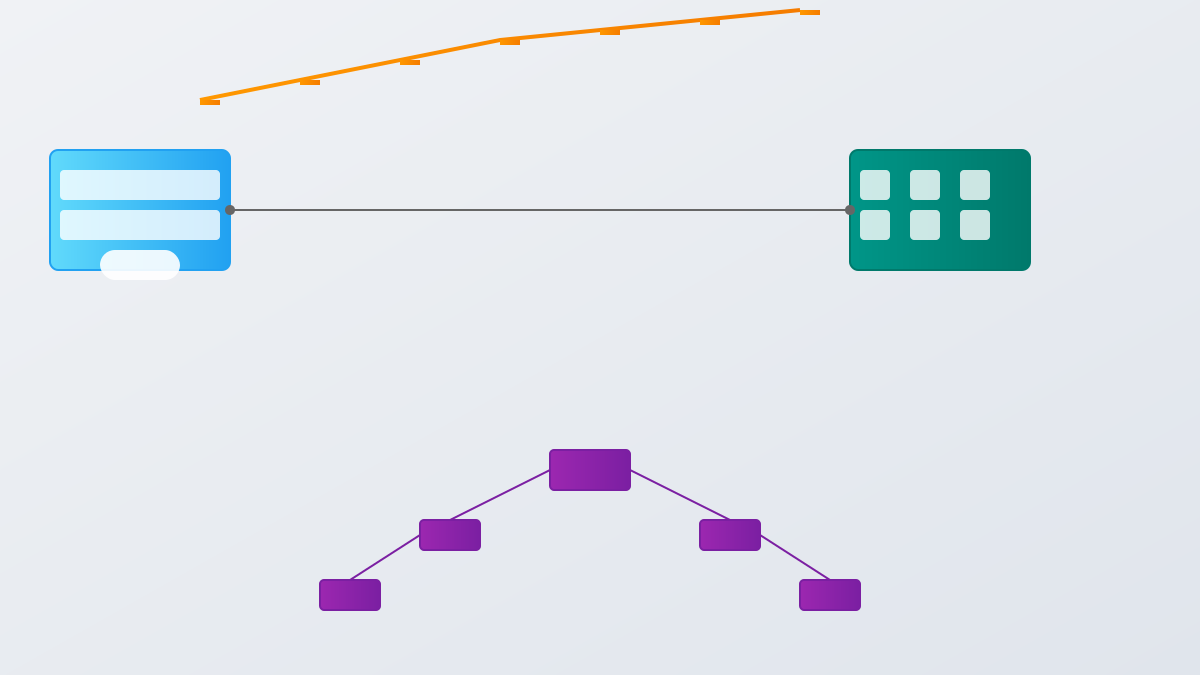
Salary Predictor is an end-to-end machine learning web application with high-precision positioning as its core feature. The technical architecture is divided into three layers: 1. Machine Learning Layer: Uses the XGBoost regression model, which excels at handling tabular data, supports regularization to prevent overfitting, and automatically learns feature interactions; 2. Backend Service Layer: Asynchronous FastAPI framework, with high performance, native support for asynchronous operations, and automatic generation of OpenAPI documentation; 3. Frontend Presentation Layer: Minimalist React design, clean interface, and instant return of predicted salary upon user input.

4

Section 04

End-to-End Engineering Practice Process

The project covers a complete engineering process: Data Collection and Cleaning: Collect salary data from the AI industry (public datasets, recruitment APIs, etc.), handle missing values, outliers, and standardize text; Feature Engineering: Key features include technical stack, experience, education, geography, and company characteristics; Model Training and Tuning: XGBoost training, cross-validation evaluation, grid/Bayesian optimization for parameter tuning, with metrics including MSE, MAE, and interpretability analysis; API Encapsulation and Deployment: Model serialization, FastAPI encapsulation of RESTful APIs, handling preprocessing and postprocessing; Frontend Integration: React calls the API to implement form validation, result display, and visualization.

5

Section 05

Application Scenarios and Multiple Values

The project's value is reflected in multiple scenarios:

  • Job seekers: Input skills and experience to get salary references, gain confidence in salary negotiations, and understand high-value skills;
  • Corporate HR: Assist in formulating compensation strategies to ensure competitiveness while avoiding overspending;
  • Educational institutions: Optimize curriculum settings to match market demands;
  • Career planners: Analyze salary prospects of career paths to assist decision-making.
6

Section 06

Technical Highlights and Scalability

Technical Highlights:

  1. Model Interpretability: XGBoost feature importance analysis reveals key factors affecting salaries;
  2. Real-time Prediction: FastAPI's asynchronous architecture handles high concurrency;
  3. Modular Design: Frontend-backend separation allows independent evolution of each layer (e.g., changing models without modifying the frontend);
  4. Scalable Data Pipeline: Supports continuous data access and regular model retraining.
7

Section 07

Limitations and Future Improvement Directions

Limitations:

  1. Data Bias: Training data sources may lead to insufficient representation of certain groups;
  2. Market Dynamics: The AI industry changes rapidly, so models need regular updates;
  3. Individual Differences: Statistical models struggle to cover top experts or career changers;
  4. Privacy Ethics: Must adhere to data protection principles. Improvement Directions: Introduce more data sources (e.g., GitHub activity), add confidence intervals, support multiple regions and currencies, and develop mobile applications.
8

Section 08

Conclusion: A Typical Case of Machine Learning Engineering

Salary Predictor is a typical machine learning engineering project that demonstrates the transformation from algorithm to product. From XGBoost modeling to FastAPI services and React interfaces, it embodies the balance between performance, maintainability, and user experience. For developers learning full-stack machine learning development, it is a reference case worth studying.

