Zing Forum

Reading

Rocky: An Open-Source AI Quadruped Robot Built for $60

A low-cost, open-source quadruped robot project based on ESP32-S3 and 8 MG90S servos, supporting WiFi remote control and AI voice interaction. It aims to provide an affordable solution for mine detection and reconnaissance as well as STEM education.

机器人四足机器人ESP32开源硬件3D打印AI语音STEM教育人道主义技术
Published 2026-05-19 02:44Recent activity 2026-05-19 02:51Estimated read 5 min
Rocky: An Open-Source AI Quadruped Robot Built for $60
1

Section 01

Rocky: Introduction to the $60 Open-Source AI Quadruped Robot

Rocky is a low-cost, open-source quadruped robot project. Its core components are the ESP32-S3 and 8 MG90S servos, with a total cost of approximately $60-$70. It supports WiFi remote control and AI voice interaction, aiming to provide an economical solution for mine detection and reconnaissance, while also serving as a STEM education platform.


2

Section 02

Project Background and Vision

Industrial-grade mine-clearing robots cost as high as $500,000 to $2 million, making them difficult to popularize. The Rocky project aims to break this barrier by providing a low-cost 3D-printed alternative, addressing the humanitarian mine-clearing challenges in post-war regions, and offering an affordable learning platform for STEM education.

3

Section 03

Hardware Architecture and Cost Breakdown

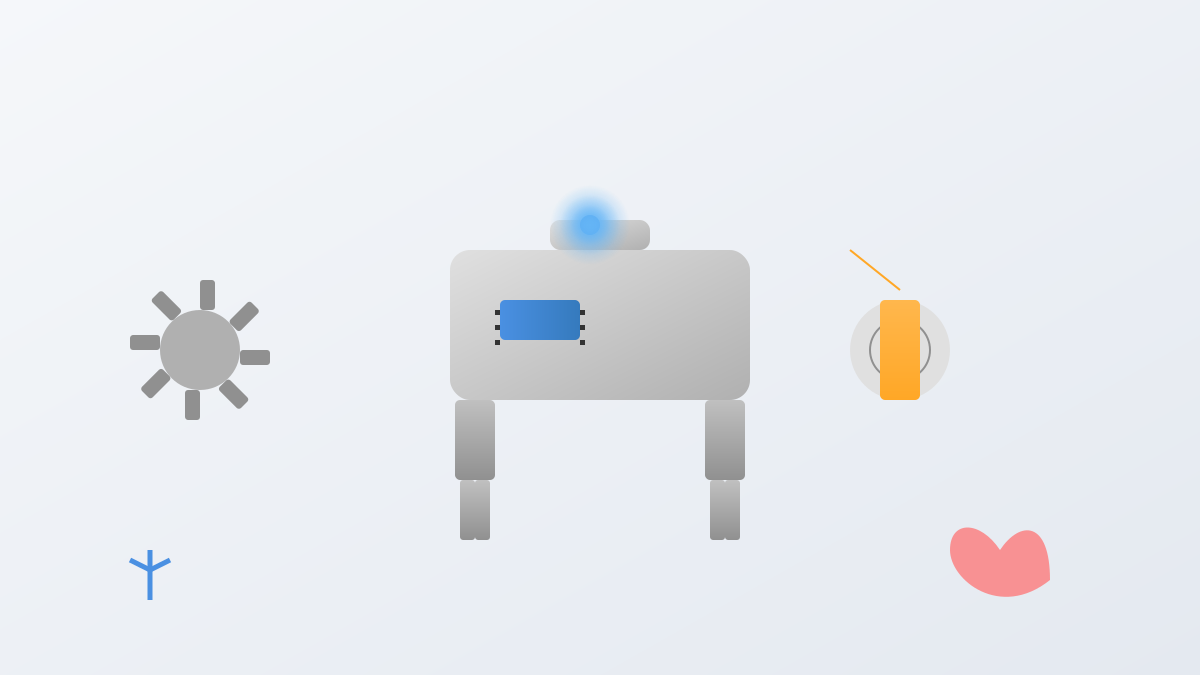
Rocky's hardware configuration is streamlined and efficient: ESP32-S3 development board ($20), 8 MG90S servos ($20), lithium battery ($10), etc., totaling approximately $63. Each leg has 2 degrees of freedom (hip joint, knee joint), using 8 servos in total. GPIO assignments are clear, and the onboard WS2812B LED displays statuses such as startup and readiness.

4

Section 04

Motion Control and Remote Interaction

It supports modes such as walking (trot gait), running (bound gait), in-place turning, standing/resting, etc. Smooth gait interpolation technology is used to reduce mechanical impact. A REST API is provided via WiFi for remote control (e.g., using curl commands to implement walking, turning, and emergency stop).

5

Section 05

AI Voice Interaction Tech Stack

Voice interaction is implemented via a supporting Python application: OpenAI Whisper (multi-language support) for speech recognition, GPT-4o-mini for semantic understanding, and OpenAI TTS for speech synthesis. Each command costs approximately $0.001. To use it, you need to install dependencies, set up the API key, and configure the robot's IP address.

6

Section 06

Development Tools and Open-Source Statement

A servo calibration tool (serial port interactive fine-tuning) is provided. The development environment requires Arduino IDE (ESP32 package ≥3.0) and libraries such as ESP32Servo and ArduinoJson. It is open-sourced under the MIT license, allowing free use. Note: The current version is an educational prototype, not a certified mine-clearing device, and is prohibited from use in real minefields.

7

Section 07

Project Significance and Summary

Rocky proves that practical functions can be achieved at low cost, integrating advanced AI services with controllable costs, reflecting the trend of AI democratization. Open-source hardware helps solve social issues (such as mine-clearing), making it suitable for robot enthusiasts, STEM educators, and humanitarian developers. We look forward to more such projects serving all of humanity.

