Zing Forum

Reading

Implementation of an Intelligent PDF Q&A Chatbot Based on RAG Architecture

A detailed introduction to building a PDF document Q&A system based on Retrieval-Augmented Generation (RAG) technology, covering the complete tech stack including document chunking, vector embedding, FAISS indexing, LangChain integration, and Streamlit interface design.

RAGPDF问答LangChainFAISSLlama 3向量检索文档智能
Published 2026-05-22 14:45Recent activity 2026-05-22 14:51Estimated read 6 min
Implementation of an Intelligent PDF Q&A Chatbot Based on RAG Architecture
1

Section 01

Introduction - Core Value and Project Overview of RAG-based PDF Intelligent Q&A System

In the era of information explosion, PDF documents are the main carrier of knowledge storage, but traditional keyword search struggles to meet the needs of complex semantic queries. This project builds an AI chatbot based on the RAG (Retrieval-Augmented Generation) architecture to enable interactive dialogue between natural language and PDFs. The RAG architecture combines information retrieval and text generation to address issues such as knowledge timeliness, hallucinations, traceability, and cost of pure generative models, providing users with an efficient and intelligent knowledge extraction tool.


2

Section 02

Background - Challenges of PDF Information Retrieval and Necessity of RAG Architecture

Facing hundreds of pages of PDF documents, quickly locating key information is a major challenge. Traditional keyword search cannot handle complex semantic queries. Pure generative models have pain points such as knowledge cutoff, hallucinations, and non-traceability. The RAG architecture dynamically retrieves external knowledge bases to reduce the probability of hallucinations, clarify answer sources, and does not require fine-tuning large models, resulting in low maintenance costs, making it an ideal solution for PDF intelligent Q&A.

3

Section 03

Methodology - System Architecture and Core Technology Implementation

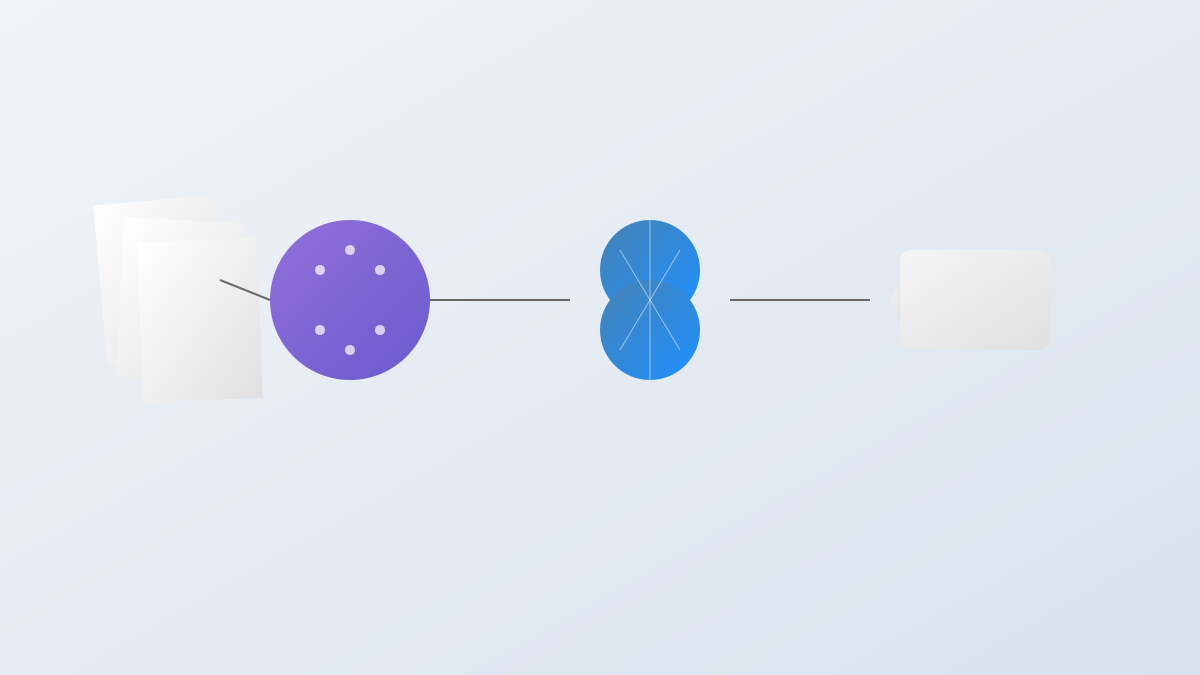
The system architecture includes two main processes: PDF text extraction → intelligent chunking → vectorization → FAISS index storage; and user query → vectorization → similarity retrieval → context assembly → LLM answer generation. Core technologies include: 1. PDF extraction (handling plain text, scanned versions, and complex layouts); 2. Intelligent chunking (fixed-length, semantic, recursive chunking and optimization); 3. Text vectorization (embedding model selection and vector storage); 4. FAISS vector database (index types and similarity metrics); 5. LangChain framework integration (core components and RAG Chain construction); 6. Llama3 model selection (open-source, cost-controllable, customizable); 7. Streamlit interactive interface (function design and experience optimization).

4

Section 04

Method Details - Key Technical Challenges and Solutions

  1. Long document processing: streaming processing, asynchronous indexing, incremental updates; 2. Retrieval accuracy optimization: query rewriting, hybrid retrieval, re-ranking, multi-hop retrieval; 3. Context length limitation: result compression, intelligent truncation, Map-Reduce strategy; 4. Multi-document management: collection management, metadata filtering, conversation isolation.
5

Section 05

Performance Evaluation - Metrics for Retrieval and Generation Quality

Retrieval performance metrics include recall, precision, MRR, NDCG; generation quality evaluation includes faithfulness, answer relevance, and context precision. System optimization measures include index caching, concurrent processing, and result caching to improve response speed and user experience.

6

Section 06

Application Scenarios - Practical Implementation Directions of RAG Systems

This system can be extended to: 1. Enterprise knowledge bases (querying rules and regulations, product manuals); 2. Academic research (literature review assistance); 3. Legal assistants (contract review, case retrieval); 4. Educational tutoring (textbook Q&A, exercise analysis); 5. Customer service support (automatic Q&A for product documents).

7

Section 07

Future Outlook - Development Directions of RAG Technology

Future explorations will include: 1. Multimodal RAG (integrating images, tables, etc.); 2. Agent enhancement (tool calling capabilities); 3. GraphRAG (combining knowledge graphs); 4. Continuous learning (optimization based on user feedback).

8

Section 08

Conclusion - Project Value and Technical Reference Significance

This project fully demonstrates the implementation of a PDF intelligent Q&A system based on the RAG architecture, covering the entire tech stack from document parsing to LLM generation. The componentized design of LangChain ensures scalability, Llama3 supports private deployment to meet data security needs, and the Streamlit interface lowers the threshold for use. It provides a complete technical reference and implementation example for document intelligent applications.

