Zing Forum

Reading

Building an End-to-End RAG System: A Practical Guide from PDF Documents to Intelligent Q&A

This article introduces a complete implementation of a Retrieval-Augmented Generation (RAG) project, demonstrating how to convert official PDF documents into an interactive intelligent Q&A system, especially suitable for automated query scenarios involving structured knowledge such as educational policies and regulatory documents.

RAG检索增强生成LLMPDF解析向量数据库教育科技智能问答
Published 2026-05-20 09:40Recent activity 2026-05-20 09:48Estimated read 6 min
Building an End-to-End RAG System: A Practical Guide from PDF Documents to Intelligent Q&A
1

Section 01

[Introduction] Building an End-to-End RAG System: A Practical Guide from PDF Documents to Intelligent Q&A

This article introduces a complete implementation of a Retrieval-Augmented Generation (RAG) project, demonstrating how to convert official PDF documents into an interactive intelligent Q&A system, especially suitable for automated query scenarios involving structured knowledge such as educational policies and regulatory documents. Keywords: RAG, Retrieval-Augmented Generation, LLM, PDF Parsing, Vector Database, EdTech, Intelligent Q&A. This project targets the Beca 18 scholarship program of Peru's PRONABEC institution, solving the challenge of querying PDF documents and improving answer accuracy and timeliness through the RAG architecture.


2

Section 02

Project Background and Motivation

In the education sector, scholarship policies and regulations are often published as PDF documents, which are lengthy and frequently updated. For applicants and administrators, quickly and accurately finding specific clauses is a challenge. Traditional keyword search often fails to meet the needs of complex semantic queries. This project targets the Beca 18 scholarship program of Peru's PRONABEC institution, building an end-to-end Retrieval-Augmented Generation (RAG) system that can understand natural language questions, retrieve relevant fragments from official PDF documents, and generate accurate answers.

3

Section 03

Core Value of the RAG Architecture

Retrieval-Augmented Generation (RAG) represents an important evolutionary direction for large language model applications. Unlike relying solely on model parameter knowledge, RAG enhances answer accuracy and timeliness by dynamically retrieving external documents. Its advantages include: handling new information after the model's training cutoff; answers are traceable (citing original document fragments); customizable for specific domains without retraining the entire model.

4

Section 04

Technical Implementation Path

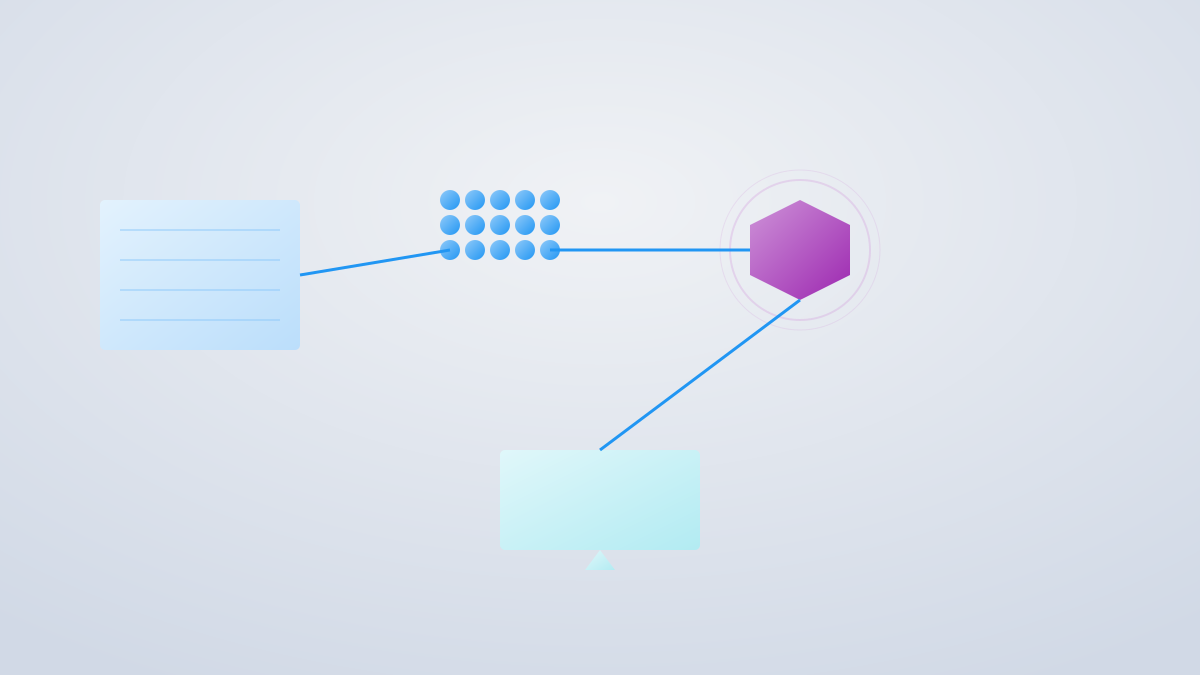
The core process of the project includes key stages: 1. Document Preprocessing: Parse PDFs into structured text blocks, preserving chapter titles and paragraph relationships; 2. Text Embedding: Convert text blocks into high-dimensional vector representations to capture semantic meaning, using mainstream embedding models; 3. Vector Storage: Store vectors in a vector database to support efficient similarity search.

5

Section 05

Collaborative Work of Retrieval and Generation

The retrieval stage determines the upper limit of answer quality. A similarity-based retrieval strategy is used to recall the most relevant document fragments from the vector database and inject them into the prompt as context. The generation stage leverages the reasoning ability of large language models to construct answers based on the context. The key lies in prompt engineering design, instructing the model to answer only based on the provided context to avoid hallucinations.

6

Section 06

Application Scenarios and Extensibility

This project focuses on educational scholarship policies, but the architecture has wide applicability and can be deployed in scenarios such as legal and regulatory querying, enterprise knowledge base Q&A, product document support, etc. The modular design allows independent optimization of components: replacing the embedding model to improve retrieval accuracy, switching language models to balance performance and cost, and adjusting vector database selection according to data scale.

7

Section 07

Practical Insights and Future Outlook

This project demonstrates the process of transforming cutting-edge AI technology into practical tools, providing developers with a complete RAG implementation reference (from data preprocessing to full deployment workflow). Future outlook: Extend support for multimodal document elements such as images and tables; integrate with Agent architecture to perform complex tasks (e.g., automatic application form filling, application status tracking).

