Zing Forum

Reading

Intelligent Document Q&A System Based on RAG Technology: Making PDF Files 'Speak'

This article introduces an open-source RAG (Retrieval-Augmented Generation) chatbot project that combines the FAISS vector database with the Google Gemini large language model to enable intelligent Q&A functionality based on private documents.

RAG检索增强生成向量数据库FAISSGoogle GeminiPDF问答文档检索大语言模型人工智能chatbot
Published 2026-06-13 22:15Recent activity 2026-06-13 22:49Estimated read 6 min
Intelligent Document Q&A System Based on RAG Technology: Making PDF Files 'Speak'
1

Section 01

Introduction: Open-Source Project Overview of the RAG-Based Intelligent Document Q&A System

This article introduces the open-source RAG chatbot project (ragchatbot) developed by vijaykumar-devcode. The system combines the FAISS vector database with the Google Gemini large language model to enable intelligent Q&A functionality based on private PDF documents. The project source code is hosted on GitHub, released on June 13, 2026, providing a learning case for developers exploring AI applications with private data.


2

Section 02

Background: RAG Technology Addresses Pain Points in Private Document Q&A

Traditional chatbots can only answer questions based on training data and cannot handle specific document content uploaded by users. RAG (Retrieval-Augmented Generation) technology generates answers by retrieving relevant knowledge base fragments and combining them with large language models, offering three key advantages:

  • Knowledge real-time: Supports newly uploaded documents
  • Answer accuracy: Reduces model "hallucination" issues
  • Data privacy: Private documents only need indexing, no training required
3

Section 03

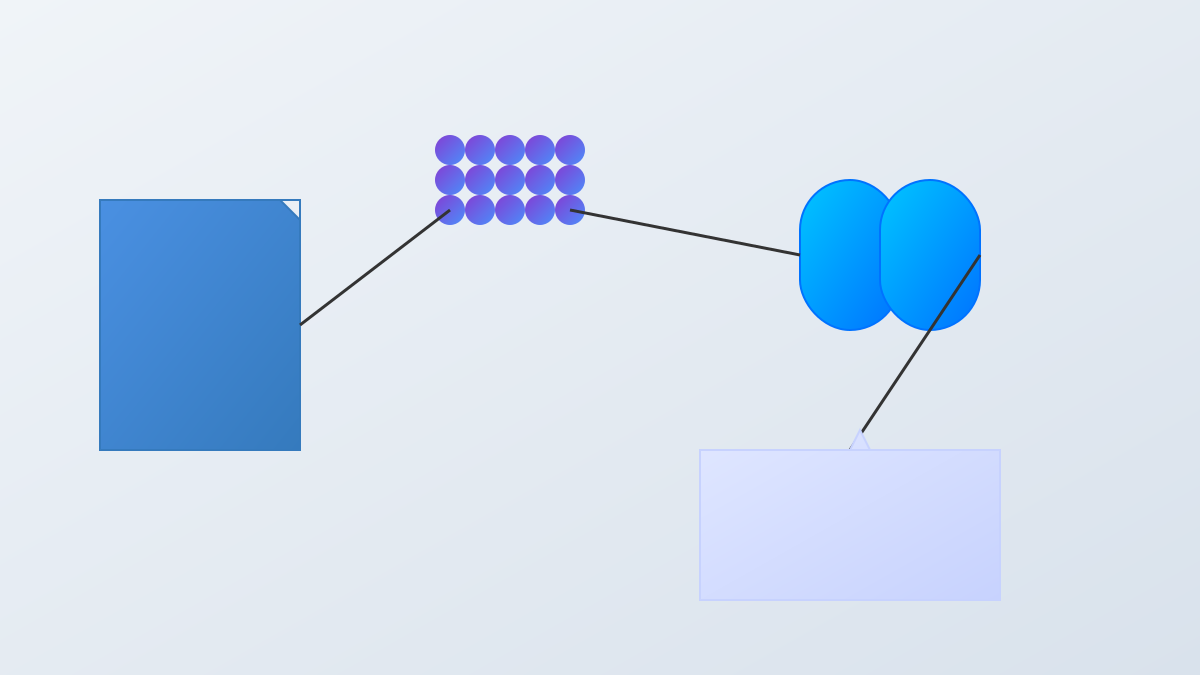
System Architecture: Analysis of Four Core Components

1. Document Processing Module

Supports PDF uploads, automatically completes text extraction, cleaning, and format standardization

2. Text Segmentation and Vectorization

Intelligently splits documents into semantically complete text chunks, converting them into high-dimensional vectors via an embedding model

3. FAISS Vector Database

Uses Meta's open-source FAISS library to achieve efficient similarity search, ensuring real-time Q&A performance

4. Google Gemini Large Language Model

Takes retrieved document fragments as context to generate accurate answers based on document content

4

Section 04

Application Scenarios: Practical Value Across Multiple Domains

  • Enterprise Knowledge Management: Quickly query internal documents, manuals, and regulations
  • Academic Research Assistance: Upload paper collections and locate relevant research content via Q&A
  • Legal Document Analysis: Extract key information and precedents from case materials
  • Customer Service Enhancement: Provide precise technical support based on product manuals
5

Section 05

Technical Highlights and Solutions to Implementation Challenges

Technical Highlights

  1. End-to-end workflow: Covers the entire process from PDF upload to intelligent Q&A
  2. Modular design: Clear component responsibilities for easy expansion and maintenance
  3. Real-time preview: Supports real-time preview of uploaded images
  4. Accurate answers: RAG architecture ensures answers strictly rely on document content

Implementation Challenges and Solutions

  • Text segmentation: Uses an intelligent chunking strategy to balance retrieval accuracy and context integrity
  • Vector retrieval: Uses FAISS's approximate nearest neighbor algorithm for efficient search
  • Context window limitation: Optimizes context usage via relevance ranking and intelligent truncation
6

Section 06

Future Outlook: Improvement Directions for RAG Technology

  • Multimodal support: Handle multiple formats such as images and tables
  • Conversation memory: Maintain context coherence in multi-turn dialogues
  • Source annotation: Clearly indicate document fragments cited in answers
  • Multi-document joint query: Support comprehensive Q&A across multiple documents
7

Section 07

Conclusion: Project Value and Application Prospects

This RAG chatbot project demonstrates the organic combination of retrieval technology and generative models, providing practical reference for AI applications with private data. With the advancement of large language models and vector database technologies, such systems are expected to play an important role in enterprise knowledge management, intelligent customer service, academic research, and other fields.

