Zing Forum

Reading

Enterprise Document Intelligence Platform: Using RAG Technology to Make Documents 'Speak'

An AI-driven document intelligence platform that supports uploading PDF and DOCX files, enabling semantic search and context-aware intelligent Q&A through Retrieval-Augmented Generation (RAG) and large language models.

RAGdocument intelligencesemantic searchLLMLangChainPDF processingvector embeddings
Published 2026-06-07 23:42Recent activity 2026-06-07 23:49Estimated read 6 min
Enterprise Document Intelligence Platform: Using RAG Technology to Make Documents 'Speak'
1

Section 01

[Introduction] Enterprise Document Intelligence Platform: Using RAG Technology to Make Documents 'Speak'

This is an AI-driven document intelligence platform developed by amarbhardwaj112003 (Amar Kumar Singh), released on GitHub on June 7, 2026 (repository link: https://github.com/amarbhardwaj112003/enterprise-document-intelligence). Addressing the pain point of low retrieval efficiency for enterprise unstructured documents (PDF, DOCX), it leverages Retrieval-Augmented Generation (RAG) and Large Language Model (LLM) technologies to enable semantic search, context-aware intelligent Q&A (with source tracing), and local document processing to ensure data privacy.


2

Section 02

Project Background: Retrieval Dilemma of Enterprise Unstructured Documents

In the era of information explosion, enterprises have accumulated massive unstructured documents (such as PDF reports, Word documents, technical manuals, policy documents, etc.), which contain valuable knowledge. However, traditional keyword retrieval methods are inefficient, making it difficult to quickly obtain the required information. This project aims to transform these documents into an intelligent knowledge base, allowing users to interact with documents through natural language queries while maintaining context relevance and source traceability.

3

Section 03

Core Features: Intelligent Document Processing and Interaction Capabilities

The core features of the platform include:

  1. Document Upload and Processing: Supports uploading and intelligent parsing of PDF and DOCX files;
  2. Semantic Retrieval: Based on vector embedding technology, it breaks through the limitations of keyword matching and understands the true intent of user queries;
  3. RAG-Driven Q&A: Provides accurate, context-aware answers, with each answer supported by document sources;
  4. Local Processing: Meets data privacy needs—sensitive documents do not need to be uploaded to external cloud services.
4

Section 04

Technical Architecture: End-to-End Process from Document to Intelligent Response

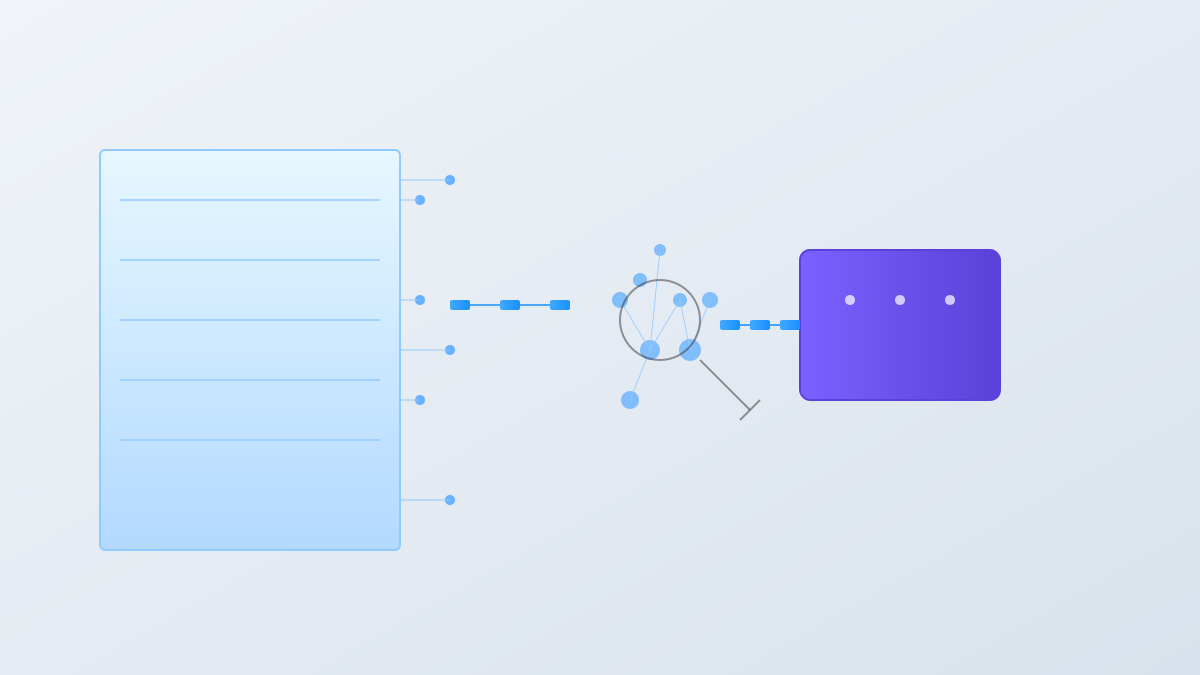
Data Processing Flow: Document upload → Text extraction → Text chunking and vector embedding → Vector database storage → Relevant context retrieval → LLM processing → Context-aware response. Key Technical Components: Python (backend), LangChain (RAG pipeline construction), vector embedding (semantic representation), LLM (natural language understanding and generation), Streamlit (web interface), etc. Project Structure: Includes app.py (main entry), core module (document loading, embedding generation, retriever, RAG pipeline), requirements.txt, etc.

5

Section 05

Application Scenarios: Multi-Domain Enterprise Solutions

The platform is suitable for multiple scenarios:

  1. Enterprise Knowledge Management: Build a unified knowledge base for employees to quickly query required information;
  2. Research Document Analysis: Upload academic papers to understand research status through Q&A;
  3. Legal Document Retrieval: Quickly find contract clauses and case precedents;
  4. Technical Document Assistant: Query API manuals and technical details to improve development efficiency.
6

Section 06

Future Plans: Feature Expansion and Optimization Directions

The project will add the following features in the future:

  • Multi-document dialogue: Support querying multiple documents simultaneously;
  • Dialogue memory: Retain historical conversations to enable contextually coherent multi-turn Q&A;
  • Source citation: Clearly mark the specific location of answer sources;
  • OCR support: Process scanned PDFs;
  • Cloud deployment option: Expand processing capacity;
  • Role-based access control: Manage different user permissions;
  • Analytics dashboard: Provide usage statistics and insights.
7

Section 07

Technical Value: Practical Reference for RAG Technology

This project demonstrates the potential of RAG technology in practical applications—combining the accuracy of retrieval systems with the generative capabilities of LLMs, it provides a natural interaction experience while ensuring information accuracy. For developers, it offers a complete reference implementation from document processing to vector retrieval and LLM integration, which has high learning and reference value.

