Zing Forum

Reading

Experimental Evaluation and Application Prospects of RAG Architecture in Intelligent Traffic Regulation Analysis

This article provides an in-depth interpretation of an experimental study on the application of Retrieval-Augmented Generation (RAG) architecture in intelligent transportation systems and autonomous driving protocols. It analyzes how this technology improves the accuracy and reliability of regulatory information retrieval, and explores its practical value and future development directions in autonomous driving safety supervision and compliance analysis.

RAG架构检索增强生成智能交通系统自动驾驶法规大语言模型法规分析AI幻觉生成式AI搜索合规管理交通监管科技
Published 2026-03-25 08:00Recent activity 2026-03-28 00:50Estimated read 7 min
Experimental Evaluation and Application Prospects of RAG Architecture in Intelligent Traffic Regulation Analysis
1

Section 01

[Introduction] Core Value and Experimental Summary of RAG Architecture in Intelligent Traffic Regulation Analysis

This article conducts an experimental evaluation focusing on the application of Retrieval-Augmented Generation (RAG) architecture in intelligent traffic regulation analysis. Its core goal is to address the accuracy issue of regulatory retrieval in the autonomous driving field, especially the 'hallucination' flaw of Large Language Models (LLMs). Experimental results show that RAG can significantly improve the semantic similarity and factual accuracy of regulatory analysis, providing reliable technical support for scenarios such as autonomous driving compliance management and regulatory decision-making, while serving as an example for the responsible deployment of AI in high-risk fields.


2

Section 02

Research Background: Regulatory Challenges of Autonomous Driving and the Proposal of RAG

The rapid development of autonomous driving technology brings complex regulatory challenges covering multiple dimensions such as road safety, data privacy, and insurance liability. Traditional manual regulatory retrieval is inefficient and prone to omissions; although LLMs have generative capabilities, their 'hallucination' problem (generating incorrect information) limits their application in high-risk fields. The RAG architecture, through the approach of 'retrieving external knowledge first, then generating answers', combines real information sources to effectively reduce the risk of hallucinations, becoming a feasible path to solve this problem.

3

Section 03

Principle of RAG Architecture: Collaborative Mechanism of Retrieval and Generation

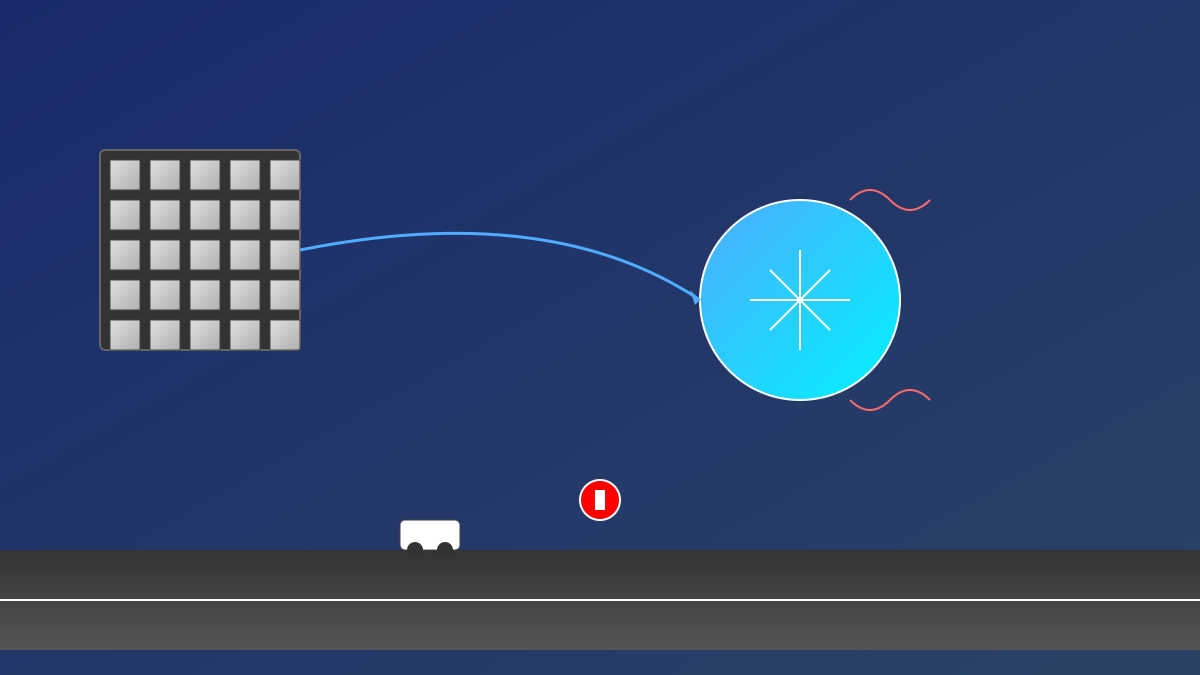
The core of the RAG architecture is the collaboration of 'retrieval + generation': after receiving a query, it first retrieves relevant document fragments from an external knowledge base, then inputs them as context into the LLM to generate answers. Its advantages include: anchoring real regulatory texts to improve credibility; independent updates of the knowledge base to ensure information timeliness. Technical components include document indexing (splitting and encoding to build vector indexes), retrieval modules (finding relevant fragments), and generation modules (generating answers based on retrieval results).

4

Section 04

Experimental Design: Rigorous Evaluation of RAG's Regulatory Analysis Performance

The experiment selected Euro NCAP and traffic regulation documents from various countries as the knowledge base, covering topics such as autonomous driving testing and safety assessment. Evaluation metrics include semantic similarity (matching degree between generated content and regulatory texts) and accuracy (factual correctness), and the performance of different question types (definition explanation, procedural specification, case analysis) was analyzed. The test dataset contains hundreds of expert-reviewed question-answer pairs, and the comparison benchmarks include pure retrieval systems, pure generation systems, and RAG variants.

5

Section 05

Experimental Results: RAG Significantly Improves Accuracy and Credibility

The semantic similarity score of the RAG system increased by 16.65% compared to the baseline model (p<0.0072), and the generated content was more consistent with regulatory texts; hallucinations were significantly reduced, especially with obvious accuracy advantages in specific clause citations and numerical information. Retrieval quality directly affects generation results: precise retrieval leads to high generation quality, and vice versa. Complex cross-clause reasoning issues still need optimization.

6

Section 06

Application Scenarios: RAG Empowers the Entire Chain of Autonomous Driving Compliance

RAG can be applied in multiple scenarios: 1. Automobile manufacturers: internal compliance review to ensure products meet regulatory standards; 2. Testing and certification: analyzing whether test scenarios are compliant; 3. Regulatory agencies: improving the efficiency of regulation formulation/interpretation and assisting decision-making; 4. Insurance/legal: assisting in liability determination for autonomous driving accidents and sorting out relevant regulations.

7

Section 07

Challenges and Prospects: Future Development of Intelligent Regulatory Assistants

Current challenges: knowledge base construction and maintenance (automated update mechanism to be improved), retrieval accuracy (algorithms need to be optimized for legal texts), multilingual support, and interpretability (need to show answer sources and reasoning basis). Future directions: multimodal processing (supporting regulatory content in charts/videos), conversational interaction, cross-domain knowledge integration, and decision support systems (proactively providing compliance suggestions).

