Zing Forum

Reading

Quantum-MNIST: Exploration of Hybrid Quantum-Classical Neural Networks in Handwritten Digit Recognition

An in-depth analysis of hybrid model architectures combining quantum computing and classical deep learning, exploring the implementation principles, advantages, and current limitations of quantum neural networks in image classification tasks.

量子机器学习混合神经网络MNISTQiskitPyTorch变分量子电路量子计算
Published 2026-05-03 22:15Recent activity 2026-05-03 22:20Estimated read 6 min
Quantum-MNIST: Exploration of Hybrid Quantum-Classical Neural Networks in Handwritten Digit Recognition
1

Section 01

Introduction: Core Exploration of the Quantum-MNIST Project

The Quantum-MNIST project focuses on the application of hybrid quantum-classical neural networks in handwritten digit recognition, aiming to explore the architectural principles, advantages, and limitations of combining quantum computing with classical deep learning. Using the MNIST dataset as a testbed, the project is implemented collaboratively with Qiskit and PyTorch, providing a reference for understanding the potential of quantum machine learning in real-world AI tasks.


2

Section 02

Background: Frontiers of Quantum Machine Learning and the MNIST Dataset

Quantum Machine Learning (QML) is an interdisciplinary frontier of quantum computing and machine learning, leveraging quantum properties such as superposition and entanglement to enhance traditional algorithms. As a classic test set (60,000 training / 10,000 test 28x28 handwritten digit images), MNIST has become the preferred benchmark for validating new architectures due to its clear task and moderate complexity, reflecting the project's steady R&D approach.

3

Section 03

Methodology: Hybrid Quantum-Classical Architecture Design

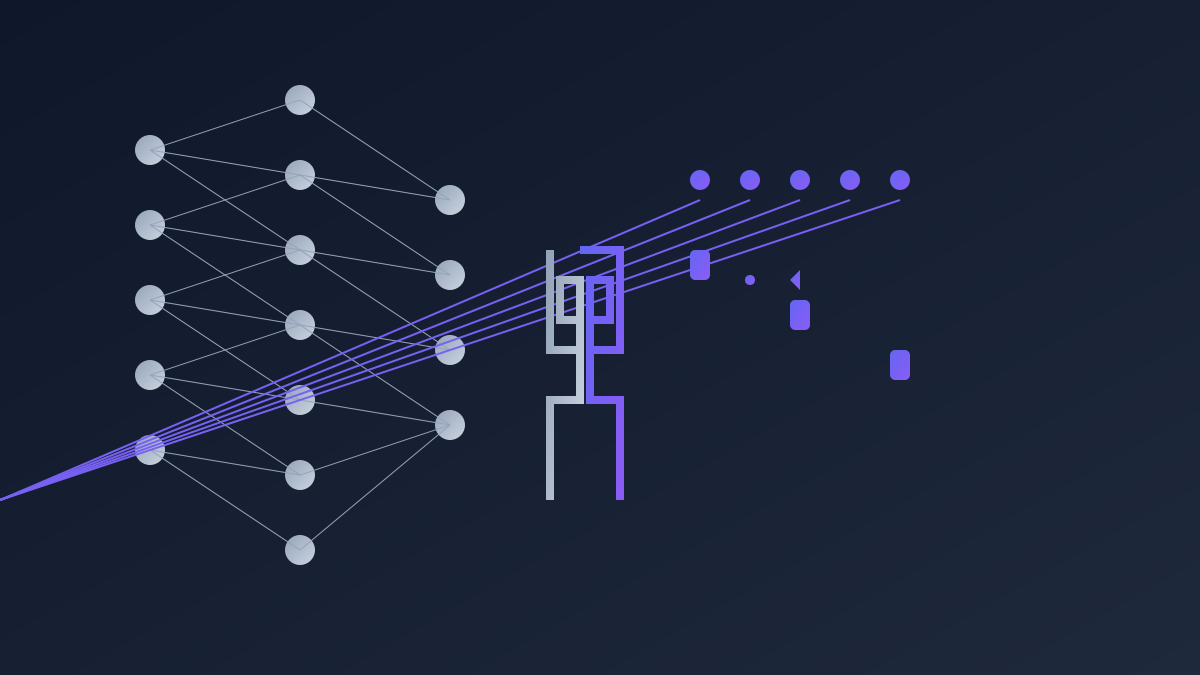
Quantum-MNIST adopts a hybrid architecture: the classical part handles data preprocessing and feature extraction (e.g., convolutional/full-connected layers encoding low-dimensional representations), while the quantum part performs transformations via parameterized quantum gates, and the measurement results are returned to the classical network for classification decisions. This division of labor combines the data processing advantages of classical computing with the theoretical transformation advantages of quantum computing.

4

Section 04

Technical Implementation: Collaboration Between Qiskit and PyTorch

The project uses Qiskit (a mature quantum SDK) and PyTorch (a mainstream deep learning framework). The key technology is to implement gradient backpropagation across the classical-quantum boundary. The Qiskit Machine Learning module provides a PyTorch-compatible interface, allowing quantum circuits to participate in automatic differentiation, laying the foundation for end-to-end training.

5

Section 05

Quantum Mechanism: Role of Variational Quantum Circuits

The quantum part uses a Variational Quantum Circuit (VQC), which consists of a fixed sequence of quantum gates, some with adjustable parameters. During training, parameters are updated via classical optimizers to learn classification feature transformations. Quantum circuits can manipulate high-dimensional Hilbert space states, and theoretically can express functional relationships that are difficult for classical networks to represent efficiently.

6

Section 06

Current Challenges and Experimental Limitations

Currently, quantum machine learning is in its early stages. Quantum-MNIST may run on quantum simulators (which cannot demonstrate quantum advantages because simulation is limited by classical resources). Real quantum hardware faces issues such as noise, decoherence, and limited qubits. Noise affects the accuracy of gradient estimation, leading to training difficulties or suboptimal solutions.

7

Section 07

Academic Value and Future Directions

This project has important academic and educational value: it provides an experimental platform for researchers, helps students understand the combination of quantum and machine learning, and establishes a methodological system. Future directions include exploring specific tasks where quantum advantages exist (e.g., chemical simulation/optimization), developing robust quantum training algorithms to handle noise, and migrating experiments to real hardware.

8

Section 08

Conclusion: Significance of Quantum Machine Learning Exploration

Quantum-MNIST is a microcosm of quantum machine learning. Advances in cutting-edge technology start with rethinking classical problems. When quantum computing and deep learning are deeply integrated, such explorations will become milestones. For developers at the forefront of technology, now is the best time to participate in this field.

