Zing Forum

Reading

PyTorch-based Intelligent Classification of Rice Varieties: Practice of Deep Learning in Agricultural Quality Inspection

This article introduces a complete project that uses PyTorch to build an Artificial Neural Network (ANN) for rice variety classification, covering the entire workflow of data preprocessing, feature engineering, model training, and evaluation, demonstrating the practical application value of deep learning technology in the field of agricultural quality inspection.

PyTorch深度学习人工神经网络稻米分类农业AI机器学习计算机视觉特征工程模型训练品质检测
Published 2026-06-16 18:13Recent activity 2026-06-16 18:18Estimated read 7 min
PyTorch-based Intelligent Classification of Rice Varieties: Practice of Deep Learning in Agricultural Quality Inspection
1

Section 01

Introduction: Core Overview of the PyTorch-based Intelligent Rice Variety Classification Project

The project introduced in this article is a complete practice of using PyTorch to build an Artificial Neural Network (ANN) for intelligent rice variety classification, covering the entire workflow of data preprocessing, feature engineering, model training, and evaluation. Developed by Muhammad Musharraf and published on GitHub (Project link: https://github.com/Muhammad-Musharraf/Rice-Classification-ANN-Using-Pytorch), this project aims to demonstrate the application value of deep learning technology in the field of agricultural quality inspection and solve the problems of time-consuming, labor-intensive, and highly subjective traditional manual identification.


2

Section 02

Project Background and Significance

As one of the most important food crops globally, rice variety identification and quality inspection are key links in agricultural production and trade. Traditional manual identification methods are time-consuming, labor-intensive, and prone to subjective influences. With the development of deep learning technology, computer vision and neural networks provide new solutions for agricultural automated inspection. This project demonstrates a complete deep learning workflow, using PyTorch to build an ANN for automatic rice variety classification, which can significantly improve the efficiency and accuracy of agricultural quality inspection.

3

Section 03

Technical Architecture and Core Components

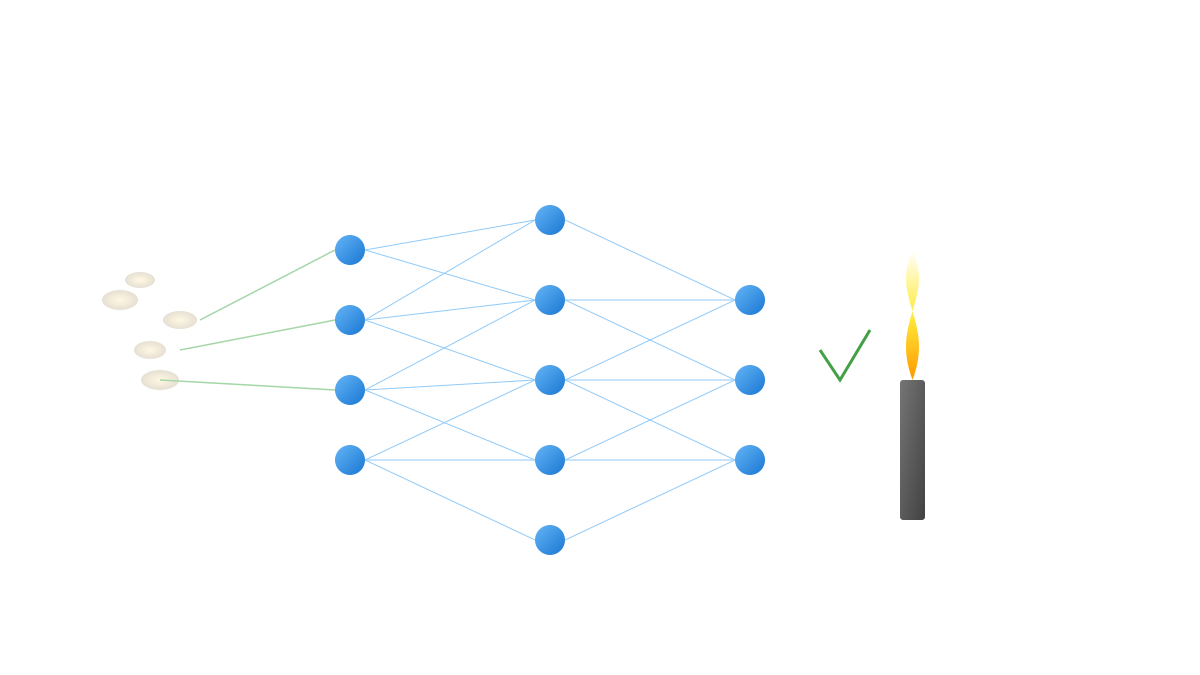
The project uses the PyTorch framework (an open-source library by Meta AI, known for its dynamic computation graph and flexible model construction), with the core algorithm being the Artificial Neural Network (ANN). By simulating biological neuron connections to build a multi-layer perceptron, ANN learns the complex non-linear mapping between input features and output categories, and can process multi-dimensional features of rice (images or sensor data) to achieve end-to-end variety identification.

4

Section 04

Data Processing and Feature Engineering

Data preprocessing includes steps such as cleaning, normalization, and feature extraction. The input features for rice classification cover geometric features (length, width, area), color features (RGB values, hue), texture features, etc. The quality of feature engineering directly affects model performance; reasonable selection and construction of features can help the network understand the essential differences between varieties (such as grain shape ratio, surface texture).

5

Section 05

Model Training and Optimization Strategies

Training involves network architecture design, selection of activation functions, configuration of loss functions (cross-entropy loss), and optimizers (SGD, Adam; Adam performs better due to its adaptive learning rate). To address overfitting, mitigation strategies such as Dropout regularization, early stopping, and data augmentation are used.

6

Section 06

Model Evaluation and Performance Analysis

Evaluation metrics include accuracy, precision, recall, F1 score, and confusion matrix (which intuitively shows category performance). Performance analysis needs to focus on overall metrics and differences in category performance; for varieties with few samples or indistinct features, sampling strategies or feature extraction methods need to be adjusted.

7

Section 07

Application Scenarios and Future Outlook

Application scenarios include grain procurement (variety grade identification, pricing basis), processing (automated sorting), and quality supervision (auxiliary inspection and quarantine). Future directions: Introduce CNN to process raw images to reduce manual feature engineering; use transfer learning to accelerate adaptation to new varieties; combine edge computing to develop portable devices for real-time field detection.

8

Section 08

Project Summary

This project fully demonstrates the deep learning workflow from data preparation to model deployment, providing a reference example for intelligent agricultural inspection. The combination of PyTorch's flexibility and ANN's expressive power effectively solves the rice classification problem. With technological evolution, the application of deep learning in the agricultural field will become more extensive and in-depth.

