Zing Forum

Reading

PlantGuard-AI: A Comparative Study of Deep Learning vs. Traditional Machine Learning for Plant Disease Detection

PlantGuard-AI is a plant disease detection system that implements two technical approaches—end-to-end deep learning and feature extraction-based traditional machine learning. It analyzes the advantages and disadvantages of both paradigms in agricultural vision tasks through comparative experiments and provides a complete Streamlit interactive application.

植物病害检测深度学习传统机器学习EfficientNet迁移学习集成学习Streamlit农业AI
Published 2026-05-19 03:45Recent activity 2026-05-19 03:48Estimated read 7 min
PlantGuard-AI: A Comparative Study of Deep Learning vs. Traditional Machine Learning for Plant Disease Detection
1

Section 01

[Overview] PlantGuard-AI: A Comparative Study of Deep Learning vs. Traditional Machine Learning for Plant Disease Detection

PlantGuard-AI is a plant disease detection system that implements two technical approaches: end-to-end deep learning (EfficientNetV2B0 transfer learning) and feature extraction + traditional machine learning (ResNet50 feature extraction + ensemble classifier). The project analyzes the pros and cons of both paradigms in agricultural vision tasks through comparative experiments and provides a complete Streamlit interactive application to serve as a reference for technology selection.


2

Section 02

Research Background and Motivation

Plant disease detection is a classic application of computer vision in agriculture, but existing studies mostly focus on a single technical approach. PlantGuard-AI adopts a comparative perspective, implementing both machine learning paradigms in parallel on the same dataset. This not only has academic value but also provides a reference for technology selection in practical applications (there are trade-offs between different methods in terms of accuracy, efficiency, interpretability, and deployment cost).

3

Section 03

Dual-Track Architecture Design of the Project

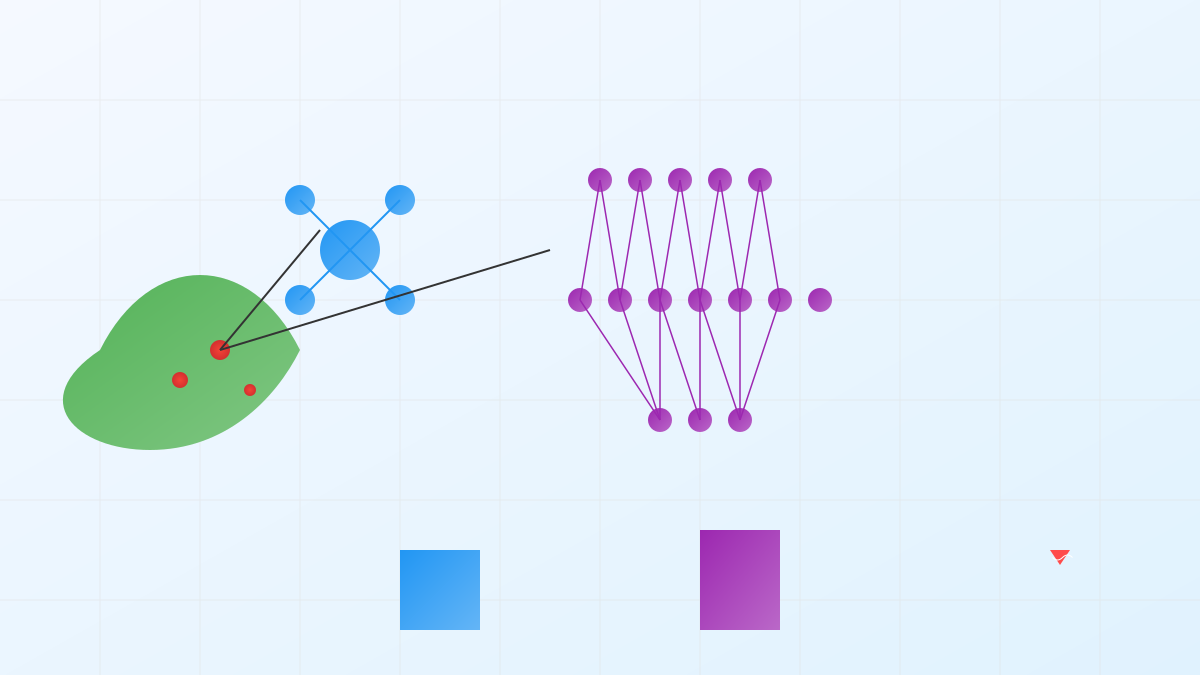
PlantGuard-AI’s core is a dual-pipeline architecture:

Pipeline 1: End-to-End Deep Learning

Uses EfficientNetV2B0 as the backbone network, with transfer learning fine-tuning and data augmentation to improve generalization. The end-to-end design reduces manual feature engineering.

Pipeline 2: Feature Extraction + Traditional Machine Learning

Uses ResNet50 (without the top layer) for feature extraction. After standardization and PCA dimensionality reduction, the features are input into a voting ensemble classifier consisting of logistic regression, SVM, random forest, and K-nearest neighbors, integrating the advantages of each algorithm to improve stability.

4

Section 04

Key Findings from Comparative Analysis

Comparative results under the same dataset and evaluation conditions:

  • Accuracy: The deep learning pipeline achieves 98.8%, significantly better than the ensemble pipeline’s 92.3%, with a more obvious gap in complex disease categories;
  • Generalization Ability: Deep learning is better at distinguishing similar diseases, which is beneficial for early identification;
  • Computational Efficiency: The traditional pipeline is lighter in training and inference, suitable for resource-constrained environments;
  • Interpretability: The feature extraction approach provides more interpretable intermediate results;
  • Training Stability: Transfer learning accelerates convergence, and the ensemble effect is affected by the correlation of base learners.
5

Section 05

Introduction to the Streamlit Interactive Application

The project includes a complete Streamlit application with a unified interface for both pipelines: users can upload leaf images and select prediction pipelines to compare results in real time. It also provides additional functions such as confidence analysis, disease description, severity estimation, and treatment recommendations, transforming the research prototype into a usable auxiliary diagnostic tool.

6

Section 06

Dataset and Evaluation Methods

Uses a public plant disease dataset covering RGB leaf images of 14 plant species and 38 disease categories. Evaluation metrics include accuracy, precision, recall, and F1 score, and visualization tools such as confusion matrices are used to analyze category prediction performance.

7

Section 07

Research Significance and Implications for Technology Selection

The core value of PlantGuard-AI lies in revealing the applicable boundaries of different technical paradigms: in an era dominated by deep learning, a well-designed traditional pipeline is still competitive in specific scenarios. For agricultural AI developers: choose deep learning for accuracy, choose the feature extraction approach for deployment cost and interpretability; hybrid strategies (such as deep learning for coarse classification + traditional methods for fine screening) are worth exploring.

8

Section 08

Future Outlook

The project plans to be expanded into a formal research paper focusing on the comparison of the two paradigms. Application directions will explore edge device deployment, integration of more disease types, introduction of active learning mechanisms, etc., with the ultimate goal of serving actual agricultural production.

