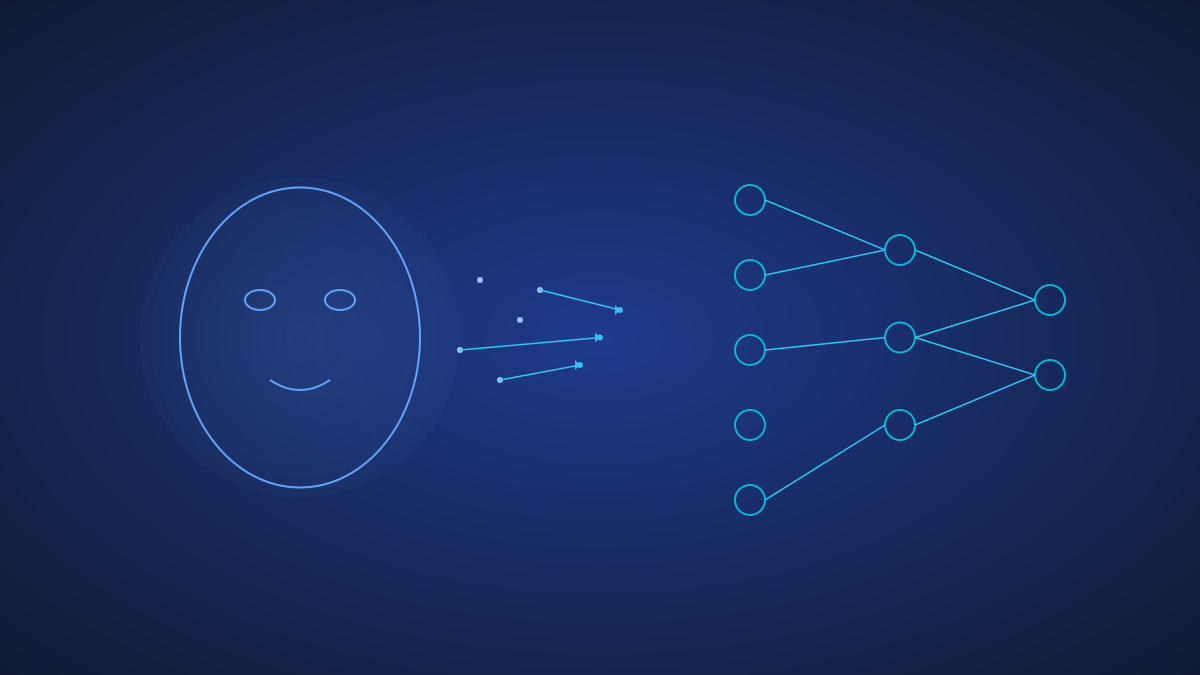
Detailed System Implementation Process
The implementation of the project is divided into several key stages. First is the data preparation stage: developers need to collect and organize the face image dataset, convert images into numerical matrix format, and perform normalization processing. Then comes data segmentation: divide the dataset into training set and test set to ensure the model can be validated on unseen data.
Next is the PCA feature extraction stage: the system calculates the average face of all training images, then computes the difference between each image and the average face, and extracts principal components via Singular Value Decomposition (SVD) or eigenvalue decomposition. Usually, selecting the top 50 to 100 principal components can retain more than 90% of the variance information, significantly reducing the input dimension of the subsequent classifier.
Then is the ANN model training stage: the neural network receives the PCA-reduced feature vectors as input and is trained through a multi-layer perceptron structure. The hidden layers use ReLU activation function to introduce nonlinearity, and the output layer uses Softmax function to generate probability distributions for various categories. During training, cross-entropy loss function and Adam optimizer are used, and the validation set accuracy is monitored to prevent overfitting.
Finally, the model evaluation stage: the trained model is applied to the test set, and indicators such as recognition accuracy and confusion matrix are calculated to evaluate the actual performance of the system.