Zing 论坛

正文

ParaView-MCP:用自然语言操控科学可视化

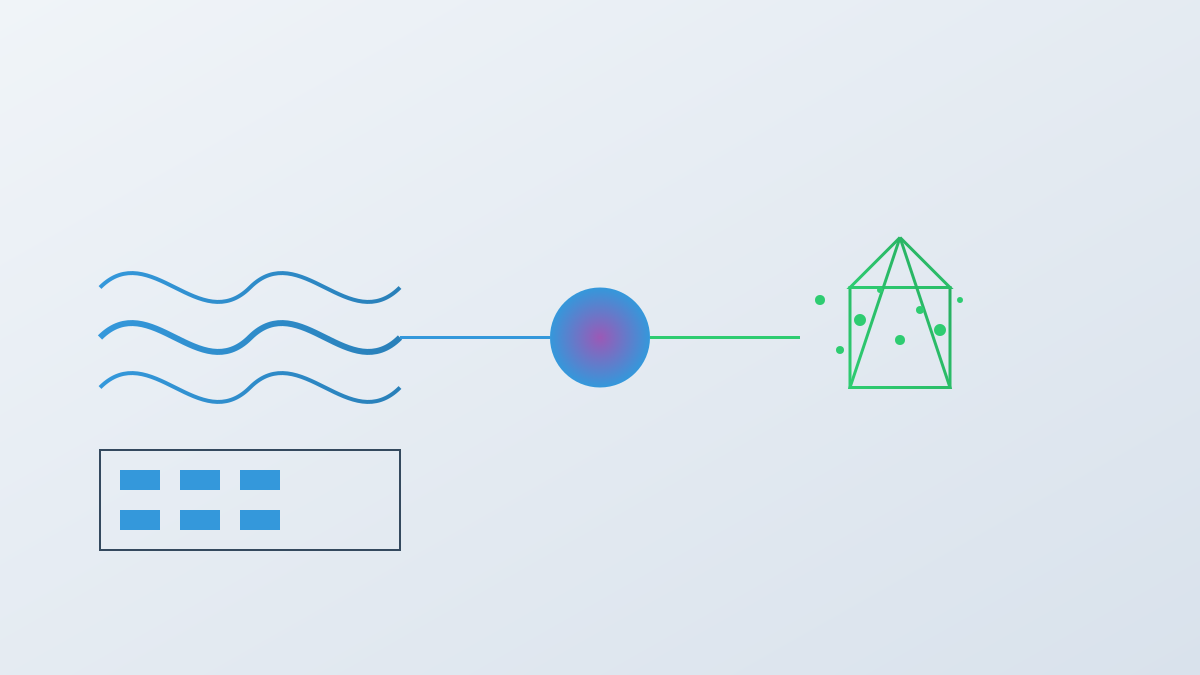
ParaView-MCP通过模型上下文协议将多模态大语言模型与ParaView集成,实现自然语言控制科学可视化。智能体能够观察视口获取视觉反馈,让复杂的可视化工具对所有用户可及,同时为专家提供智能自动化能力。

科学可视化ParaViewMCP多模态AI自然语言控制LLNL科学计算
发布时间 2026/04/23 01:26最近活动 2026/04/23 01:52预计阅读 6 分钟
ParaView-MCP:用自然语言操控科学可视化
1

章节 01

ParaView-MCP: Bridging Natural Language and Scientific Visualization

ParaView-MCP, developed by Lawrence Livermore National Laboratory (LLNL), integrates multi-modal large language models with ParaView via the Model Context Protocol (MCP). It enables natural language control of scientific visualization, allowing AI agents to observe the viewport for visual feedback. This tool lowers the barrier for non-professionals to use complex visualization tools while providing intelligent automation capabilities for experts. Key keywords: scientific visualization, ParaView, MCP, multi-modal AI, natural language control, LLNL, scientific computing.


2

章节 02

The Steep Learning Curve of ParaView

ParaView is one of the most powerful open-source tools in scientific computing visualization, widely used in computational fluid dynamics, meteorological simulation, medical imaging, etc. However, its powerful functions come with a steep learning curve—users need to master complex interface operations, filter settings, and rendering parameter adjustments. For non-professionals, creating meaningful visualizations often takes hours or days of learning.

3

章节 03

Core Technical Architecture of ParaView-MCP

Model Context Protocol (MCP)

MCP is an emerging AI tool integration standard defining communication between AI models and external tools. Through MCP, large language models can call functions, get context, and make decisions based on results. ParaView-MCP uses this protocol to enable AI to 'operate' ParaView.

Multi-modal Interaction

AI agents can receive text instructions and 'observe' ParaView's viewport for visual feedback. This vision-language combination helps AI understand intent, execute operations, check results, and adjust.

Natural Language to Operations

Users can describe needs in daily language (e.g., 'Show velocity field isosurface with threshold 0.5' or 'Map temperature with rainbow colors and add color bar'). AI converts these into ParaView operations like loading data, applying filters, adjusting camera angles, etc.

4

章节 04

Application Scenarios and Value

Lower Learning Cost

New users can use natural language instead of memorizing complex menus/parameters.

Efficiency for Experts

AI automates repetitive tasks: batch rendering, parameter adjustment, recommending visualization strategies.

Exploratory Analysis

Conversational interaction (e.g., 'What features does this data have?' 'Show abnormal pressure areas') helps discover key patterns.

Teaching & Collaboration

Teachers can demo with natural language; non-technical team members can participate in visualization discussions via language.

5

章节 05

Technical Implementation Challenges

ParaView-MCP faces several technical hurdles:

  • Viewport Capture: Efficiently capturing ParaView's rendering results and enabling multi-modal models to understand image content.
  • Operation Atomization: Breaking ParaView's functions into AI-callable atomic operations while maintaining flexibility.
  • State Management: Synchronizing state between AI and ParaView to ensure correct operation sequences.
  • Error Handling: Identifying and correcting unexpected operation results.
6

章节 06

AI-Scientific Computing Fusion Trend & Conclusion

ParaView-MCP represents an important direction in merging scientific computing tools with AI. Traditional scientific software is powerful but complex to interact with; LLMs bridge human intent and machine operations. This fusion can extend to grid generation, solver setup, post-processing, and the entire scientific computing workflow.

Conclusion: ParaView-MCP transforms how we interact with complex scientific software—lowering barriers for non-experts and empowering experts with automation. It is a值得关注的 technology direction for scientific computing researchers.

